

Bitcoin Mining Difficulty Slightly Down…"Mining Firms Hold Instead of Selling"
Summary
- Bitcoin mining difficulty reported to have decreased slightly after nearing all-time highs.
- After the April 2024 halving, mining firms are experiencing financial pressure from reduced block rewards and rising operating costs.
- Some listed mining companies are choosing a Bitcoin holding strategy, keeping their mined Bitcoin instead of selling.
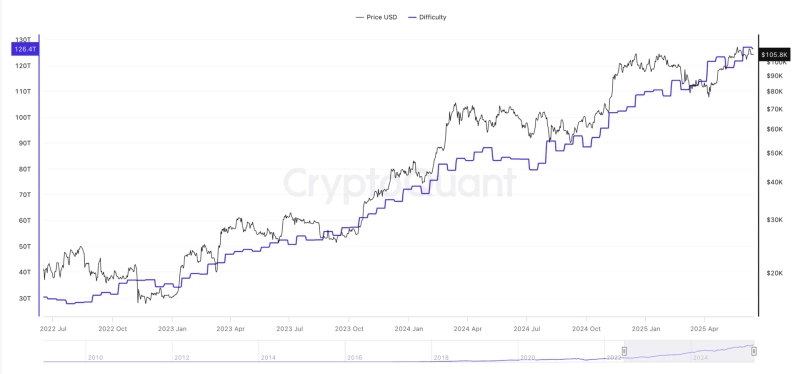
Bitcoin (BTC) mining difficulty decreased slightly after nearing an all-time high on May 31.
According to Cointelegraph on the 16th (local time), data from CryptoQuant shows that Bitcoin mining difficulty reached a record 126.9 trillion on May 31, and has since slightly adjusted to around 126.4 trillion recently.
Mining difficulty is an indicator of how complex the calculations are to create new blocks on the blockchain network. As difficulty increases, mining competition intensifies and production costs rise.
The outlet reported that mining companies are facing financial difficulties due to reduced block rewards post the April 2024 halving, rising operating costs, and higher mining difficulty. However, some listed mining firms are adopting a strategy of increasing production and holding mined Bitcoin without selling. This signals a shift from the traditional business strategy of mining companies, which has been to sell coins to cover operating expenses.
In fact, Marathon Digital Holdings (MARA) mined 950 Bitcoin in May, bringing its Bitcoin holdings up to 49,179 BTC. CleanSpark also mined 694 Bitcoin in May, recording a 9% increase from the previous month. Both companies are holding their mined Bitcoin as assets rather than selling.

Heecheol Yang
heecheol@bloomingbit.ioHello, I'm a reporter at bloomingbit