

"U.S. Leans Toward Striking Iranian Nuclear Facilities"...Pressure to Surrender Unconditionally
Summary
- The United States has indicated the possibility of striking Iran's nuclear facilities, raising military tensions in the Middle East.
- According to foreign media such as CNN, President Trump is weighing the option of deploying U.S. forces, and depending on the possibility of U.S. intervention, regional dynamics and market volatility in the Middle East may intensify.
- Uncertainties regarding Iran's nuclear development, opposition among U.S. supporters, and the potential for wider conflict are expected to be key variables for investors.
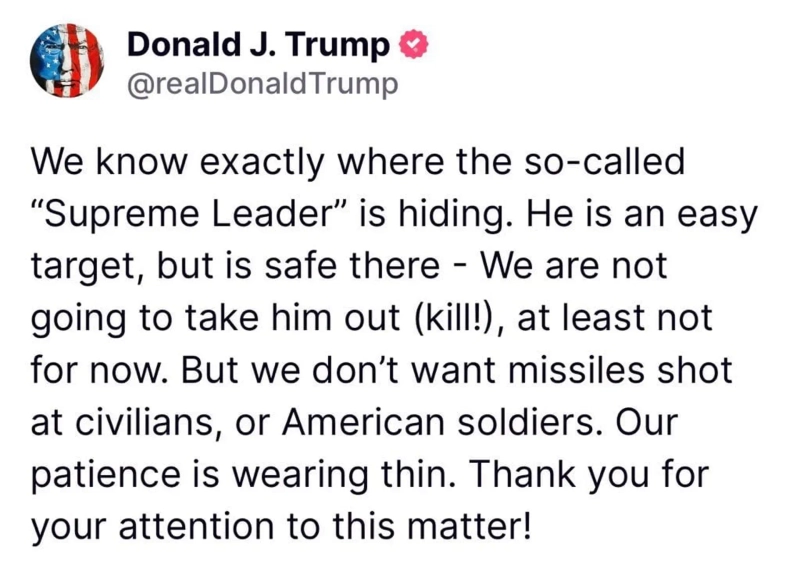
U.S. President Donald Trump pressured Iran on the 17th (local time), saying, "I know exactly where the Iranian Supreme Leader is hiding" and urging Iran to "surrender unconditionally."
President Trump, referring to the Iranian Supreme Leader on social media that day, stated, "He is an easy target." He added, "At least for now, we will not eliminate (kill) him." He also said, "We have achieved full and comprehensive control over Iran's airspace." The term 'we' is interpreted as referring to the United States and Israel.
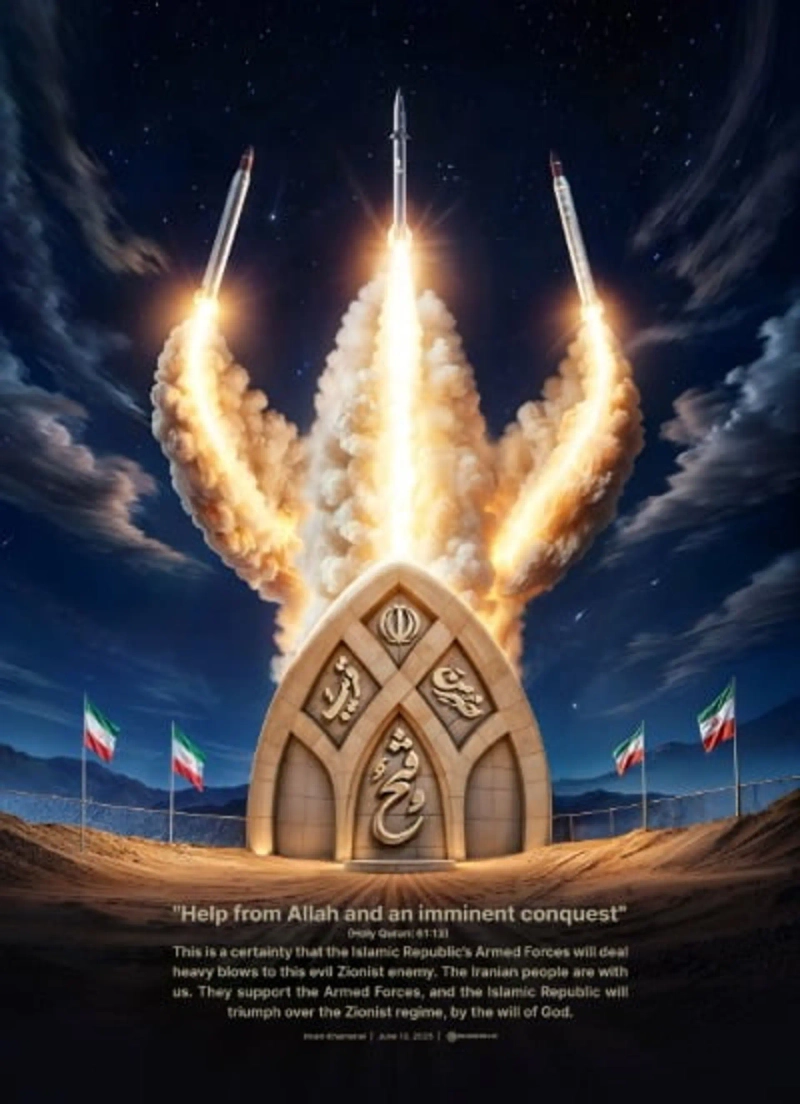
Iranian Supreme Leader Ayatollah Ali Khamenei posted on social media early that morning, "A strong response must be given to the terrorist Zionist (Israeli) regime. There will be no mercy." He also posted in Persian, "The battle has begun." Rather than surrendering, he chose to resist.
President Trump sent an ultimatum that day, saying, "My patience has run out. Surrender unconditionally." Returning earlier than scheduled from the G7 summit in Canada, he convened a National Security Council (NSC) meeting later that afternoon for a session lasting 1 hour and 20 minutes.
It is interpreted that they discussed whether the U.S. would intervene in the Iran-Israel conflict. The U.S. Department of State announced the closure of the Embassy in Israel until the 20th and urged its citizens not to travel to Iran, Israel, or Iraq.
○ Trump Reveals Willingness to Participate
CNN reported, citing sources, that after the NSC meeting, President Trump appeared to be leaning toward mobilizing the U.S. military to strike Iranian nuclear facilities. Previously, U.S. Vice President J.D. Vance also stated that President Trump "could take additional measures to end Iran’s uranium enrichment." Sources said that diplomatic resolution was possible if "Iran makes significant concessions," but CNN interpreted Trump’s new tougher stance as an indication that he favors military mobilization.
That afternoon, President Trump spoke by phone with Israeli Prime Minister Benjamin Netanyahu. While specific details were not disclosed, there is speculation that Netanyahu may have argued that Iran’s nuclear facilities should be completely destroyed.
○ U.S. Expands Force Deployment in the Middle East
Since last weekend, the U.S. has been increasing its military deployment in the Middle East. In addition to sending more F-35 fighter jets, it dispatched around 30 aerial refueling tankers to key European regions. The USS Nimitz, previously stationed in the South China Sea, is also headed for the Middle East. While it was initially expected to replace the USS Carl Vinson operating in the Middle East, both carriers are expected to remain in the region for now.
The key question is whether to support the use of bunker busters capable of striking underground Iranian nuclear facilities and the B-2 Spirit bombers able to deploy them. There may be nuclear facilities located even deeper than the explosive range of the bunker busters, but repeated strikes could have an impact.
Despite continuing missile counterattacks, Iran’s war capabilities are considered markedly inferior to Israel’s. CNN reported that Iran’s current arsenal is limited to Shahab-3 missiles and guided missiles, with many of its launchers having been destroyed. Israel, on the same day, deployed over 50 fighter jets to strike the Tehran area. If the U.S. intervenes, it will become even harder for Iran to overcome its disadvantages, and the possibility of regime change in Iran cannot be ruled out.
○ Divided Over Nuclear Development
The issue is whether the U.S. has justification to intervene in this war. In March, Tulsi Gabbard, Director of National Intelligence (ODNI), stated at a Senate Select Committee on Intelligence hearing, "We assess that Iran is not currently developing nuclear weapons." However, President Trump is currently considering intervention on the assumption that Iran is developing nuclear weapons. Regarding this issue, President Trump told reporters that day, "What she (Director Gabbard) said is irrelevant," adding, "I believe Iran will soon acquire nuclear weapons." According to The Wall Street Journal, the ODNI also determined that Israeli intelligence does not constitute definitive evidence of nuclear weapon production.
Director Gabbard later changed her stance, saying, "My opinion is the same as President Trump's." For Americans who remember the war in Iraq, which began in 2003 with claims about 'weapons of mass destruction' that were never found, whether the justification for this war is based on facts is a major concern. The Washington Post predicted that Iran could produce highly enriched uranium within a week, but it would take several months to a year to actually build a nuclear weapon.
○ MAGA Supporters Say "Not My War"
The 'Make America Great Again (MAGA)' base, President Trump’s core supporters, are generally opposed to intervention. Whereas they previously offered unconditional support and enthusiasm for Trump’s posts, they are now posting "Not my war" on Truth Social and X (formerly Twitter).
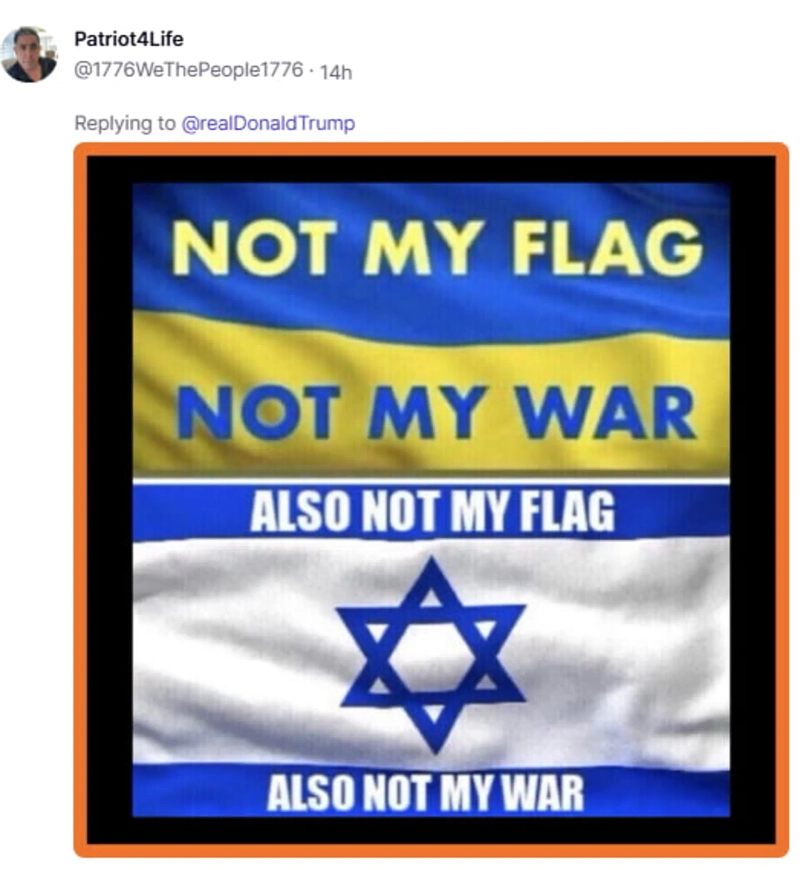
They cannot understand why President Trump, who had insisted that costly foreign intervention runs counter to America First, has suddenly reversed his position. In the U.S. House of Representatives, Congressmen Thomas Massie (Republican–Kentucky) and Ro Khanna (Democrat–California) jointly introduced a war powers resolution stating that the military should not intervene in conflicts without Congressional approval.
If the U.S. enters the conflict, it could spread throughout the Middle East. The New York Times and others analyzed that Houthi militias backed by Iran may resume attacking ships in the Red Sea and that U.S. bases in Iraq and Syria could come under attack. Rosemary Kelanic, head of Middle East Studies at Defense Priorities, told the NYT, "Once the U.S. is involved in the war, it’s really hard to step back," adding, "Everything will be at stake."
Washington correspondent: Lee Sang-eun selee@hankyung.com

Korea Economic Daily
hankyung@bloomingbit.ioThe Korea Economic Daily Global is a digital media where latest news on Korean companies, industries, and financial markets.