

Stablecoins Get a Boost… 'GENIUS Act' Passes in U.S. Senate
Korea Economic Daily
Summary
- With the passage of the GENIUS Act in the U.S. Senate, the issuance of stablecoins now comes with a 100% reserve requirement and mandatory audits.
- The new law establishes stablecoins as formal financial instruments, raising expectations for improved stability for investors.
- Growing demand for stablecoins backed by U.S. Treasury Bonds could further increase Treasury values and become a key market driver.
100% Reserve Requirement Mandated
Legal Framework Established... Enhanced Stability
Banks and General Companies Can Issue Coins
U.S. Treasury Value Rises As Demand Increases
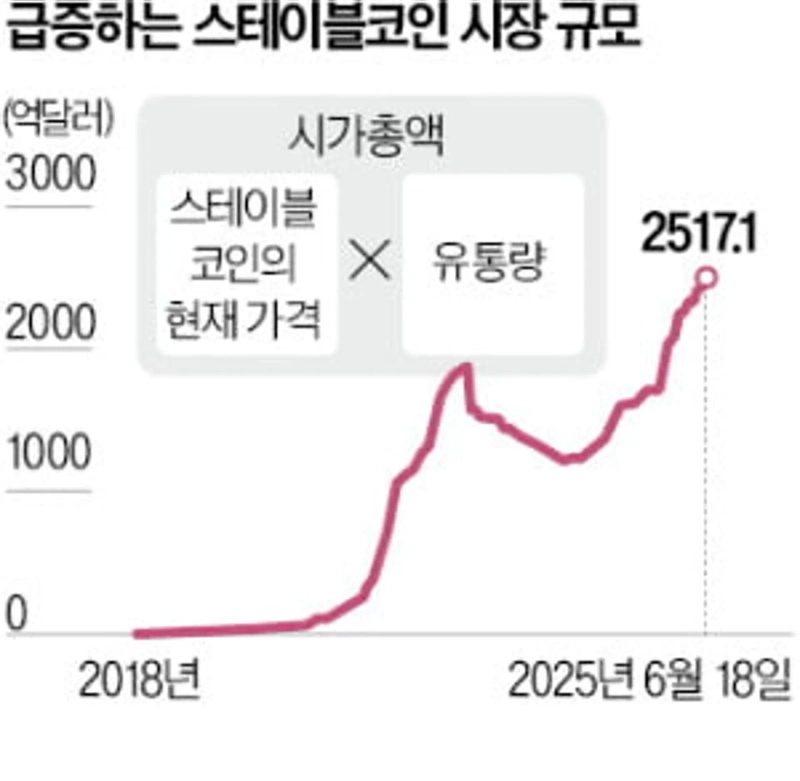
The so-called 'GENIUS' Act, which regulates stablecoins, passed the plenary session of the United States Senate on the 17th (local time). The act not only establishes an institutional framework for stablecoins but is also expected to be an opportunity to elevate the value of U.S. Treasury Bonds used as stablecoin collateral.
The GENIUS Act was proposed by Republican Senator Bill Hagerty, but several Democratic senators also participated as co-sponsors, making this a bipartisan bill. It passed the Senate plenary session with 68 votes in favor and 30 against and has now moved to the House of Representatives.
The GENIUS Act stands for 'Guiding and Establishing National Innovation for U.S. Stablecoins'. According to the bill, to issue a stablecoin, holding 100% reserve assets is mandatory, and issuers must undergo monthly financial audits. Additionally, anti-money laundering (AML) requirements must be observed.
This law serves as both a regulatory bill and formally recognizes stablecoins as legitimate financial instruments. It allows investors to invest in stablecoins with greater peace of mind.
The market is especially attentive to the potential of this bill to increase the value of U.S. Treasury Bonds. Stablecoins require collateral to preserve their value, and most use U.S. Treasury Bonds for this purpose. As demand for stablecoins grows, the scale of Treasury Bond purchases by issuers may also expand. Previously, the Donald Trump administration had openly stated its intention to inject liquidity into the market by lowering Treasury interest rates.
On the 11th, U.S. Treasury Secretary Scott Besant also told a Senate budget subcommittee, "Stablecoin legislation backed by U.S. Treasury Bonds will expand global use of the dollar through stablecoins," adding, "A $2 trillion market cap is a very reasonable projection for stablecoins, and could be greatly exceeded."
Although this bill bans legislators and their families from profiting from stablecoins, it does not impose such restrictions on the president and presidential family members. This could prove to be an obstacle when passing through the House. With the Trump family heavily invested in cryptocurrency, concerns about conflicts of interest are being raised. Last September, Donald Trump Jr. and Eric Trump, the president’s eldest and second sons, founded the virtual asset platform 'World Liberty Financial' (WLF) and issued a ‘Trump meme coin’. They also launched their own stablecoin, USD1. Democratic Senator Elizabeth Warren (Massachusetts) pointed out, "This bill creates a 'superhighway' for President Trump’s corruption."
There are also questions over whether regulatory authorities will be able to manage this system. Under the bill, banks that have federal deposit insurance as well as general companies can issue stablecoins. Firms with issuance amounts under $10 billion are subject to state regulation, while those above fall under federal authorities. Consequently, if stablecoin issuance balloons, there are concerns that regulatory agencies may be overwhelmed. The New York Times (NYT) criticized, "Regulators can’t even properly oversee deposit-insured banks like Silicon Valley Bank; what will happen if hundreds or thousands of stablecoins are issued?"
New York = Park Shin-young, Correspondent nyusos@hankyung.com

Korea Economic Daily
hankyung@bloomingbit.ioThe Korea Economic Daily Global is a digital media where latest news on Korean companies, industries, and financial markets.