

Iran's nuclear stronghold 'Fordow' lies 80 meters underground... Impossible to destroy without US bunker buster
Summary
- Iran's Fordow nuclear facility is located 80–90 meters underground, making it reportedly difficult to destroy with existing weapons.
- The facility is said to store large quantities of highly enriched uranium, raising concerns about nuclear weapon manufacturing risks.
- Analyses indicate that high-performance weapons such as the US bunker-buster GBU-57 are necessary to eliminate the Fordow facility.
US bunker buster, precision bombing with GPS
Can penetrate up to 60m underground
Simultaneous strikes can reach deeper
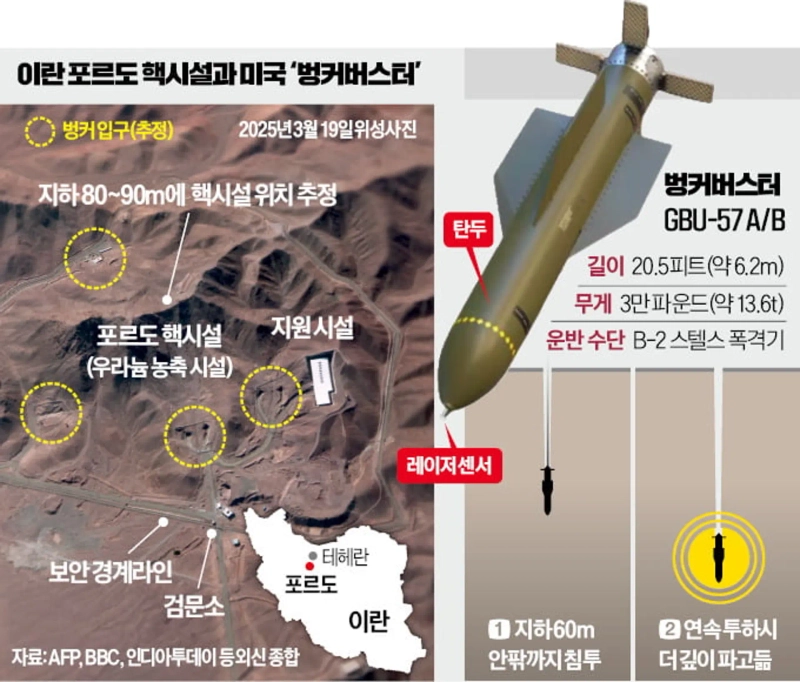
Iran's Fordow nuclear facility has been mentioned as a potential target for future Israeli attacks. As this facility is deeply buried underground, there is attention on whether the US bunker-buster bomb, specialized for bunker destruction, might be deployed.
According to Reuters and others on the 17th (local time), the Fordow nuclear facility is located 160 km from Iran's capital Tehran and 32 km from the Islamic holy city of Qom. Buried deep in rugged mountainous terrain, it's difficult to approach, and with Iran's elite Islamic Revolutionary Guard Corps and Russian surface-to-air missiles deployed, attacking it is not easy either.
Fordow is said to house high-performance centrifuges, essential for uranium enrichment to high purity. Unlike the Natanz nuclear facility—mainly used for storing low-enriched uranium—Fordow is believed to store large amounts of highly enriched uranium suitable for nuclear weapon development. The International Atomic Energy Agency (IAEA) reported in 2023 that uranium enriched to 83.7% purity was discovered here, a figure approaching the 90% enrichment needed for nuclear weapon production. Analysis also suggests that with the nuclear material here, up to nine nuclear warheads could be produced within three weeks. The reason Israel hasn't attacked Fordow since beginning airstrikes on Iran on the 13th is because it lacks weapons capable of striking the facility. Fordow is estimated to be located 80–90 meters underground—deeper than the Natanz facility, which is known to be about 8 meters below ground. Fordow is also situated in a rocky area composed of limestone and gneiss, making missile penetration harder than in soil areas.
Without the deployment of ground or special forces, the only conventional weapon capable of destroying the site via airstrike is the US bunker-buster. The US bunker-buster 'GBU-57' is 6.2 meters long and weighs 13.6 tons, with an explosive yield equivalent to 12,000 sticks of 200g dynamite. However, in underground bunkers, it can generate pressure waves comparable to small nuclear weapons. Using defense radars and GPS, it is also capable of highly precise strikes. Currently, only the US B-2 stealth bomber can deliver it. The GBU-57 reportedly can penetrate up to 60 meters underground. Some analysts suggest that to reliably destroy the Fordow facility, at least two GBU-57 bombs must be dropped at the same spot. The B-2 stealth bomber is designed to carry and deploy two bombs of the GBU-57's size and weight simultaneously.
By Juwan Kim kjwan@hankyung.com

Korea Economic Daily
hankyung@bloomingbit.ioThe Korea Economic Daily Global is a digital media where latest news on Korean companies, industries, and financial markets.