

"Uncertainty remains high"…Fed holds rates steady and maintains outlook for 'two rate cuts this year' [Fed Watch]
Summary
- The Fed announced it would keep the policy rate unchanged while maintaining its outlook for two rate cuts this year.
- The forecast for the United States’ economic growth rate has been revised downward, while the projection for inflation has been raised.
- Markets are describing the Fed’s latest decision as a "hawkish hold," with increasing concerns over stagflation.
Fed keeps rates unchanged amid tariff uncertainty
Meaning they will wait until the impact of tariffs is clear
U.S. economy remains solid, but stagflation fears linger
This year's growth forecast lowered, inflation estimate raised
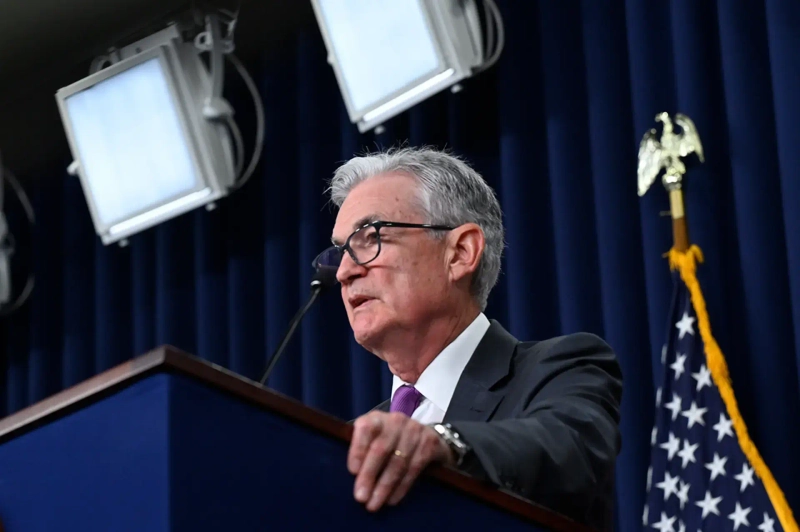
The U.S. central bank (Fed) held its target rate steady at 4.25~4.5% at the Federal Open Market Committee (FOMC) regular meeting on the 18th (local time).
The main reasons for this pause are uncertainty surrounding tariff policies and a still-solid economy. Jerome Powell, Chair of the Fed, stated at a press conference that “(Tariff-related) economic uncertainty remains high.” This signals an intent to proceed cautiously until there is more clarity on the direction of the economy.
The Fed also said in a statement, “Recent indicators suggest economic activity continues to expand at a solid pace.” This indicates the Fed does not believe the current situation warrants a rate cut yet. However, there are growing signs of concern about stagflation within the Fed itself.
On hold due to tariff uncertainty
Chair Powell cited tariffs as a reason for not cutting rates, despite a positive economic backdrop. He assessed, “Although uncertainty about the economic outlook from tariffs has diminished, it still remains elevated.”
He suggested the Fed would wait until the effect of tariffs on the economy becomes clearer. Powell added, “Prices of goods have risen slightly, and we expect the upward trend to expand further during the summer,” and projected, “Inflation will climb to a meaningful level in the coming months.” He explained that it takes time for the impact of tariffs to filter through distribution channels to final consumers.
Powell said, “I think more pronounced (tariff) effects will become evident over the next few months,” and noted, “We are already seeing price increases due to tariffs in items such as personal computers and audio equipment.”
Accordingly, the Fed’s Summary of Economic Projections (SEP) released the same day maintained the year-end 2025 median policy rate forecast at 3.9%, the same as in March. This assumes two rate cuts by the end of the year from the current rate level, signaling a cautious approach to monetary policy.
Rising stagflation concerns
While the Fed acknowledges considerable uncertainty from tariffs, it maintains that the U.S. economy is currently solid. The continued inflation rate above the Fed’s 2% target is also cited as a reason for holding rates steady.
Still, the Fed sees a considerable likelihood of a slowdown ahead. This is because the U.S. economic growth rate forecast has been lowered while inflation expectations have been raised.
In the SEP, the Fed revised down the U.S. GDP growth projection from 1.7% in March to 1.4%. Inflation is now expected to stay higher for longer than previously anticipated. This year’s personal consumption expenditures (PCE) inflation forecast was raised to 3.0%, while the core PCE (excluding food and energy) was forecast at 3.1%. Both are higher than March’s forecasts of 2.7% and 2.8%, respectively. The Fed apparently views inflation as converging toward the 2% target more slowly than previously hoped.
While the unemployment rate is forecast to rise slightly, the labor market is still considered solid overall. The 2025 unemployment forecast is 4.5%, 0.1 percentage point higher than March, and is expected to remain at similar levels in 2026.
"Hawkish hold"
Although the Fed held rates steady, Wall Street called this a “hawkish hold.” Bank of America noted, “The SEP indicates worries about stagflation—higher inflation projections and lower growth forecasts,” and analyzed, “Taking into account Powell’s muted comments about the weak labor market and his cautious tone on inflation, the Fed’s stance is somewhat hawkish.”
Deutsche Bank commented, “Powell had opportunities to mention labor market deterioration but instead described it as robust,” and also assessed his remarks as hawkish.
Meanwhile, the gap between South Korea's rate (2.50% per year) and the U.S. rate will remain at 2.00 percentage points at the upper bound as a result of the Fed’s decision. After the Fed held rates steady on the 7th of last month, the rate gap between Korea and the U.S. was 1.75 percentage points, but after the Bank of Korea lowered its policy rate from 2.75% to 2.50% on the 29th of that same month—a reduction of 0.25 percentage points—the gap widened further.
New York = Shin-Young Park, Correspondent nyusos@hankyung.com

Korea Economic Daily
hankyung@bloomingbit.ioThe Korea Economic Daily Global is a digital media where latest news on Korean companies, industries, and financial markets.