

New government allocates an additional ₩20.2 trillion... ‘Consumption coupons’ worth ₩150,000–₩500,000 per person
Summary
- The government announced that, through the second supplementary budget, it will provide ‘living recovery consumption coupons’ worth ₩150,000–₩500,000 per citizen.
- It will raise the local currency discount rate up to 15% and strengthen consumption-boosting policies such as a 10% rebate on high-efficiency home appliance purchases.
- ₩2.7 trillion will also be spent to revitalize the construction sector, including unsold home purchases and early starts on social infrastructure projects.
Up to ₩2.08 million for a 4-person household... Living expense consumption coupons to be distributed as early as July
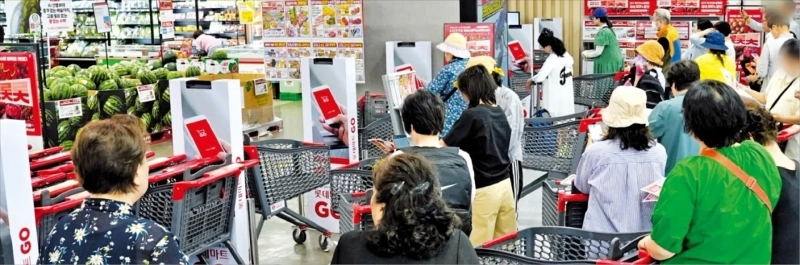
The government has announced that it will distribute living recovery consumption coupons to all citizens, with each person set to receive ₩150,000 (top 10% income bracket) to ₩500,000 (basic livelihood recipients). Residents in 84 demographic extinction areas will receive an additional ₩20,000 each. The earliest payout may be in the middle of next month. National funding support for local love gift certificates (local currency) will also be increased, raising the maximum discount rate from the previous 10% to 15%. In addition, 10% rebates will be offered for the purchase of high-efficiency home appliances, and discount coupons will be provided for lodging, movie tickets, sports facilities, and more. The government aims to stimulate the stagnant domestic demand by significantly expanding consumption-boosting measures through the second supplementary budget.
₩20,000 Extra for Residents in Population-Declining Regions
According to the Ministry of Economy and Finance on the 9th, the largest project within the second supplementary budget is the ₩10.3 trillion living recovery consumption coupon program. Adding in local government contributions, the total amounts to ₩13.2 trillion.
The subsidies will be distributed in two rounds. In the first installment, each person will receive a base payment of ₩150,000, those in the second-lowest income bracket will receive ₩300,000, and basic livelihood recipients will receive ₩400,000. Among the 4.11 million people living in 84 demographic extinction areas, each will get an additional ₩20,000. In the second round, an additional ₩100,000 will be paid only to the lower 90% income bracket based on health insurance contributions.
Ultimately, 5.12 million people in the top 10% will receive ₩150,000 each. The general public (42.96 million) will get ₩250,000, the second-lowest income group (380,000) will get ₩400,000, and basic livelihood recipients (2.71 million) will receive ₩500,000. For example, an average citizen living in Seoul will receive ₩250,000, while a basic livelihood recipient in a demographic extinction area will receive ₩520,000.
The top 10% income threshold will be calculated by the government based on household health insurance premiums, with inputs from the Ministry of the Interior and Safety and the Ministry of Health and Welfare. In the first round, payment will be made within two weeks after the supplemental budget passes the National Assembly in a plenary session. The government expects the bill to pass as early as July, so payments may begin as soon as mid-July. The second payout will be made as soon as the income screening process is completed.
The living recovery consumption coupons can be received in the form of local currency, prepaid cards, or credit/debit card points. No cash payments will be made. The period of use will be four months. The coupons cannot be used at entertainment bars, racetracks, or other entertainment/gambling industries. Han Sunki, Director General for Local Finance and Economy at the Ministry of the Interior and Safety, stated, "Relevant ministries will form a task force and announce detailed schedules and eligible places of use soon."
10% Rebate on High-Efficiency Home Appliance Purchases
The government has allocated ₩600 billion for supporting local currency discount schemes. This will increase the total issue volume of local currency from ₩21 trillion to ₩29 trillion. The discount rate for local currency will also be raised from the previous 7–10% to 7–15%. In the Seoul metropolitan area, the discount rate will be raised to 10% (from 7–10%), and in non-metropolitan areas, it will be raised to 13% (from 7–10%). For demographic decline areas, the rate goes up from 10% to 15%. For local governments not receiving local allocation tax, such as Seoul Metropolitan Government, Hwaseong City (Gyeonggi Province), and Seongnam City, the minimum discount rate will be changed from ‘discretionary’ to at least 7%.
₩326.1 billion has been allocated for the program that reimburses 10% of the purchase cost of high-efficiency home appliances. Eligible products include 11 first-grade energy efficiency appliances (refrigerators, air conditioners, washing machines, electric rice cookers, TVs, etc.). Consumers who purchase these products will receive a rebate of up to ₩300,000 per person. The government estimates around 2.4 million people will benefit.
For the five major sectors of boosting consumption—lodging, moviegoing, sports facilities, art exhibitions, and performing arts—₩77.8 billion will be allocated to provide 7.8 million discount coupons. Through ‘Yanolja’ and other online accommodation booking sites, coupons worth ₩20,000–₩30,000 will be available. Each movie ticket will be discounted by ₩6,000.
To revitalize the construction sector, ₩2.7 trillion will be provided. ₩300 billion will be allocated for buyback purchases of 10,000 unsold housing units under repurchase agreements. ₩1.4 trillion will support early starts and completions of major social infrastructure projects such as the Pyeongtaek-Osong Second Double-Tracking Project and the Honam High-Speed Railway. ₩460.7 billion will be set aside for small-scale public works such as the renovation of national universities and military facilities.
Lim Ki-geun, Second Vice Minister of Ministry of Economy and Finance, stated, “Timely and bold fiscal spending is essential to get the economy on an upward path,” adding, “We hope the second supplementary budget will be the catalyst to revive the sluggish economy.”
Kim Ik-hwan/Nam Jeong-min Reporters lovepen@hankyung.com

Korea Economic Daily
hankyung@bloomingbit.ioThe Korea Economic Daily Global is a digital media where latest news on Korean companies, industries, and financial markets.