

Concerns of '0% Growth' Despite 44 Trillion Won Spent This Year
Summary
- The government announced that the total 44 trillion won supplementary budget is expected to boost this year’s economic growth rate by 0.2% points.
- Global investment banks forecast this year’s economic growth rate at 0.3~0.6%, but also noted that worsening external economic conditions could push estimates even lower.
- Economists warn that while a large-scale supplementary budget might stimulate domestic demand this year, the base effect could drag down growth next year.
0.2%P Growth Rate Increase Effect from Extra Budget
Impact of Trump Tariffs·Worsening Situation in the Middle East
The government expects that injecting a total of 44 trillion won through two rounds of supplementary budgets this year will be able to raise Korea’s economic growth rate by 0.2% points this year. Both inside and outside the government, there are concerns that persistent uncertainty surrounding 'Trump tariffs' and worsening conditions in the Middle East will make it difficult to escape '0% range growth' this year.
Geun Lim, the 2nd Vice Minister of the Ministry of Economy and Finance, remarked at a briefing on the 19th, "We estimate that the second supplementary budget, totaling 30.5 trillion won (including 10.3 trillion won in tax revenue adjustment), will generate a 0.2% point growth effect for the year," adding, "However, since the execution period for the second supplementary budget is limited to the second half of the year, the actual effect will be raising the growth rate by just half that, or 0.1% point."
When announcing the initial 13.8 trillion won supplementary budget, which passed the National Assembly last month, the government analyzed that it would raise the economic growth rate by 0.1% point. Combining the effects of the 1st and 2nd supplementary budgets, the calculation is that this year’s economic growth rate will increase by a total of 0.2% point.
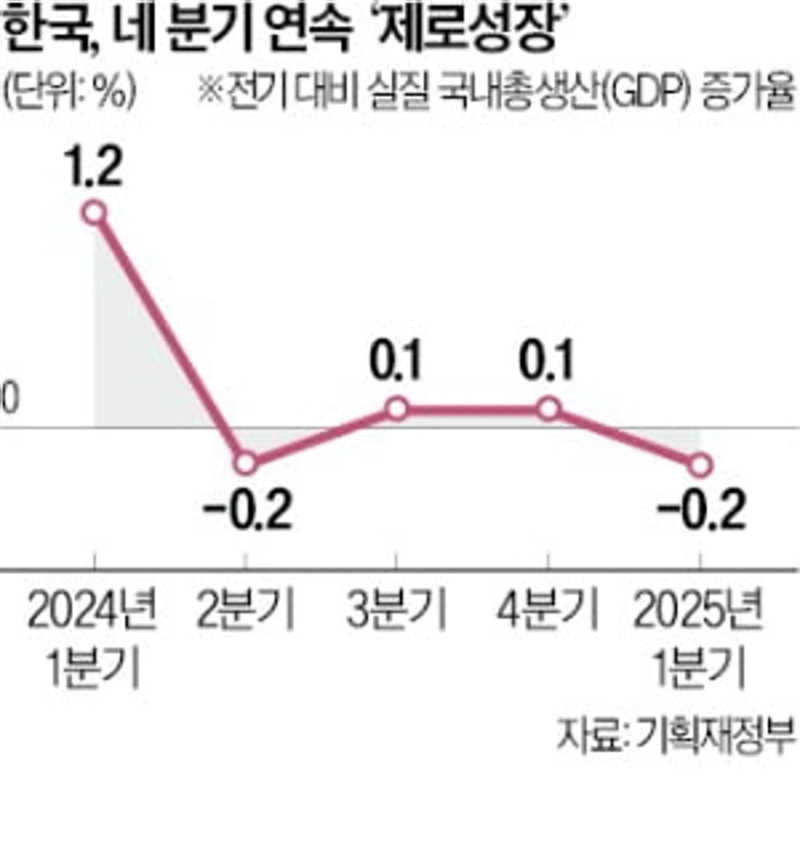
Previously, Bank of Korea and the Korea Development Institute (KDI), a national research institute, suggested a growth outlook of 0.8% for this year. By simple calculation, if both supplementary budgets are implemented, the growth rate could reach 1% for the year. However, an official from the Ministry of Economy and Finance explained, "The growth rate forecasts from the Bank of Korea and KDI already reflect the effect of the first supplementary budget (a 0.1% point increase)," and added, "With U.S. tariff measures and the Israel·Iran war worsening external economic conditions, even the 0.8% figure itself could decline."
There are also criticisms that the Bank of Korea and KDI outlook is optimistic. Global investment banks such as J.P. Morgan and Citigroup put this year’s growth at 0.5~0.6%, and Société Générale at 0.3%. Vice Minister Lim commented, "If indirect effects such as improvements in public economic sentiment from the new government’s policies are realized, further growth in the rate might be possible." However, economists warn that a large-scale supplementary budget boost to domestic demand this year could result in a base effect that slows next year’s growth.
By Younghyo Jung hugh@hankyung.com

Korea Economic Daily
hankyung@bloomingbit.ioThe Korea Economic Daily Global is a digital media where latest news on Korean companies, industries, and financial markets.