

PiCK
New York Stock Market Mixed Amid Iran Uncertainty... Semiconductor Stocks Weak [New York Stock Market Briefing]
Summary
- It was reported that uncertainty regarding the U.S. military response to Iran and weakness in semiconductor stocks weighed on the overall mood of the New York stock market.
- The U.S. government notified major semiconductor firms, including Samsung Electronics and SK Hynix, of its intention to restrict the supply of equipment to China factories, resulting in related stocks weakening.
- Despite statements about rate cuts from FOMC members, the market reflected a high probability of a rate hold in July and increased volatility.
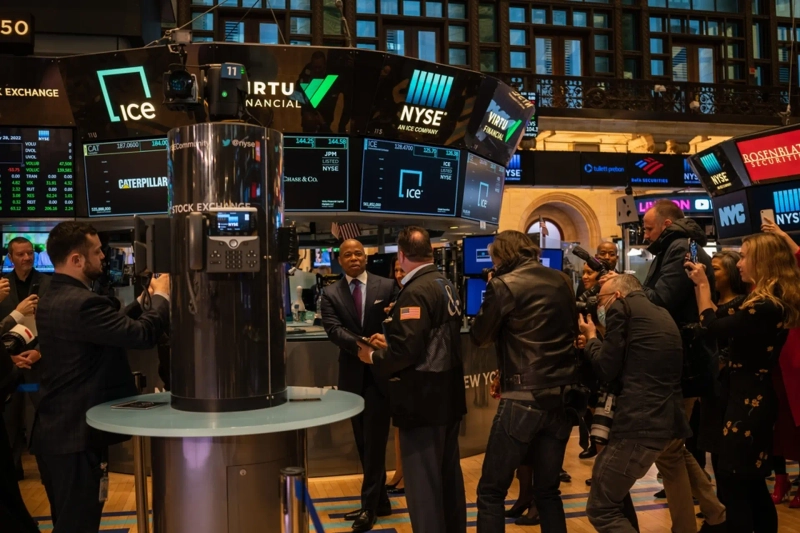
The three major New York stock indexes showed mixed movements. The Dow rose for the first time in three sessions, while the S&P 500 Index fell for the third consecutive day. Amid ongoing uncertainty over the U.S. military response to Iran, semiconductor stocks were weak, creating a generally heavy mood.
On the 20th (U.S. Eastern Time) at the New York Stock Exchange (NYSE), the Dow Jones Industrial Average closed at 42,206.82, up 35.16 points (0.08%) from the previous session. The S&P 500 Index closed at 5,967.84, down 13.03 points (0.22%), while the NASDAQ Composite Index closed at 19,447.41, down 98.86 points (0.51%). The previous day, the New York stock market was closed in observance of Juneteenth.
Ahead of the market open, in an interview with CNBC, Director Waller expressed about rate cuts, "We are in a position where we could do this as early as July," adding, "Whether or not the Committee agrees, this is my view." Just after the end of the 'blackout period' during which FOMC participants refrain from monetary policy comments, he aggressively advocated for rate cuts.
This stands in contrast to Chair Jerome Powell not letting his guard down about tariff impacts during the FOMC press conference.
Following Waller's remarks, all three indexes opened higher. The NASDAQ rose nearly 0.8% right after the open. However, this simultaneous rally did not even last an hour. With the weakness of the semiconductor sector, the NASDAQ turned downward first, followed by the S&P 500. The Dow, after repeated reversals, managed to climb at the end of trading.
That day, The Wall Street Journal (WSJ) reported that the Trump administration had notified Samsung Electronics and SK Hynix, among other Korean semiconductor companies, of its plan to restrict the supply of U.S.-made equipment to their China plants. According to WSJ, Jeffrey Kessler, Assistant Secretary for Industry and Security in the U.S. Department of Commerce's export control division, informed Samsung Electronics, SK Hynix, and Taiwan's TSMC of this policy. Kessler was also reported to have conveyed the desire to revoke the policy that allowed these companies to supply U.S. semiconductor manufacturing equipment to their China plants without requiring case-by-case approval.
Following this report, major semiconductor companies all saw their stocks weaken. NVIDIA, a leader in the AI theme, fell 1.12%, while Broadcom dropped 0.27%. TSMC American Depositary Receipt (ADR), listed on the New York Stock Exchange, plunged 1.87%. The Philadelphia Semiconductor Index dropped 0.75%.
With President Donald Trump stating that a decision on a military strike against Iran would be made within the next two weeks, there was a cautious mood to wait and see developments in the Middle East. There were also explanations that volatility increased due to the so-called 'Triple Witching Day,' when single stock options, stock index futures, and options all simultaneously expire.
Sam Stovall, Chief Investment Strategist at CFRA Research, said, "Who would want to take on a long position going into the weekend in such uncertain times?" adding, "A calming in geopolitical activity could help." He noted that the S&P 500 is trading about 3% below its recent 52-week high, and referred to the previous high as being "like a rusty door, requiring multiple attempts before it finally opens."
President Trump met with reporters in Washington, D.C., before heading to the State of New Jersey late in the session, noting that the two-week deadline he had set the day before for deciding whether the U.S. would join Israel's attack on Iran was a "maximum" length and urged Iran to make a decision to give up nuclear development. He also stated that the U.S. has been in dialogue with Iran, and, as Iran does not want dialogue with Europe, dismissed the effectiveness of the talks held that day in Geneva between European countries and Iran.
By sector, Communication Services plunged 1.83% to perform the worst, followed by Materials (-0.66%). Energy (+1.05%) was the only one to rise more than 1%.
Manufacturing conditions in the jurisdiction of the Federal Reserve Bank of Philadelphia remained in contraction for the third straight month. According to the Philadelphia Fed, the region's Manufacturing Activity Index for June came in at -4.0, unchanged from the previous month. This was worse than the market's expectation for a rise to -1.0. The index has stayed below the "zero" (0) line, which separates expansion and contraction, since April.
According to the Chicago Mercantile Exchange (CME) FedWatch Tool, the federal funds rate futures market reflected a total rate cut of about 51bp (1bp=0.01% point) by the end of this year, about 3bp higher than the previous day. Waller's remarks are believed to have had an impact. However, the probability of a rate hold in July remained high, in the mid-80% range. The Chicago Board Options Exchange (CBOE) Volatility Index (VIX) fell 1.55 points (6.99%) to 20.62.
HyeWon An, Hankyung.com Journalist anhw@hankyung.com

Korea Economic Daily
hankyung@bloomingbit.ioThe Korea Economic Daily Global is a digital media where latest news on Korean companies, industries, and financial markets.