

Cornered Iran Plays 'Hormuz Blockade' Card… US: 'Act of Self-Destruction'
Summary
- Iran resolved to blockade the Strait of Hormuz, but this is not the final decision.
- The Strait of Hormuz is a critical bottleneck through which 20% of the world’s oil supply passes. If blocked, it is expected to severely impact global energy supplies.
- Analysts say blockading the Strait could significantly harm Iran’s own economy, so the effects may be limited.
Iran's 'brinkmanship'… Global economy on high alert
20 million barrels of crude oil exported daily to Asia, including South Korea, Japan, and China, pass through
The only route connecting the Persian Gulf with the open ocean
Oil exports make up 20~30% of Iran's GDP
Blockade would trigger economic shock and diplomatic isolation
Iran has hesitated to take real action for decades
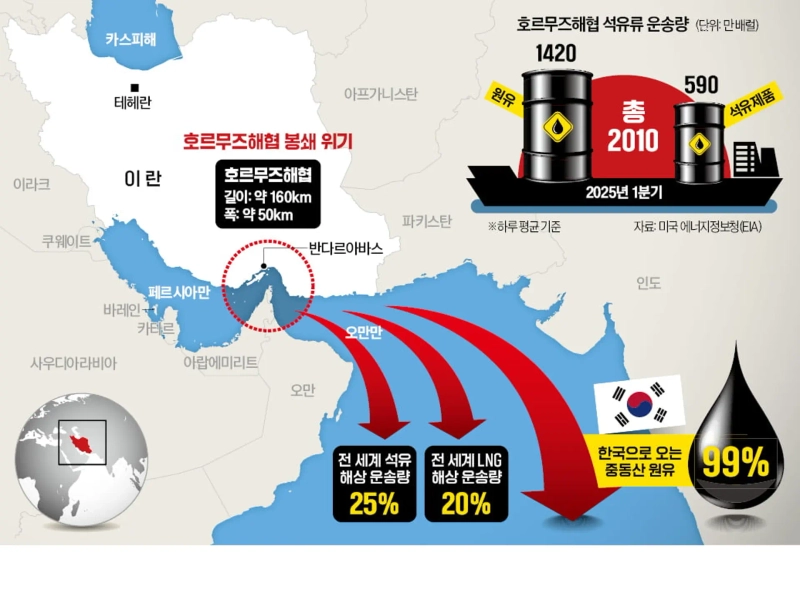
Iran’s plan to blockade the Strait of Hormuz is widely regarded as ‘brinkmanship.’ This is because it could turn into a self-destructive measure, cutting off the nation’s own economic lifeline. In the past, Iran has mentioned the possibility of blockading the Strait of Hormuz, but has never actually enforced it.
◇ Iran Raises 'Hormuz Blockade'
On the 22nd (local time), Iran’s parliament (Majlis) passed a resolution to blockade the Strait of Hormuz immediately after the US struck Iran’s nuclear facilities. However, this is not a final decision. The authority for the final blockade decision lies with Iran’s Supreme National Security Council (SNSC), the nation’s top strategic body responsible for all foreign, security, defense, and intelligence policy decisions. Iranian President Masoud Pezeshkian chairs the SNSC. Ayatollah Ali Khamenei’s closest aide serves as secretary general, and the body is composed of about 12 members, including the defense and foreign ministers, the intelligence chief, the commander of the Islamic Revolutionary Guard Corps, top military officials, and other experts appointed by the Supreme Leader.
Most decisions on Iran’s various disputes and matters of security or diplomacy are made through this council. Decisions from the meeting must receive the Supreme Leader’s approval. Ultimately, whether the Strait of Hormuz is blocked is in Khamenei’s hands.
The Strait of Hormuz is one of the world’s key oil transportation routes and a ‘bottleneck.’ It is about 160 km long and only about 50 km wide at its narrowest. It is the only maritime passage from the Persian Gulf to the open ocean. According to a recent report by the US Energy Information Administration (EIA), as of 2024, an average of 20 million barrels of crude oil per day are transported through this strait—around 20% of global oil consumption. This level of traffic reportedly remained consistent even during the first quarter of this year.
◇ 20% of World’s Oil Consumption Passes Through
Most of the oil passing through the Strait of Hormuz is bound for Asian markets, including China, Japan, India, and South Korea. KOTRA recently analyzed in a report that 99% of Middle Eastern oil heading to South Korea passes through this strait. The Strait’s geopolitical importance is why its blockade is considered Iran’s trump card in retaliating against the US and Israel.
However, blockading the Strait of Hormuz would also have a direct impact on Iran itself. US sanctions already constrain Iran’s oil exports, but the country still exports hundreds of thousands of barrels of crude oil daily to China and others via the Strait. According to the Korea Institute for International Economic Policy, oil exports account for over 80% of Iran’s total exports and 20~30% of its gross domestic product (GDP).
US Vice President J.D. Vance warned, "Iran’s blockade of the Strait would be an act of suicide," adding, "As Iran’s economy depends on exports through the strait, it would be cutting off its own lifeline." Michael Rubin, a senior fellow at the American Enterprise Institute (AEI), also pointed out, "If Iran blocks the Strait of Hormuz, its own economy would be paralyzed before its enemies felt the impact," and added, "Iran’s military and economic capabilities would be exhausted, ultimately threatening the regime’s survival."
This could also lead to diplomatic isolation. A blockade of the Strait of Hormuz might be seen as an attack on global energy security and could alienate even countries that are friendly to Iran, such as China. Reuters reported that China is absorbing nearly 90% of Iran’s oil exports.
◇ Blockade Effect Limited?
For these reasons, Iran has so far hesitated to block the Strait of Hormuz. During incidents like the ‘Tanker War’ in 1984, the ‘Iran Nuclear Crisis’ in 2011, and ‘Tensions between the US and Iran’ in 2018, Iran carried out attacks on oil tankers and launched missiles, but never fully closed the strait.
Some experts believe the effectiveness of a blockade would be limited. For decades, Iran has boasted of training for a blockade. The Islamic Revolutionary Guard Corps (IRGC) Navy possesses hundreds of fast attack craft, drones, anti-ship missiles, and the capability to lay naval mines. However, analysis suggests the US Navy and others could easily restore shipping lanes through mine countermeasures and escort fleets. The US maintains major air and naval forces at its base in Bahrain (home of the Fifth Fleet) and in Qatar and the United Arab Emirates (UAE). Immediately following the Iranian parliament’s resolution, the US State Department stated, "If Iran closes the strait, the situation will escalate rapidly."
Reporter: Juwan Kim kjwan@hankyung.com

Korea Economic Daily
hankyung@bloomingbit.ioThe Korea Economic Daily Global is a digital media where latest news on Korean companies, industries, and financial markets.