

PiCK
[Blooming Lunch] John Park: "The Next 2 Years, Korea's Golden Time for Digital Assets"
Summary
- John Park, Head of Korea at the Arbitrum Foundation, stated that Korea will enter a 'golden time' in the digital asset sector over the next two years.
- He expressed firm belief in the sustainability and growth potential of the decentralized ecosystem and DAOs.
- He also emphasized that if the Korean-won stablecoin is integrated with the nation’s infrastructure, it could secure competitiveness in the digital currency market.
John Park, Head of Korea at the Arbitrum Foundation
Career Includes SK, Memebox, SparkLabs, and More
Entered the Crypto Scene Through Decentralization Research
Fascinated by the DAO’s ‘New Collaboration’
Korea Will Have Its Golden Time in the Next 2 Years

'Meeting good people and having great conversations.' This encapsulates the core purpose of Blooming Lunch. We meet outstanding people in the Crypto Scene (blockchain and digital asset ecosystem) and share their work and lives with our readers.
John Park, Head of Korea at the Arbitrum (Arbitrum, ARB) Foundation, spent his adolescence in India. His family immigrated to India when he was 13 years old.
Park attended a boarding school in South India on his own. “There were about 90 students per grade, with over 40 different nationalities,” he recalled, adding, “Growing up in India greatly increased my openness to new cultures.”
We met John Park, who has been leading the Arbitrum Foundation's Korea business since 2023, at Garam Guksu in Gangnam-gu, Seoul. Garam Guksu, a Korean restaurant near Hakdong Station on Line 7, opened in 2002. Its signature dishes are kalguksu (hand-cut noodles) and pancake. Blue Ribbon described it as “a restaurant specializing in clean Gyeongsang-do style noodles,” and noted that “anchovy noodles and kongguksu are also popular.”
Arriving early, Park was making work calls while waiting for a table. After nodding to him and waiting about five minutes, a table became available. We ordered two bowls of kongguksu, the summer menu item, and hobakjeon (zucchini pancake).
Shortly after ordering, the kongguksu arrived first, and Park finished his phone call. He apologized, saying, “Sorry, my call took longer than expected.” The broth of the kongguksu was savory and thick. Even without adding extra seasoning, it was rich and could be enjoyed without salt. Park smiled and said, “It’s a place I come to often since it’s near my house. I also just really like noodles.”

Fascinated by the ‘Potential’ of Decentralization
After several bites of kongguksu, I asked Park how he ended up working in the crypto scene. “While working at SparkLabs, I thought deeply about how decentralized systems could reshape capital markets,” he began. SparkLabs is one of Korea’s leading startup accelerators.
He continued, “The key turning point was realizing that ‘cryptographic trust’ could replace existing institutional trust. I saw that this fundamental shift (decentralization) could redistribute economic influence in ways that traditional finance (TradFi) never could.”
His entry into the startup industry was also driven by ‘potential.’ After graduating from college in the US, he started his career in the strategic planning division at SK, then moved to global tobacco firm British American Tobacco (BAT), and later worked as Business Development Lead at K-beauty startup Memebox.
“Startups are like a ‘high-speed laboratory’ where small teams can generate big profits and impacts,” Park said, “My connection with SparkLabs formed during my Memebox days, and SparkLabs was actually Memebox’s first investor.”
While chatting, the ordered hobakjeon came out—zucchini julienned and pan-fried to chewy and slightly sweet perfection. The bite-sized pieces were also impressive, and the combination with the nutty kongguksu was quite good.
“DAO, an Unprecedented Way of Working”
The conversation continued over hobakjeon. Park said, “Working at the Arbitrum Foundation, my confidence in the sustainability of the decentralized ecosystem has grown even stronger.” He explained, “Most (crypto) foundations are established with the aim of making the world better through technology. Both foundations and decentralized autonomous organizations (DAOs) are far broader concepts than typical companies.”
He emphasized, “The appeal of DAOs is especially significant.” DAOs serve as core governance bodies running the crypto ecosystem, where token holders participate as members, voting on proposals that determine how the ecosystem is operated. Proposals and voting are not limited by time or place.
“In a DAO, countless anonymous individuals who don’t know each other’s names or faces come together to make decisions toward a single goal. This is an entirely new form of human collaboration that simply did not exist before,” he said.
He continued, “Since DAOs lack a physical form or structure, they can spread rapidly and be maintained over the long term. While there’s an overarching direction in crypto ecosystems like Arbitrum, technology and business are always evolving.”
“But of course, as much as the decentralized ecosystem centered around foundations and DAOs is an ideal structure, there are still many problems to solve. Yet, the attempt to build such an ecosystem itself is beautiful enough in my view,” he added.
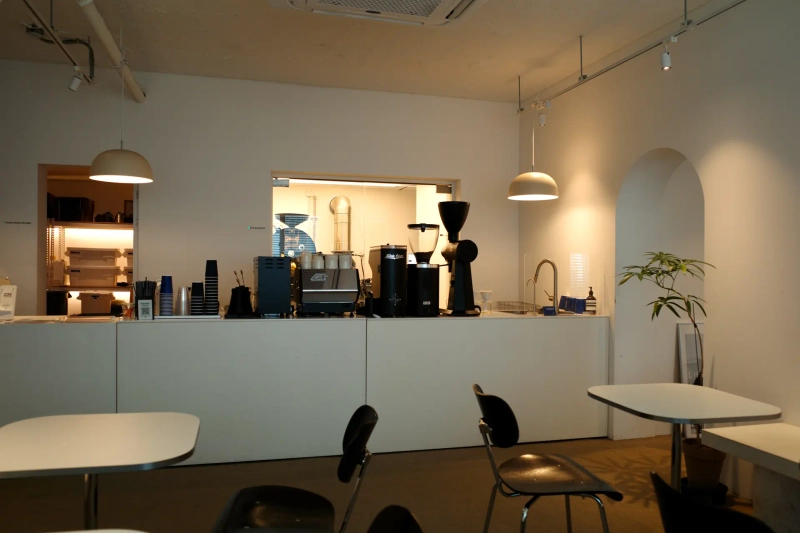
After the meal, we headed to Objective Coffee Roasters, a specialty café located about a 10-minute walk from Garam Guksu. On the way, Park remarked, “Basically, I believe decentralization will accelerate across a range of fields. Even financial infrastructure will inevitably have to adopt decentralized systems in the end.”
We settled on the café’s second floor and ordered two filter coffees: ‘Ethiopia Banko Gotiti’ and ‘Ethiopia Chelbesa Decaf.’ Park chose the decaf. The business card–sized card served with the coffee described the Banko Gotiti’s notes as grapefruit, lavender, raspberry, and red grape.
“The Next 2 Years are the ‘Golden Time’”
Over coffee, we discussed Korea’s crypto industry. Expectations are rising as the newly inaugurated Lee Jae-myung administration is making industry development a key agenda.
Park predicted, “Korea is one of the few countries where culture, capital, and technology converge, putting it in a unique position to design the next-generation digital infrastructure. If Korea accelerates institutionalization now, it has every chance of becoming Asia’s crypto hub.”
However, he stressed that the next 2 years will be the real ‘golden time.’ “If Korea fails to establish itself as Asia’s crypto hub within 2 years, it could fall at least 10 years behind competitors like Hong Kong. It’s true the industry nurturing policy started a bit late, but I don’t think it’s too late yet,” he said.

Park also gave a positive assessment of the new government’s plans for a Korean-won stablecoin. “The goal of a won-based stablecoin is not to compete with dollar stablecoins,” he explained, “Its competitiveness lies in its ability to integrate with Korea’s existing infrastructure in fields like gaming and fintech.”
He added, “Major countries are moving aggressively to dominate the digital currency market, but few have as strong an environment as Korea. If the won stablecoin’s positioning is done right, the won could rank next to the dollar in the digital currency space.”
When asked about his hobbies, Park replied, “I enjoy walking and hiking.” He added, “Last year, I stayed in the UAE for about 9 months for work. Since there were no mountains there, I mostly walked in the desert or along the beaches.” He also said, “I usually go to bed at 10 p.m. and wake up around 4–5 a.m.—having a relaxed morning boosts my work efficiency.”
After the interview, we said goodbye in front of the café. Park said his office isn’t far from the café. By then, it was well past 2 p.m., and he walked briskly toward the main road.
This interview was not sponsored or financially supported by any specific restaurant or brand, and was conducted with no commercial intention. The ‘Blooming Lunch’ series aims to capture candid interviews in the favorite neighborhood eateries of our interviewees.

JOON HYOUNG LEE
gilson@bloomingbit.ioCrypto Journalist based in Seoul