

KR·US Negotiations May Cause Exchange Rate to Fluctuate Between ₩1,350 and ₩1,390
Summary
- This week, the KRW-USD exchange rate is likely to fluctuate within the range of ₩1,350 to ₩1,390 due to variables such as KR-US negotiations and U.S. tariff policies.
- It was reported that treasury bond yields rose across the board due to concerns over increased supply of government bonds from the expanded second supplementary budget.
- The Bank of Korea is expected to unanimously hold the base rate this month, and the possibility of a rate cut occurring in the third quarter is considered high.
Weekly Exchange Rate and Bond Outlook
If Directly Hit Like Japan
Exchange Rate Volatility Increases
Supplementary Budget Raised to ₩31.8 Trillion
Treasury Bond Yields Rise
Last week, the KRW-USD exchange rate briefly fell below ₩1,350 due to dollar selling by exporters at the end of the half-year, but rose to the ₩1,360 level later in the week. As U.S. employment indicators came out better than expected, the probability of the Federal Reserve lowering the base rate this month decreased, strengthening the dollar.
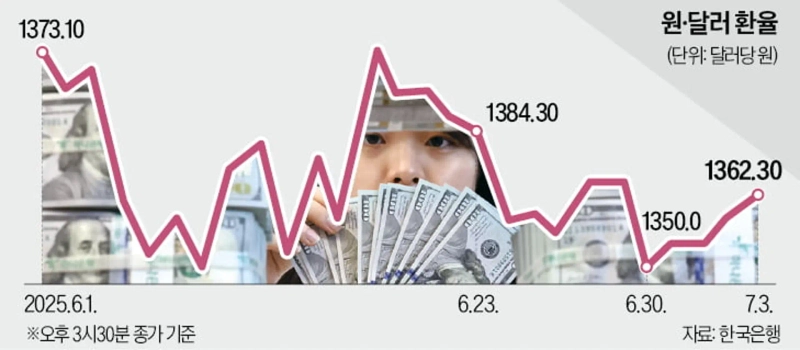
This week, major issues that will impact the foreign exchange market are scheduled, including U.S. tariff negotiations and the Bank of Korea's rate decision. Many expect that the KRW-USD exchange rate may fluctuate between ₩1,350 and ₩1,390. Lee Min-hyuk, an economist at KB Kookmin Bank, said, "The biggest variable will be the U.S. announcement regarding the end of the tariff exemption on the 8th," adding, "Depending on news of KR-US negotiations around this time, the exchange rate could rise or fall significantly." Seo Jung-hoon, a research fellow at Hana Bank, noted, "If, like Japan, we are hit harder by tariffs than expected, the exchange rate's volatility will increase."
Baek Seok-hyun, an economist at Shinhan Bank's S&T Center, stated, "The market may stabilize and the exchange rate could decline again around the 9th. However, there is also the possibility of a sudden announcement or policy change by Trump, so there may be a period of wide exchange rate swings for a while."
There is also attention on domestic investors moving into the U.S. stock market. Min Kyung-won, an economist at Woori Bank, noted, "Domestic investors are again looking to invest in U.S. stocks, increasing demand for dollars," and predicted, "This week, the exchange rate is likely to rise gradually."
Last week, treasury bond yields rose across the board due to concerns over increased government bond supply from the expanded second supplementary budget. On the Seoul bond market, the yield on the 3-year treasury bond closed at 2.446% per annum on the 4th, up 0.018% points from the previous trading day. The 10-year yield rose 0.014% points to 2.828% per annum. The 5-year and 2-year yields climbed by 0.025% points and 0.02% points, respectively, ending at 2.620% and 2.446% per annum.
This week, the bond market is expected to be influenced by the National Assembly Special Committee on Budget and Accounts' discussion of the second supplementary budget and remarks by President Lee Jae-myung at press conferences. The committee held a subcommittee meeting for budget adjustment, and the supplementary budget was increased during the review process. The government's supplementary budget plan was ₩30.5 trillion, but was increased by ₩1.3 trillion during the preliminary review, resulting in a decision to set it at around ₩31.8 trillion. The ruling party adjusted the proportion of consumption coupon distribution and decided to additionally grant ₩30,000 and ₩20,000 to non-metropolitan areas and depopulated regions, respectively. As the supplementary budget was expanded, concerns about increased government bond issuance caused treasury bond yields to rise across the board.
The consensus in the bond market is that the Bank of Korea's Monetary Policy Board will unanimously freeze the base rate at 2.50% per annum this month. Ahn Ye-ha, a researcher at Kiwoom Securities, remarked, "Considering the recent rise in real estate prices centered in the Seoul metropolitan area and the increase in household loans, the central bank is likely to focus on financial stability factors and hold the rate steady this month. As for the policy effect of boosting the economy, the chance of a rate cut is expected to be high in the third quarter."
Reporters: Jo Mi-hyun/Bae Jeong-cheol mwise@hankyung.com

Korea Economic Daily
hankyung@bloomingbit.ioThe Korea Economic Daily Global is a digital media where latest news on Korean companies, industries, and financial markets.