

Korea’s Potential Growth Rate Falls Again
Summary
- The OECD announced it has revised down Korea’s projected potential growth rate for next year from 1.98% to 1.88%.
- It analyzed that the delay in structural reforms in key areas such as labor and education, as well as low birth rates and an aging population, are factors behind the decline.
- Among countries with a GDP of over $1.5 trillion, Korea has experienced the biggest drop in potential growth rate.
OECD Lowers Next Year’s Forecast from 1.98% to 1.88%
Delays in Structural Reforms in Labor, Education, etc.
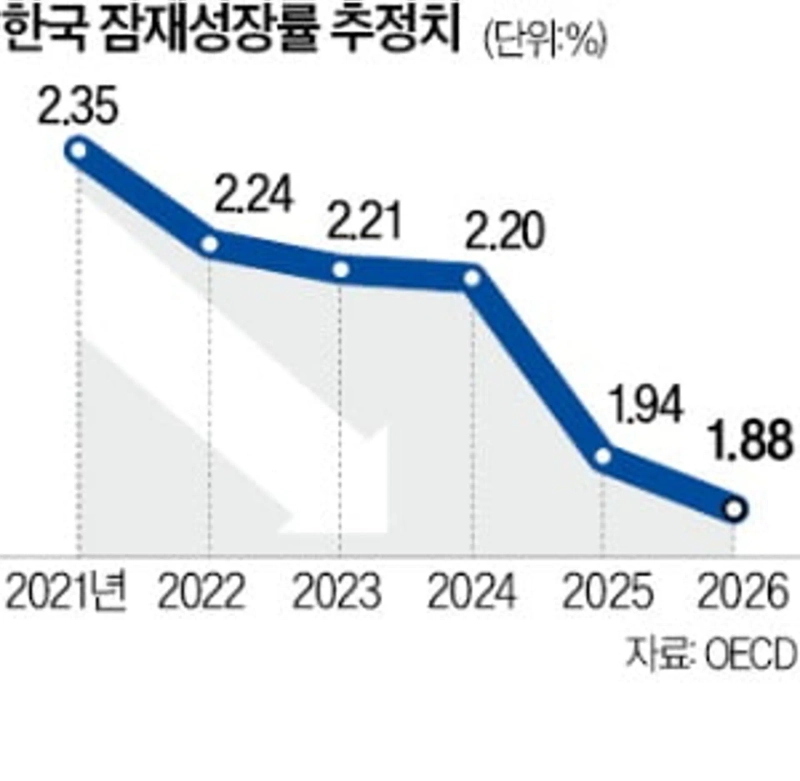
According to an analysis by The Korea Economic Daily on the 7th of the economic outlook report released last month by the OECD, this trend has emerged. The potential growth rate refers to the maximum rate at which a country can grow by fully employing all productive resources—labor, capital, and materials—without causing inflationary pressure. Analysts say this reflects delayed structural reforms in key sectors such as labor and education, amid a sharp decline in the working-age population due to low birth rates and aging demographics.
Typically, an expanding economy experiences a decrease in potential growth rate, but Korea’s decline is unusually rapid. It dropped by 1.19 percentage points over the past decade, from 3.13% in 2015 to 1.94% this year. Among countries with a GDP of over $1.5 trillion, Korea has seen the largest drop.
By Jin-Gyu Kang josep@hankyung.com

Korea Economic Daily
hankyung@bloomingbit.ioThe Korea Economic Daily Global is a digital media where latest news on Korean companies, industries, and financial markets.