

Targeting allies first: Trump's strategy behind singling out South Korea and Japan as the 'first hitters' for tariff letters [Washington Now by Lee Sang-eun]
Summary
- President Trump notified that starting August 1, all South Korean products will be subject to a 25% tariff.
- This measure is described as the U.S. leveraging high tariffs on major allies as a negotiation tool, aiming at reducing the trade deficit and restoring manufacturing jobs.
- While the Korean government plans to monitor domestic industrial impact and enter negotiations, it is expected that arriving at a deal satisfying the U.S. in the short term will be challenging.
25% tariff notification for both South Korea and Japan
25% also for Malaysia and Kazakhstan
40% notified for Laos and Myanmar

White House Press Secretary Caroline Leavitt holds up President Trump's letter notifying tariffs on South Korea and Japan during a press briefing on the 7th (local time). /Reuters Yonhap
On the 7th (local time), U.S. President Donald Trump sent letters to South Korean President Lee Jae-myung and Japanese Prime Minister Shigeru Ishiba specifying a 25% reciprocal tariff rate for each. This will take effect starting August 1. The newly inaugurated South Korean government has now been included as the first target in Trump's country-specific tariff war.
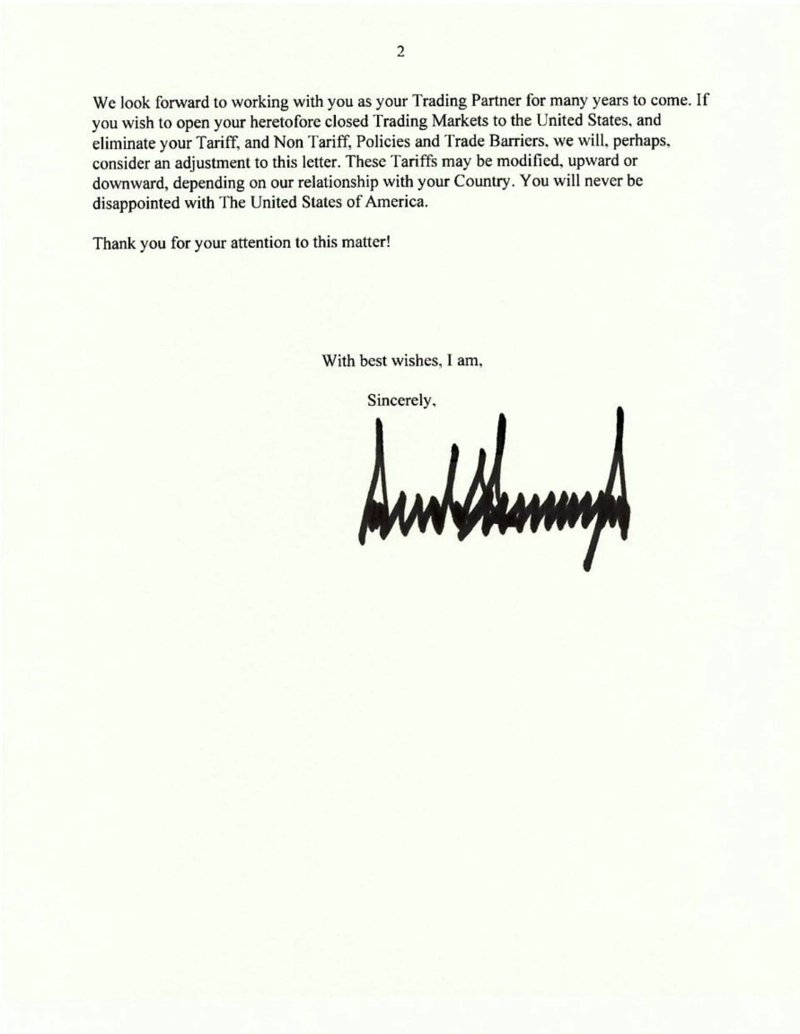
The documents President Trump sent to South Korea and Japan differ only in the recipient; all other content is identical, essentially created by copying and pasting. In his letter to South Korea, President Trump wrote, "Unfortunately, our trade relationship has long deviated from reciprocity," and, "Because of Korea's tariffs, non-tariff measures, policies, and trade barriers, I have concluded that the time has come to change course to resolve our long-standing trade deficit."
He continued, "From August 1, all Korean products imported to the U.S. will be subject to a 25% tariff on top of any sector-specific tariffs. For transshipped goods aiming to evade higher tariffs, an even higher tariff will be applied." He also added, "Please understand that the figure 25% is still significantly short of the level needed to close our trade deficit with your country." The letter contained a veiled threat: "If for any reason you decide to raise South Korea's tariffs against the U.S., whatever increase you choose will be added to our 25% on Korea." According to Press Secretary Leavitt, President Trump is expected to sign an executive order postponing the reciprocal tariff grace period from July 9 to August 1.
The Ministry of Trade, Industry and Energy explained, "With this letter, we now see the reciprocal tariff imposition grace period effectively extended until August 1, and we will accelerate negotiations to swiftly resolve uncertainties caused by tariffs and achieve mutually beneficial results in the remaining time."
On the same day, President Trump also officially notified five countries—Malaysia, Kazakhstan, Laos, Myanmar, and South Africa—of the new tariff rates, applying 25% each to Malaysia and Kazakhstan, and 40% each to Laos and Myanmar.
◆ The U.S. sees South Korea and Japan as a 'bundle'
It is symbolic that South Korea and Japan, both strong manufacturing nations and U.S. security allies, were the first 'tariff notification' targets for President Trump. Ian Bremmer, President of Eurasia Group, recently commented in an interview with the Ministry of Trade, Industry and Energy that President Trump "views South Korea and Japan almost identically from a geopolitical perspective."
From a trade standpoint, the U.S. likely perceives more similarities than differences between South Korea and Japan. Both countries hold a trade surplus with the U.S. through exports like automobiles and other manufactured goods, and they have significant investments in the U.S. While both exports and FDI contribute positively to the U.S., the Trump administration has not meaningfully recognized this. This is a similarity as well.
Negotiations have been held much more extensively with Japan, which has completed seven rounds. South Korea has had three rounds in total, and the new government had its first round at the end of June. Currently, National Security Advisor Wi Sung-lac and Trade Minister Yeo Han-koo are in Washington, D.C. for high-level talks.
Neither country has made significant progress. President Trump, Secretary of the Treasury Scott Besant, and other White House aides have repeatedly mentioned Japan or alluded to it, labeling it as "stubborn." President Trump has refused to concede on Japan's demand for car tariff reductions, and the demands for rice market access and U.S. car purchases have been difficult for Japan to accept. Japan faces an upper house election on the 20th and cannot make specific commitments regarding the rice market before then. U.S. cars are also hampered by Japan's road and parking space conditions, making them less marketable.
Due to the recent government transition, South Korea was not in a position to engage in substantial negotiations, and there are still no cabinet-level appointments. The Ministry explained, "Since the launch of the new government, we have negotiated fiercely with the national interest principle in mind, but it is true that time was lacking to reach an agreement on all issues."
The reasons for stalled negotiations are different, but South Korea's demands are largely similar to Japan's. In addition to reciprocal tariffs, the exemption of itemized tariffs is a major point. Both countries also emphasize potential U.S. investments and cooperation. From the U.S. side, even if Korea hasn't appeared as 'stubborn' as Japan, it may still be lumped together and treated similarly in internal discussions. This order of Trump's tariff notifications likely reflects an internal atmosphere in which South Korea and Japan are seen as a bundle.
◆ A power play—with room for adjustment
During her press briefing, Press Secretary Leavitt emphasized, "President Trump is designing customized trade plans for every country on this planet." Leavitt claimed, "The President is literally looking at maps and reviewing all countries on this planet, identifying nations deceiving the American people, weakening our industrial base, and those whose tariff policies have driven our jobs overseas." Asked about specifically targeting South Korea and Japan, she replied, "That is the President's prerogative."
It is paradoxical that South Korea and Japan are the first targets. The outcome reflects President Trump's longstanding view that allies have "taken advantage of" the U.S. In other words, this is a bill to pay for being an ally. The risks of President Trump's negotiating tactics being thwarted by surprise moves, as with China, are lower. There is also the intention of setting an example for other countries—a sort of power play.
Unlike with Japan, where there have at least been several rounds of talks, it is difficult to say that South Korea has had a chance to fully exchange expectations with the U.S. In this context, the 25% tariff rate offered by the U.S. is as arbitrary as the figure announced earlier on April 2, 'Liberation Day.'
Previously, Secretary of the Treasury Scott Besant announced the application of a 10% tariff rate to over 100 countries. This suggests the U.S. lacks the capacity to negotiate individually with non-major trade partners and that the 10% base tariff is the absolute lower limit. It also hints that countries negotiating with the U.S. should expect tariffs higher than 10%.
It is not equitable for negotiating countries to face higher tariff rates than non-negotiators. The Trump administration had previously stated it would notify tariffs as high as 70%. In this case, the additionally imposed tariffs on China under Trump’s second term (30% under temporary suspension, or nearly 50% including previous rates) would be lower.
To grasp these dynamics, it is important to realize that the Trump administration is not trying to maintain the current situation permanently, but rather using tariffs as leverage to gain an advantage in negotiations. When the Trump administration insists on high tariffs for key trade partners, it routinely uses this as a negotiation tactic. The logic is that tariffs go up in order to go down eventually. In other words, for countries offering "no room for reduction (no benefits to gain from negotiation)," a 10% rate suffices—this was implicitly stated by Secretary Besant.
◆ 'Winning' for the American people is key
Most important for the Trump administration is showing the American public a 'win.' The reason President Trump repeatedly highlights straightforward issues like rice and autos in negotiations with Japan, despite many other topics, is not necessarily because of their economic value, but because such topics can be easily presented as victories to the public. Even if the arguments are somewhat illogical, an aggressive, one-sided posture signals strength and psychologically intimidates the counterpart—this is fundamental to President Trump’s approach.
Products like autos and electronics, which are mainstays of Korean industry and easily understood, are likelier to become Trump’s targets. In contrast, complex issues like digital companies paying network fees in Korea are more difficult to explain to the American public, and thus, any U.S. gains there may not be readily appreciated.
Although the administration’s explicit aims are reducing the trade deficit and restoring manufacturing jobs, its negotiation methods and objectives keep changing. Even the August 1 grace period is not a fixed deadline. President Trump’s basic position is that the U.S. need not and should not consider the levels of pushback that its demands might trigger domestically in partner countries. Such fine points aimed at economic revitalization through 'manufacturing partnership' may be meaningful at the working level but may not suit President Trump’s salesmanship approach.
The U.S. demand for a 25% tariff is not final and could be reduced. The Ministry announced plans for an emergency meeting chaired by the First Vice Minister to assess the impact of tariffs on individual domestic industries. However, it is considered unlikely that South Korea will be able to present a proposal that fully satisfies President Trump in the short term.
Washington = Lee Sang-eun, Correspondent selee@hankyung.com

Korea Economic Daily
hankyung@bloomingbit.ioThe Korea Economic Daily Global is a digital media where latest news on Korean companies, industries, and financial markets.