

Tariff and Non-Tariff Barriers at a Standstill…No Visible Exit in Korea-U.S. Tariff Negotiations
Summary
- President Trump announced that a 25% tariff will be imposed on Korean imports starting August 1.
- While the U.S. is demanding the elimination of non-tariff barriers, the Korean government emphasized a national interest-first and cautious negotiation approach.
- As leverage such as manufacturing cooperation is not being readily accepted by the U.S., the outcome of negotiations in the remaining three weeks is expected to critically affect the investment climate.
"For U.S. tariffs, upholding national interests is more important than rushed talks"
Presidential office holds emergency meeting after Donald Trump announces 'August 1 tariffs'
U.S. demands removal of tariff and non-tariff barriers—pressures allies like South Korea and Japan
Effectively grants a three-week grace period for tariff imposition…Government maintains a cautious negotiation stance
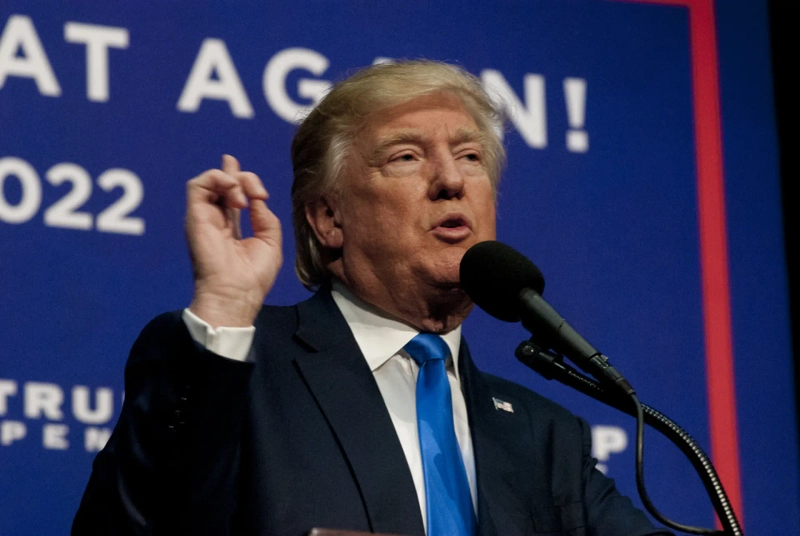
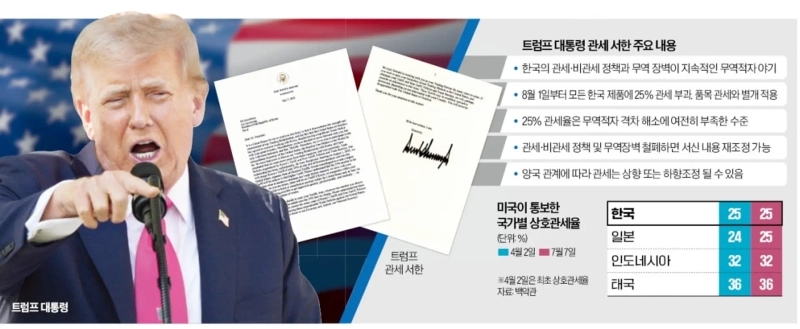
Donald Trump, President of the United States, sent a 'tariff letter' to President Lee Jae-myung on the 7th (local time), stating that the U.S. will impose a 25% tariff on all imported Korean products starting August 1. President Trump sent this tariff letter not only to South Korea but also to a total of 14 countries, including Japan. The presidential office convened an inter-ministerial meeting chaired by Chief Policy Secretary Kim Yong-beom and decided to prioritize 'serving national interests' until August 1, placing this as the utmost priority in the negotiations.
On this day, President Trump posted the entire text of the tariff letter sent to countries like South Korea on his social media platform Truth Social. In the letter, President Trump stated, "Regrettably, our trade relationship has been far from reciprocal," adding, "Because of Korea's tariff and non-tariff policies and trade barriers, we've concluded we need to change course to address the long-standing trade deficit."
The 25% tariff rate proposed to Korea by President Trump is the same percentage he announced would be imposed through an executive order on April 2. For Japan, which he previously called "badly behaved," the tariff was increased by 1 percentage point to 25% compared to before. The letters sent to President Lee and Japanese Prime Minister Ishiba Shigeru were identical in content. Choosing two manufacturing powerhouses and American security allies—South Korea and Japan—as the first recipients of the tariff notification is seen as highly symbolic. Analysts note, "The Trump administration is grouping South Korea and Japan together when it comes to trade negotiations."
Although President Trump insisted on the 25% tariff rate, he fixed the effective date at August 1. The Korean government stated, "With this letter, the mutual tariff imposition grace period is effectively extended." The previous grace period was originally set to expire the day after the letter was sent, on the 8th. During his visit to the U.S., South Korea's National Security Advisor Wi Sung-rak met with U.S. Secretary of State Marco Rubio, who said, "Since there is time until the actual tariff imposition date of August 1, we hope the two countries will communicate closely to reach an agreement before then."
As a Korea-U.S. summit is being pursued, the government, having essentially gained an additional three weeks for negotiations, stated it will respond with all-out effort but maintain its prudent negotiation approach. In the meeting, Chief Secretary Kim emphasized, "Timely consultations are important, but upholding national interests is of greater value," urging attendees to make every effort to prioritize national interests during negotiations. The meeting was attended by Yoon Chang-ryeol, Chief of the Office for Government Policy Coordination, Ha Joon-kyung, Chief Secretary for Economic Growth, Oh Hyun-joo, Third Deputy Director of the National Security Office, and related vice ministers.
U.S. bill starts with pressuring allies, "25% mutual tariffs from August 1"
Lee administration faces a three-week trial…The real issue is non-tariff barriers
Upon receiving the letter from Donald Trump on the 8th, stating that '25% mutual tariffs will be imposed on Korean products starting August 1,' Korea's trade authorities commented, "In effect, the mutual tariff grace period has been extended by three weeks," adding, "We will accelerate negotiations in the remaining period to achieve mutually beneficial results." However, both inside and outside government, expectations are that the coming three weeks of talks will be difficult. The Trump negotiation team is prioritizing 'America First' over 'mutually beneficial deals.' The Korean government is also placing more emphasis on 'serving national interests' than on a rushed deal.
◇ The real U.S. interest: non-tariff barriers
President Trump originally intended to impose mutual tariffs from July 9. With the latest letter, he is pressuring trading partners like Korea again but postponing the negotiation deadline to August 1. This move highlights that significant differences between the two sides remain and talks are still deadlocked.
The U.S. is demanding the removal of Korea's non-tariff barriers. President Trump wrote in his letter that "the U.S. trade deficit was caused by Korea's tariff and non-tariff policies and trade barriers." However, analysts point out that with the Korea-U.S. Free Trade Agreement (FTA) the effective tariffs between the two nations are already at 0%, so Washington's main concern is actually the non-tariff barriers. Major issues include lifting the ban on beef imports over 30 months old and further opening up the rice market. Simplifying quarantine procedures for fruit imports such as blueberries and shortening approval processes for genetically modified organisms (LMOs) are also known to be on the list of U.S. demands.
The problem is that it is difficult for the Korean government to fully accept American demands, as strong opposition from farmers is expected. Farmers' groups argue that further opening of the rice and beef markets would destroy Korean agriculture. Kim Tae-hwang, Professor of International Trade at Myongji University, said, "If Korea is to lower non-tariff barriers as the U.S. demands, it must first gather public opinion and develop a comprehensive response, but I'm not sure Korea is prepared to do that."
Non-tariff barriers in the digital sector are another area where Washington seeks changes—such as approval to export Google Maps high-precision mapping data. In Google's case, the National Geographic Information Institute will decide next month. The U.S. remains suspicious about the online platform law, which the Korean government and ruling party tried to promote but halted. On July 1, 43 Republican members of the U.S. House of Representatives issued a statement, saying, "The law was proposed by Korea's Fair Trade Commission and accepted by the Lee administration," and pressed that "digital trade issues disadvantageous to American companies must be addressed in Korea-U.S. talks."
◇ Manufacturing cooperation card not working
The Korean government is utilizing 'Korea-U.S. manufacturing cooperation' as leverage in negotiations. In exchange for strengthened cooperation in industries like shipbuilding and defense, Korea has requested the U.S. to ease or remove tariffs on products such as automobiles and steel. During his visit to the U.S. on the 7th (local time), Deputy Minister for Trade Yeo Han-gu met with U.S. Secretary of Commerce Howard Lutnick to once again emphasize the Korean government's commitment to manufacturing cooperation and request favorable treatment on tariffs.
However, there are predictions that Washington will not easily approve tariff exemptions or "tariff-free quotas." President Trump stated in his letter that "the 25% tariff (Korean mutual tariff) and sectoral tariffs (tariff by item) are separate issues." The U.S., during its first Trump administration, gave tariff-free quotas to Korea on steel, only to face similar demands from Japan, the European Union (EU), etc. A Korean government official noted, "It's unclear to what extent Korea's investment in the U.S. and manufacturing cooperation will be reflected in tariff rates."
Experts now say it's time for the negotiation team to make concrete new proposals to Washington. Director Jang advised, "The negotiation team should highlight joint investment and technology cooperation in advanced industries and consider shifting the tariff talks toward economic security alliances."
Washington correspondent Lee Sang-eun/Han Jae-young/Kim Dae-hoon/Kim Ri-an selee@hankyung.com

Korea Economic Daily
hankyung@bloomingbit.ioThe Korea Economic Daily Global is a digital media where latest news on Korean companies, industries, and financial markets.