

PiCK
Korean and Japanese Stock Markets Rise Despite Trump’s Tariff Letter Pressure
Summary
- Despite President Trump sending a new tariff rate letter to major trading partners like South Korea and Japan, the Asian stock markets reportedly continued to rise.
- Investors perceived this tariff action as a strategy to accelerate negotiations, so market reactions were limited.
- The possibility of extended trade negotiations was already reflected in market prices, and volatility remained low.
US stock index futures show mixed trend
"Possibility of extended negotiations already reflected in the market"
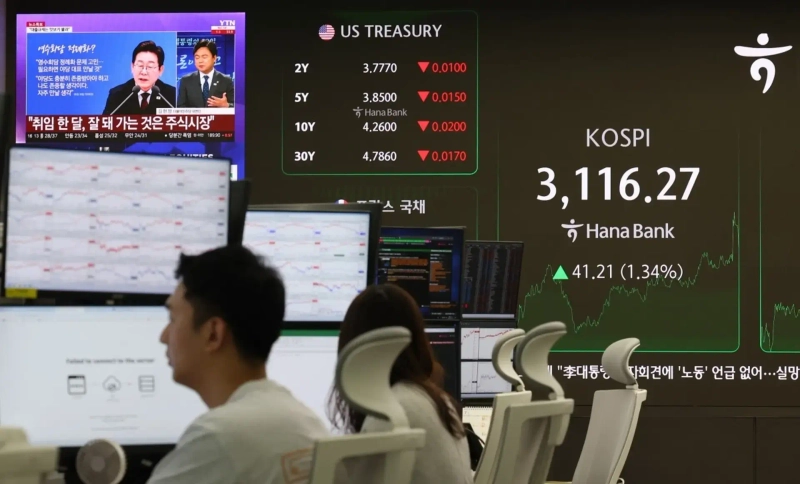
President Donald Trump sent a new tariff notification letter to South Korea, Japan, and other countries, strengthening pressure on trade negotiations while also leaving room for further talks. Despite this, Asian stocks including South Korea and Japan rose. US stock markets, which declined the previous day, rebounded slightly.
On the 8th (local time), despite Trump’s tariff letter pressure, the KOSPI surged by 1.8%, and the Japanese stock market climbed by 0.2%. The Hong Kong Hang Seng Index increased by 1.09%, and the Shanghai CSI300 by 0.7%. Major Asian indices rose marginally by 0.3%. The Korean won strengthened, while the US dollar fell 0.2%. The Japanese yen traded at a similar level to the previous day, while Japan’s 30-year government bond yield continued to rise.
At around 5AM US Eastern Standard Time, S&P 500 futures rose 0.08% and Nasdaq 100 futures gained 0.21%.
On this day, the euro rose 0.3%, supported by reports that the US proposed negotiations to apply a 10% tariff rate on the European Union (EU). The STOXX 600 index, covering a broad array of European companies, fluctuated. Politico reported that the US had proposed to the EU to maintain a 10% base tariff rate with exemptions for sensitive sectors.
President Trump sent letters stating he would impose a 25% tariff on Japan and South Korea each from August 1. For South Korea, the rate matches the reciprocal tariff announced on April 2. For Japan, it increased from 24% to 25%, rising by 1% point. Other countries receiving Trump’s tariff letter included Bangladesh, Bosnia and Herzegovina, Cambodia, Indonesia, Laos, Malaysia, Myanmar, Serbia, South Africa, Thailand, and Tunisia — fourteen countries in total.
Foreign media analyzed that the main targets of this tariff letter are Japan, the US’s 5th largest trading partner, and South Korea, the 7th largest. Both countries have already suffered significant damage through item-specific tariffs of 25% on autos, and 50% on steel and aluminum, their major exports to the US.
President Trump signed an executive order extending the reciprocal tariff deadline from July 9 to August 1, stating, "This is based on additional information and recommendations from several senior officials." He also added, "If there is a good proposal, the implementation date of August 1 can be postponed, indicating negotiations are still open."
Frederic Neumann, Chief Asia Economist at HSBC, pointed out, "Investors see Trump’s recent tariff announcement simply as a negotiation acceleration strategy and not a final decision." Accordingly, "the extension of the trade negotiation deadline did not trigger a significant reaction in the financial markets."
Fabiana Fedeli, CIO of Multi-Asset and Sustainability at M&G Investments, said in an interview with Bloomberg, "The market has become fatigued by this level of crisis, and as a result, investors are simply continuing to invest."
Andrew Heisinger, founder of New York Quant Data, commented, "The market has already priced in the possibility of extended trade negotiations and, since implied volatility was extremely low, there seems to be little concern."
Jung-A Kim, guest reporter kja@hankyung.com

Korea Economic Daily
hankyung@bloomingbit.ioThe Korea Economic Daily Global is a digital media where latest news on Korean companies, industries, and financial markets.