

Wi Sung-rak: "Proposed Trade, Investment, and Security Package Deal to the US…Rubio Agreed"
Summary
- Wi Sung-rak, National Security Advisor at the Presidential Office, proposed advancing negotiations with the US through a 'package deal' covering trade, investment, and security, and stated that Secretary Rubio, the US Secretary of State and National Security Advisor, agreed.
- The package deal includes South Korean investment in the US, expansion of US energy imports, and strengthened cooperation in shipbuilding and defense/security sectors.
- Through these negotiations, the tariff, investment, and summit agendas between South Korea and the US have been made more specific, and both sides are communicating closely to achieve mutually beneficial agreements.
Returned from US after 'Tariff and Security Negotiations'
"Communicating to reach an agreement by the 1st of next month"
Trump demands South Korea pay 10 times more for defense
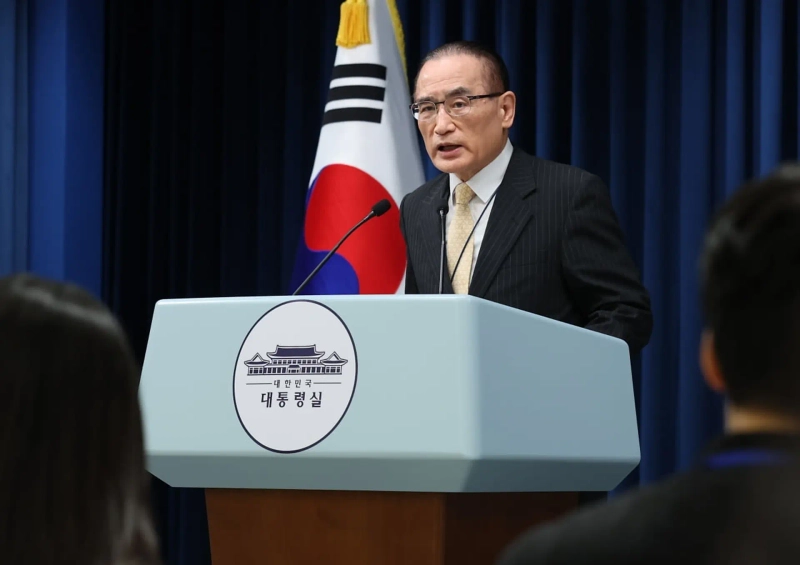
Wi Sung-rak, National Security Advisor at the Presidential Office, returned on the 9th after visiting the US for tariff and security negotiations and stated, "I suggested to the US side to move negotiations forward as a ‘package deal’ encompassing trade, investment, procurement, and overall security," adding, "Marco Rubio, the US Secretary of State and National Security Advisor, also agreed to this."
On the 7th, Wi met with Secretary Rubio, Allison Hooker (U.S. Under Secretary of State for Political Affairs), and the working-level staff in Washington, D.C., to discuss pending trade and security issues between South Korea and the US. Wi said, "Since there is an opportunity to consult until the 1st of next month, Secretary Rubio suggested close communication to reach an agreement." Regarding the Korea-US summit, he explained, "While we are narrowing down to a ‘certain timing’ in the process, it is variable and cannot be publicly disclosed."
President Donald Trump announced on the 8th (local time) that a 50% tariff would be imposed on imported copper and that tariffs on pharmaceuticals and semiconductors would also soon be announced. While mentioning tariffs, Trump abruptly said, "South Korea is paying too little for the cost of stationing US forces," emphasizing, "South Korea should cover its own defense costs." He further stated, "I think they should pay USD 10 billion (about ₩13.7 trillion) per year." This is about 10 times higher than this year’s defense cost sharing (about ₩1.5 trillion).
Regarding this, Wi said, "We are paying around ₩1.5 trillion according to the Special Measures Agreement (SMA) for US Forces Korea, in addition to direct and indirect support," and added, "Though it was not discussed during this US visit, going forward, discussions should be based on facts."
Wi Sung-rak: "Narrowing the timing of the Korea-US summit"…US investment and shipbuilding included in the package deal
"Trade talks with the US have gone quite far…nearly all desired agenda identified"
The 'package deal' Wi offered in tariff negotiations to the US includes South Korean companies’ investments in the US, expanded purchases of US energy such as LNG, and strengthened cooperation in defense and security (shipbuilding sector). The US government has been raising tariffs on countries based on the trade deficit, and by proposing comprehensive negotiations that cover benefits South Korea can offer or may offer in the future, Wi brought the card to the table again. Marco Rubio, the US Secretary of State and National Security Advisor, has reportedly formed some consensus on this, which is seen as an achievement of Wi's recent US visit.
◇ Consensus in the US on the package deal
Wi disclosed some negotiation details in a briefing after he returned from Washington, D.C., where he had visited for trade and security negotiations with the US government. In meetings with Secretary Rubio and others, Wi focused primarily on three issues: reaching an agreement to strengthen the Korea-US alliance, the package deal, and an expeditious Korea-US summit. One of the package deal items, cooperation in shipbuilding (e.g. commercial and military vessel construction), is a key area of interest for President Donald Trump.
While Wi was negotiating tariffs in Secretary Rubio's office, letters sent to South Korea, Japan, Malaysia, Myanmar, etc. flashed in real time on a screen. Wi remarked, "US trade-related departments seem to be looking at the issue from a tariff-only perspective." He continued, "I said negotiations should consider the ‘end state’ of the Korea-US alliance, and since there are people in the US who agree and those who do not, how much it will be reflected in policy decisions remains to be seen."
A positive development is that negotiation topics have been drawn up. Wi noted, “Trade negotiations with the US have progressed quite far, and (the agendas that both sides want) have all been roughly identified. We are now adjusting positions by topic.” President Lee Jae-myung had remarked in a press conference on the 3rd, “It’s not yet clearly defined what either side wants,” but the negotiations have since become more specific.
◇ "Not definitively saying the summit is before or after August 1st"
Wi also discussed the Korea-US summit with Secretary Rubio. Wi said, “I suggested we reach mutually beneficial agreements on all pending issues through a Korea-US summit at the earliest possible time, and Secretary Rubio also concurred.” Regarding the timing, Wi explained, “We haven’t discussed a specific date yet, but we’re narrowing it down to ‘a certain time period’. We are not stating definitively whether it will be before or after August 1.” He added, “Negotiations will proceed as they are, and the ideal would be to complete discussions through various channels and work toward holding a summit.”
Wi confirmed that this US visit did not include discussions on the Special Measures Agreement (SMA) for US Forces Korea. At the time of President Trump’s statement, “South Korea should pay USD 10 billion a year,” Wi was on the flight returning home. However, he stated, “We are paying around ₩1.5 trillion for the SMA and providing additional direct and indirect support; this is not an issue to be addressed diplomatically.” He added, “As for overall defense expenditures, we discussed this during the security talks, and are negotiating increases according to international trends. Security negotiations are likely to drag on longer than trade issues.” He also said, “Long-term negotiations are underway regarding the transfer of wartime operational control, which is one of President Lee’s commitments.”
On President Trump repeatedly mentioning tariffs, defense cost, and South Korea, Wi commented, “It makes me think that South Korea has recently come into the area of US interest.”
Kim Hyung-kyu, khk@hankyung.com

Son Min
sonmin@bloomingbit.ioHello I’m Son Min, a journalist at BloomingBit