

PiCK
Professor Kang Hyung-gu of Hanyang University: "In the Era of AI and Machine Trading, Stablecoins Will Become Economic Infrastructure"
Summary
- Professor Kang Hyung-gu of Hanyang University stated that stablecoins will become the key infrastructure in AI- and machine trading-driven economies.
- He analyzed that Security Token Offerings (STO) and Real World Asset tokenization (RWA) can revolutionize asset liquidity and utilization methods.
- Professor Kang noted the possibility that won-based stablecoins could form a market under foreign initiative, emphasizing the importance of institutionalization.
It was suggested that stablecoins will become a core foundation in the era of artificial intelligence.
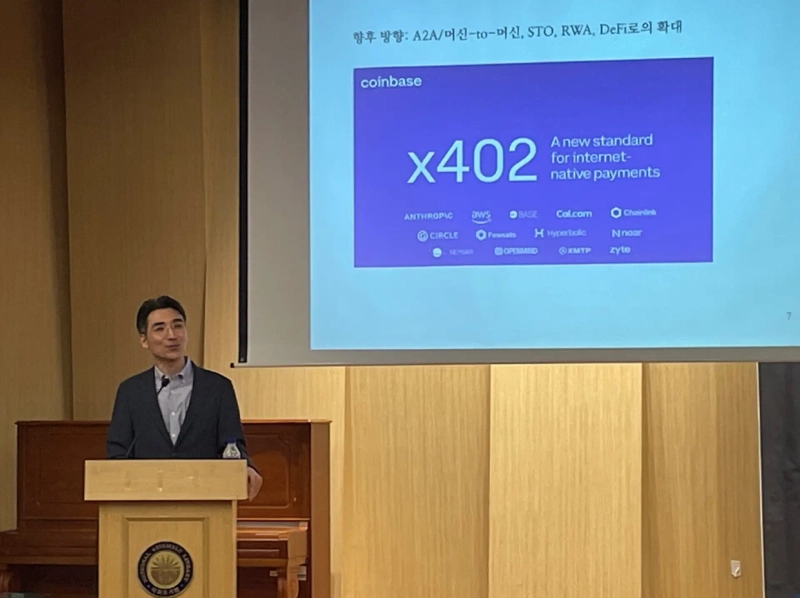
On the 7th, Professor Kang Hyung-gu of Hanyang University delivered a keynote speech at the National Assembly Library during the 'KBIPA Digital Asset TF Launch Ceremony'. He stated, "The Basic Act on Digital Assets could serve as a foundation to facilitate value-up across the industry," and added, "Institutionalization of digital assets may also contribute to resolving the 'Korea Discount.'"
Professor Kang said, "In an era where AI machines make transactions 100 times per minute, it is difficult to cope with Central Bank Digital Currency (CBDC)," and explained, "In a global economic system, only stablecoins can serve as the practical AI trading infrastructure." He continued, "When AI agent-to-agent (a2a) and machine-to-machine (M2M) economies become reality, stablecoins suitable for real-time micropayments will be the key means."
AI agents are autonomous software that learn, plan, and act independently to achieve specific goals. Unlike conventional AI bots that operate based on preset codes and rules, AI agents are capable of analyzing data and making final decisions on their own accord.
He also emphasized, "Beyond stablecoins, the real game changers are Real World Asset (RWA) tokenization and Security Token Offerings (STO)," further stating, "For example, RWA can tokenize future rental income for liquidity or connect non-productive real estate assets to the venture ecosystem, bringing innovation to asset utilization methods." He assessed that, in this process, blockchain can transparently match supply and demand and be a technological foundation for reducing transaction costs.
Regarding the controversy over won-based stablecoins, Professor Kang pointed out, "Whether we lead or not, their creation is inevitable, and if we hesitate, it may emerge under foreign leadership." He added, "For instance, a foreign entity could issue a won-based stablecoin pegged to the dollar without holding Korean bonds, and if they hedge using KRW-USD futures, a won stablecoin market could be created outside Korean monetary sovereignty."

Minseung Kang
minriver@bloomingbit.ioBlockchain journalist | Writer of Trade Now & Altcoin Now, must-read content for investors.