

PiCK
Preventing the Outflow of ₩131 Trillion in National Wealth... "Urgent Need for Institutionalization of KRW Stablecoins and Derivatives"
Summary
- Institutionalizing 'KRW Stablecoin' and digital asset 'derivatives' is urgent to prevent domestic capital outflows and attract overseas investors.
- Experts emphasize that 'margin lending' and institutionalizing the derivatives market are essential for corporations in Korea to secure hedging tools and enhance global competitiveness.
- Building state-led 'stablecoin' infrastructure and rapidly establishing regulatory frameworks are identified as key tasks for the growth of Korea's digital asset market.
Min Byung-deok, Member of the Democratic Party of Korea & Hankyung Bloomingbit
Hosting of 'Digital Asset Basic Act Policy Seminar'
Need for the Institutionalization of Digital Asset Derivatives
'KRW Stablecoin' as a Channel for Capital Inflows
Proactively Establish Under State Leadership
Rapid Regulatory Framework Needed for Corporate Entry
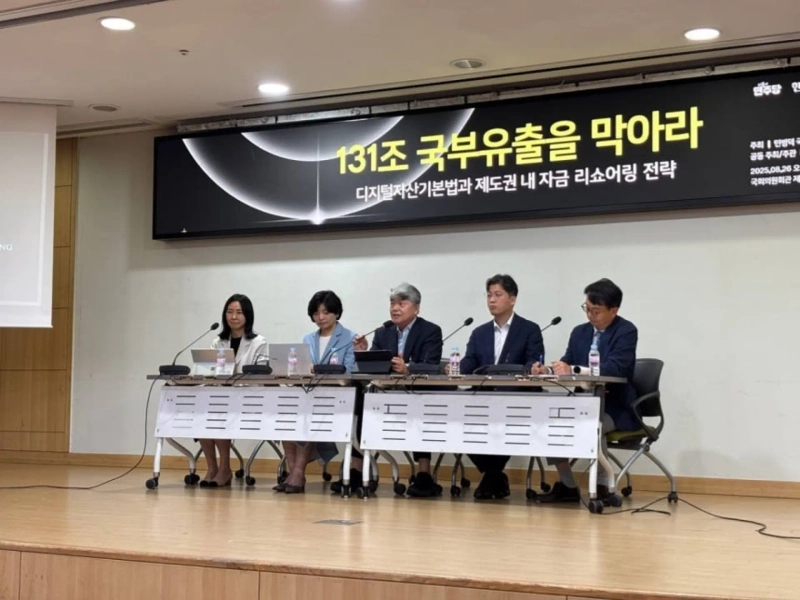
On the 26th, at the National Assembly Members' Office Building in Yeouido, Seoul, Min Byung-deok, a lawmaker from the Democratic Party of Korea, and Hankyung Media Group's Bloomingbit jointly hosted the policy seminar titled 'Prevent the Outflow of ₩131 Trillion in National Wealth: Digital Asset Basic Act and Reshoring Strategies for Institutional Funds'. During the event, academia, legal professionals, and experts emphasized that the issuance of KRW stablecoins and the institutionalization of digital asset derivatives could not be delayed any longer.
Lee Hae-boong, Head of Upbit Investor Protection Center, said, "The authorities are reportedly creating guidelines for virtual asset margin trading by considering both the impact on domestic markets and the users' right to choose," and added, "In the U.S., the Trump Administration rapidly fostered the virtual asset sector. Likewise, it is urgent for us to establish principle-based regulatory systems." He further noted, "We also need to quickly define the overall direction domestically so the flows between overseas exchanges and domestic investors can be systematically managed."
Virtual asset margin trading is a mechanism that allows investors to deposit collateral and borrow coins as needed to take long or short positions. This was also highlighted as a critical task to improve global competitiveness.
Kim Jae-jin, Executive Vice President of DAXA, said, "Institutionalizing margin trading has been discussed for a long time, with the necessity continuously raised. Major overseas exchanges already offer templates that combine spot and derivative trading, attracting large-scale capital inflows. Industry, regulators, and legislative bodies in Korea must collaborate to build an institutional foundation that boosts global competitiveness."
Lee Joo-hyun, Director of Strategic Legal Affairs at Bithumb, stated, "Corporations, by their nature as professional investors, always need hedging tools, which are impossible without derivatives. If the margin framework and institutional discussions are resolved, Korea can move toward a regulatory regime that aligns with global standards." He also remarked, "Since regulators are expected to allow corporate entry into virtual asset investments in the second half of this year, swift regulatory improvements are necessary."
Kang Hyun-jung, attorney at Kim & Chang, added, "Given that the domestic market is centered on individual investors, there is institutional demand for derivatives and margin trading that cannot be ignored. The Digital Asset Basic Act should refer to the Capital Markets Act but provide businesses with flexibility, such as allowing them to set their own credit limits according to the traits of digital assets."
Ryu Hyuk-sun, professor at KAIST, pointed out, "The greatest hindrance is that (virtual asset) derivatives are managed solely under the Capital Markets Act. First, it is important to clearly specify derivatives in the Digital Asset Basic Act and then build a foundation for institutional expansion."
KRW Stablecoins: The Gateway for Asian Capital Inflows

During the second panel discussion, experts evaluated that KRW stablecoins could become a new channel for bringing overseas capital into South Korea's financial markets, going beyond mere reshoring (returning funds to Korea).
Kang Byung-ha, Executive Director of Strategic Planning at Meritz Securities, said, "KRW stablecoins can do more than just reshoring—bringing back capital that left the country—they can also attract global investors and those in regions lacking financial infrastructure to the domestic market." He added, "If qualified businesses build the infrastructure and provide stability based on their existing credibility, the technical barrier will not be high."
Furthermore, it was forecast that stablecoins could serve as a key platform supporting the entire ecosystem, much like the 'App Store' in the Web3 era. Kim Ho-jin, CEO of ShardLab, said, "Only countries that preemptively establish stablecoins as the core layer in the Web3 era will be able to produce new unicorns. Stablecoins serve as the operating system (OS) like Android, iOS, or the App Store in the mobile market. This will become the foundation for not just industrial advancement but also for subsequent startups and ecosystem participants," adding, "Stablecoins must definitely be designed under government leadership."
Ryu Hyuk-sun, professor at KAIST, advised, "KRW stablecoins should be designed in a way that creates real demand, not just issued for its own sake." He continued, "Since Korea is already regarded as a world leader in platforms, culture, and economic power, it is crucial to globalize this position. If the 'WonStableCoin' (KRW Stablecoin) market is developed properly, it will provide new opportunities based on the local currency as key currency."
Jo Jin-seok, CEO of CODA, pointed out, "There is no domestic market for virtual asset-based lending, futures, or derivatives, so corporations cannot find risk-hedging tools. If institutional systems are not set up soon, the corporate market could be taken over by overseas players." He added, "New business areas are rapidly expanding globally, but a perfectionist approach may cause us to fall behind. It is important to foster a culture that values swift responses and improvements."
Kang Min-seung, journalist at Bloomingbit minriver@bloomingbit.io

Minseung Kang
minriver@bloomingbit.ioBlockchain journalist | Writer of Trade Now & Altcoin Now, must-read content for investors.