

'No. 1 in the world' — Why massive capital is flooding into the Chinese stock market… 'Dreadful outlook'
Summary
- The Shanghai Composite Index saw a 10-year high, attributed to an increase in liquidity and the 'money move' phenomenon, despite weak economic indicators.
- Future-oriented industries such as AI, semiconductors, and healthcare are leading the rally, marking a departure from the past focus on real estate and consumer staples.
- Experts warn of the growing gap between the real economy and financial markets and express concerns about the sustainability of the bull market.
AI-driven surprise rally in the Chinese stock market… Fundamentals remain questionable
Shanghai Composite Index hits a 10-year high… Global leader in growth rate
Ongoing weakness in Chinese economic indicators
Shanghai Composite up 12% since July
Driven by increased liquidity and relief of tariff burdens
Semiconductors and healthcare also lead gains
Wide gap between the real economy and financial markets
Sustainability of the bull market remains 'uncertain'
The Shanghai Composite Index is staging a surprising rally, hitting its highest level in 10 years. Despite lackluster economic indicators, it has boasted the highest growth rate among global stock indices in the second half of the year. However, as the gap between the real economy and financial markets widens, analysts are divided on whether this rally is sustainable.
◇ Stock market rises despite poor economic indicators
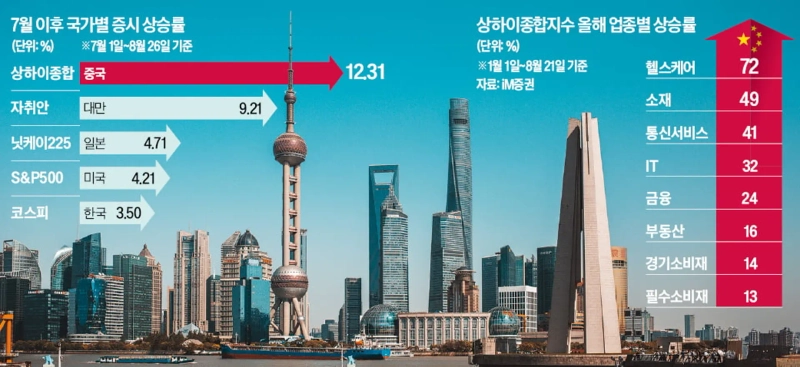
According to Bloomberg News on the 27th, the market capitalization of mainland Chinese stocks increased by about $1 trillion (about ₩1,400 trillion) over the past month. The Shanghai Composite Index soared by 12.31% from July through the 26th, reaching its highest point in a decade. During this period, it significantly outperformed major markets, including the United States (4.21%), Taiwan (9.21%), Japan (4.71%), and South Korea (3.5%).
In contrast to the stock market’s recent surge, Chinese economic indicators remain subdued. The purchasing managers' index (PMI) for China’s manufacturing sector fell for a fourth straight month in July, and retail sales grew by only 3.7% year-on-year, well below market expectations (4.6%). Producer prices have declined for 26 consecutive months, and the youth unemployment rate remains above 17%, signaling few signs of a fundamental (underlying strength) recovery.
Experts cite increased liquidity as the primary driver of the bull run. Under an accommodative monetary policy stance by the Chinese government, liquidity has been flowing from real estate and savings into the stock market in what’s known as a 'money move.'
According to the People's Bank of China, household savings in July fell by ¥1.1 trillion, while non-bank (securities/fund) deposits rose by ¥2.14 trillion. Individual investors make up about 90% of the Shanghai Composite Index participants, much higher than in the United States (20-30%). Both weekly trading volume and margin balance for the index recently reached their highest levels in 15 years.
Goldman Sachs analyzed, "Only 22% of Chinese household financial assets are invested in funds or stocks," and said, "There is still over ¥10 trillion in investable assets remaining." Consulting firm Zhiben Advisors predicted, "As Chinese investors liquidate bonds and move into equities, the upward trend will continue."
◇ Cambricon surpasses Moutai
It has also been analyzed that future-focused industries such as artificial intelligence (AI), semiconductors, and healthcare are driving the rally. AI chip manufacturer Cambricon Technologies, known as the 'NVIDIA of China,' has soared about 460% over the past year, overtaking Kweichow Moutai as the most expensive stock. Its market capitalization has topped ¥500 billion. Wong Kun, chief strategist at BNY, said, "If DeepSeek can use China-made chips, other semiconductor stocks could soar," and "Potential demand for Chinese chips will be enormous."
This year, the best-performing sectors in the Shanghai Composite Index are healthcare (72%), followed by materials (49%), communication services (41%), and information technology (32%). This trend differs from the previous emphasis on real estate and consumer goods.
Eased tariff risks have also been advantageous for the Chinese stock market. When the United States announced reciprocal tariffs in early April, China was a target of high tariffs. However, two delays of the high tariffs imposed on China have alleviated these burdens.
Still, there are worries in the financial sector about the recent gains. Robin Xing, chief economist at Morgan Stanley, commented, "Investors are overlooking China’s sluggish economic indicators and policy problems," and noted, "The upcoming 4th Plenary Session of the 19th Central Committee of the Communist Party of China, scheduled for October, could be a turning point."
Shitao Xu, chief economist at Deloitte China, also pointed out, "It will be hard for China’s real estate market to recover anytime soon," adding, "Despite government policies to boost domestic demand, they are placing a heavy burden on consumption."
Reporter Choi Mansoo bebop@hankyung.com

Korea Economic Daily
hankyung@bloomingbit.ioThe Korea Economic Daily Global is a digital media where latest news on Korean companies, industries, and financial markets.