

"Large impact of U.S. tariff increases on South Korea…will shave next year's growth rate"
Summary
- The Bank of Korea said that U.S. tariff increases will lower South Korea's growth rate by 0.45%p this year and 0.60%p next year.
- It said major export items such as automobiles, metals, and machinery are expected to suffer significant damage.
- It analyzed that U.S. tariffs will have negative effects on our economy through the trade, financial, and uncertainty channels.
Bank of Korea "It was duty-free under the KORUS FTA and then to 15%…impact is large"
"Automobiles, metals, machinery hit"
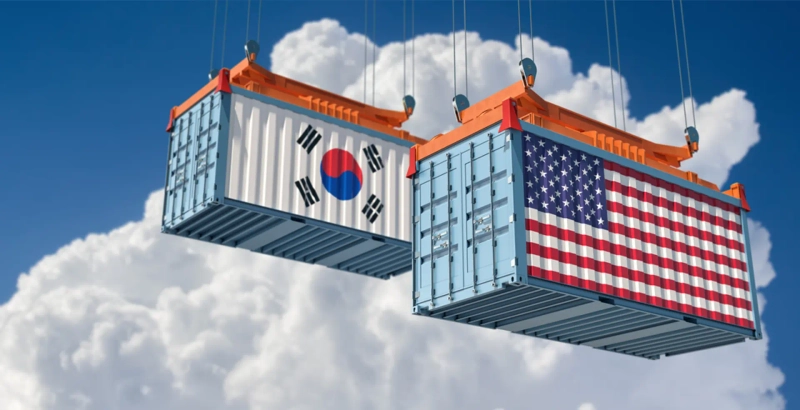
As U.S. tariffs that had been exempted under free trade agreements (FTAs) were raised through recent negotiations, an analysis says this will deal a heavy blow to the South Korean economy.
According to the Bank of Korea's report released on the 28th, "The impact of U.S. tariff policy on our economy," the increase in South Korea's tariff rate after negotiations was about 15% points (p) compared with the pre-Trump administration average, ranking 18th among 50 countries. The Bank said in the report that "(the increase) belongs to the upper-middle group, so the tariff impact will be large," and explained that "unlike the European Union (EU) and Japan, South Korea's previous tariff rate was 0% under the KORUS FTA, and exposure of items such as steel and automobiles is relatively high, so the increase in the (average tariff rate) is also large."
The U.S. tariff exposure by product was defined for 2024 as the share of that product in each country's exports to the United States. South Korea was found to be △automobiles 1st △steel, aluminum, copper 5th △semiconductors 8th. Analyzing the impact of these U.S. tariff changes through models, the new U.S. tariff policy is estimated to lower South Korea's growth rate by 0.45%p this year and 0.60%p next year.
The U.S. tariff impact is transmitted to the Korean economy mainly through trade, financial, and uncertainty channels. First, on the trade side, U.S. tariff increases raise export costs and, if rising U.S. domestic prices reduce aggregate demand, exports to the U.S. will shrink significantly. Imports demand from countries other than the U.S. is also expected to decline due to the U.S. tariff-induced slowdown, reducing exports to non-U.S. destinations overall.
In particular, items with high tariff rates such as metals and machinery and sectors with a large share of exports to the U.S., like automobiles, will inevitably be hit hard. On the financial side, if U.S. tariffs increase inflationary pressure and U.S. monetary policy operates more tightly, improvements in domestic and foreign financial conditions may be delayed, negatively affecting the real economy.
The uncertainty channel refers to the contraction in investment and consumption as firms and households delay economic decisions while watching U.S. tariff developments. The estimated impacts on this year's and next year's growth rate for each channel are △Trade -0.23%p·-0.34%p △Finance -0.09%p·-0.10%p △Uncertainty -0.13%p·-0.16%p.
The Bank warned, "Although domestic and foreign impacts have been smaller than feared so far due to mutual tariff exemptions, firms absorbing burdens, etc., they will expand in the future," adding, "If exports destined for the U.S. are redirected domestically, it could disrupt the industrial ecosystem, and expansion of U.S. local production could hollow out domestic industries, leading to employment contraction and brain drain."
An Hye-won, Hankyung.com reporter anhw@hankyung.com

Korea Economic Daily
hankyung@bloomingbit.ioThe Korea Economic Daily Global is a digital media where latest news on Korean companies, industries, and financial markets.