

NVIDIA, despite surprise earnings... investors 'cold' on China risk
Summary
- NVIDIA's Q2 revenue rose 56% year-on-year, but data center results fell short of expectations, leaving investor reactions cold.
- Weak China sales of the H20 chip and a 'de-NVIDIA' movement were cited as reasons for the core business weakness.
- However, Wall Street expects performance improvement to continue thanks to large-scale AI investment by U.S. big tech firms and NVIDIA's dominant market share.
Mixed reactions to Q2 results
Revenue KRW 65 trillion, up 56% year-on-year
Data center revenue falls short of expectations
Weak H20 chip sales in China weigh on results
"Growth potential remains thanks to big tech investment"
NVIDIA posted record results, but investor reaction was chilly. The core data center business fell short of expectations, and concerns grew over China's 'de-NVIDIA' movement. Still, Wall Street analysts expect NVIDIA to continue its steep growth based on big tech expansion of artificial intelligence (AI) infrastructure investment.
Core business results 'below expectations'
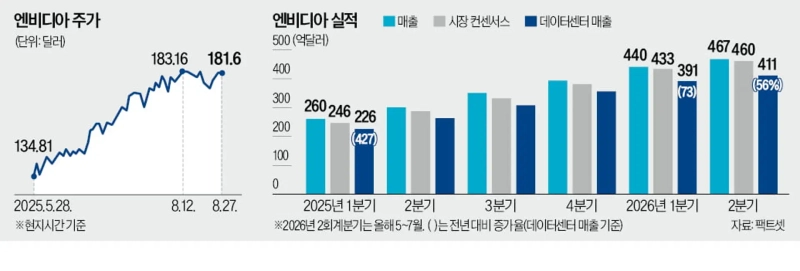
NVIDIA said on the 27th (local time) that revenue for fiscal 2026 Q2 (May–July this year) was US$46.74 billion (about KRW 65 trillion), up 56% from the same period last year. Earnings per share (EPS) were $1.05. These topped FactSet's estimates (revenue $46.05 billion, EPS $1.01).
Investors focused more on the data center segment, which disappointed relative to Wall Street expectations despite strong overall revenue. Data center-related revenue, which includes AI chips such as 'Blackwell', reached $41.1 billion. It rose 56% year-on-year to a record high but fell short of the market estimate ($41.3 billion). In after-hours trading, NVIDIA plunged more than 3%.
A sales gap of H20 chips to China contributed to the core business weakness. CFO Colette Kress said on the conference call that "since late July the U.S. government has been reviewing licenses for H20 sales to China and has approved supply for some customers, but there have been no actual shipments." The Donald Trump administration had blocked exports of H20 chips to China in April, then approved resumption of sales last month. Now the Chinese government is pressuring domestic firms not to buy H20 chips.
NVIDIA said it will exclude the China market when forecasting future results. It expects fiscal 2026 Q3 revenue to reach $54.0 billion, more than 50% year-on-year growth—a figure slightly above Wall Street's estimate ($53.14 billion).
"Big tech AI investment tailwind continues"
Wall Street experts largely agree there is no loss of momentum for NVIDIA. According to Bloomberg, Microsoft, Amazon, Alphabet and Meta plan to invest more than $344 billion (about KRW 478 trillion) in AI this year. Building AI infrastructure such as data centers requires large numbers of high-performance graphics processing units (GPUs). Given NVIDIA's near-dominant share in this market, expectations are that its performance improvement will continue. Wedbush recently maintained an 'outperform' rating on NVIDIA and raised its price target from $175 to $210. Morgan Stanley ($200→$206) and UBS ($175→$205) also raised their price targets.
NVIDIA said it expects global AI infrastructure investment to reach $3–4 trillion by 2030. CFO Kress said, "With the advent of the robotics era, billions of robots, hundreds of millions of autonomous vehicles, and hundreds of thousands of robotic factories and warehouses will be developed."
Prospects for the China business are mixed. According to the Financial Times (FT), Chinese semiconductor firms plan to triple their in-house AI chip production next year. Jensen Huang, CEO of NVIDIA, said "there may be a China version of the latest AI chip Blackwell" and added that "with a competitive product, there could be about a $50 billion (about KRW 70 trillion) opportunity in the China market this year."
Reporter Jo Ara rrang123@hankyung.com

Korea Economic Daily
hankyung@bloomingbit.ioThe Korea Economic Daily Global is a digital media where latest news on Korean companies, industries, and financial markets.