

Treasury Secretary Vincent: "Confident the tariff ruling will be overturned by the Supreme Court"
Summary
- Treasury Secretary Vincent said he is confident the use of IEEPA by President Trump to impose tariffs will be overturned by the U.S. Supreme Court.
- He said that even if the Supreme Court ruling is unfavorable, they have alternative tariff measures such as a Plan B based on the Smoot-Hawley Tariff Act.
- The ruling affects fentanyl-related tariffs imposed on China, Canada, Mexico, and does not affect existing tariffs on autos, steel, and other goods.
"Even if it isn't overturned, we have a Plan B based on the Smoot-Hawley Tariff Act"
"Russia, China, India, who are colluding, are villains"
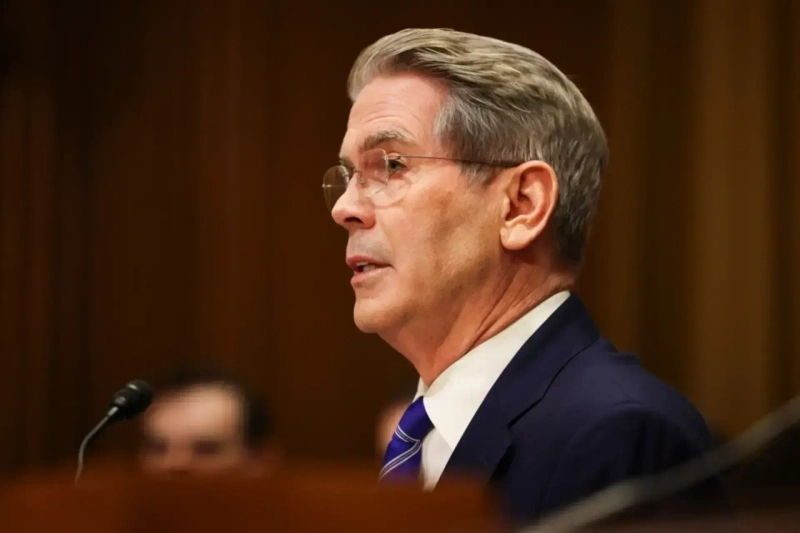
U.S. Treasury Secretary Scott Vincent said he is confident the U.S. Supreme Court will uphold President Trump's use of the 1977 International Emergency Economic Powers Act (IEEPA) to impose tariffs on trading partners. He said that even if it is not upheld, they have an alternative Plan B. This appears to be a short-term tariff imposition measure based on the Smoot-Hawley Tariff Act.
According to Reuters on the 2nd, Secretary Vincent said in interviews with U.S. media on the 1st local time that he plans to prepare a legal brief for appeal to the Supreme Court.
The brief is expected to emphasize the urgency of addressing decades-long trade imbalances and preventing the deadly fentanyl from entering the United States.
A U.S. appeals court on the 29th of last month ruled that most of President Trump's tariffs under the emergency powers were unlawful. The appeals court allowed the tariffs to remain in place until October 14 to give the Trump administration an opportunity to appeal to the Supreme Court.
The U.S. Supreme Court has traditionally leaned slightly liberal with five liberal justices and four conservative justices among the nine, but after the deaths of two liberal justices and the appointment by Trump of two judges, five justices now have Republican leanings, making it uncertain whether the federal appeals court's ruling on Trump's tariffs will stand.
The U.S. Court of Appeals in Washington D.C. issued a 7-4 decision on the 29th. The ruling applies to the reciprocal tariffs announced by President Trump in April and the fentanyl-related tariffs imposed in February on China, Canada, and Mexico. It does not affect tariffs imposed on automobile, steel, and aluminum imports under separate laws.
IEEPA grants the president authority to address "unusual and extraordinary" threats during a national emergency.
Vincent said, "The Supreme Court will support the president's use of IEEPA, but there are other authorities we can use." He added that one such authority could be Section 338 of the Smoot-Hawley Tariff Act of 1930. That provision allows the president to impose tariffs of up to 50% for five months on imports from countries found to be discriminating against U.S. commerce.
Vincent said the influx of deadly fentanyl, which kills about 70,000 people in the United States each year, is a legitimate reason to declare a national emergency.
Meanwhile, Vincent dismissed the view that Trump's tariffs have brought Russia, China, and India closer together, saying, "They are villains." He said, "India and China are fueling Russia's war machine," and added, "Someday we and our allies will step in."
He said progress has been made in persuading Europe to join the U.S. in curbing India's purchases of Russian crude oil, but he did not comment on whether similar pressure would be applied to China.
He said China will face difficulties finding markets for its goods because, outside the U.S., Europe, and English-speaking countries, there are not many places with sufficiently high per capita incomes.
Contributing reporter Kim Jeong-a kja@hankyung.com

Korea Economic Daily
hankyung@bloomingbit.ioThe Korea Economic Daily Global is a digital media where latest news on Korean companies, industries, and financial markets.