

"Defend as much as possible against the U.S.'s unilateral tariff increases"…signals a protracted negotiation with the U.S.
Summary
- President Lee Jae-myung announced negotiation principles, prioritizing the national interest, and said he will not accept unfavorable demands regarding the U.S.'s unilateral tariff increases.
- He said the detention of Korean employees (detention) is increasing uncertainty about domestic companies' investment in the U.S.
- He stated that the auto and parts industry continues to be disadvantaged in competition because it does not receive the U.S.'s tariff reduction benefits.
Tariff negotiations·Detention of workers in Georgia, U.S.
Direct mention of the 'three principles' of the negotiations
No side agreements, national interest first, fairness
'Determination' not to accept demands that would cause losses
'Don't criticize (us) for not signing'
"Companies will hesitate to invest in the U.S."
Taken aback by investment pressure and even detentions
Cars·parts, disadvantageous competition for the time being
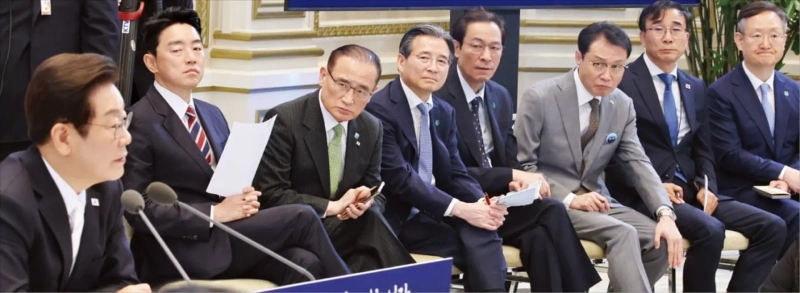
On the 11th, President Lee Jae-myung's announcement of the 'three principles' for Korea-U.S. tariff and security negotiations is interpreted as a clear determination not to accept demands that would harm the national interest, even if it means enduring a prolonged struggle. The president also said, "Don't criticize (us) for not signing (the final agreement)." While this can be seen as stating a principled position as the nation's top official, there is concern that the negotiations could become prolonged.
This is because the longer the negotiations take, the more it implies that unfavorable competitive conditions for domestic automakers and parts makers will persist in the U.S. market. With the detention of Korean employees at the construction site of the Hyundai Motor·LG Energy Solution joint battery plant in Georgia, U.S., U.S.-bound investment is inevitably being curbed, increasing the uncertainty domestic companies must contend with.
Lee appears prepared for a prolonged process to 'defend national interests'
The president laid out negotiation principles saying, "No side agreements, no decisions against the national interest, and no negotiations that stray from rationality and fairness," adding that "the final conclusion will be reached rationally." Earlier, Kim Yong-beom, the presidential office's policy chief, said that negotiations between the two sides over a $350 billion investment fund—one of the core agendas of Korea-U.S. tariff talks—are at an impasse. He said the $350 billion fund could have a large shock on our foreign exchange market, and that they have asked the U.S. side for a solution on this matter.
There are reportedly still differences over the fund's management method and profit distribution. The president said, "It's hard to say exactly how Japan reached (a final settlement), because the details are not clearly known," but indicated that accepting the same conditions as Japan would be difficult. This is interpreted in the same context as Kim's recent remark that "no one among our people could say they must sign that text as is."
The president also made clear that they would not aim simply for a final settlement, saying, "We will need to negotiate for a long time." Regarding the Korea-U.S. summit, he said, "People ask, 'Why can't you sign?' but we didn't go there to get something," and added, "We went to defend, as much as possible, against the U.S.'s unilateral tariff increases." He went on to say, "If the conditions are good, we'll sign, but why sign something that isn't beneficial?"
Even detentions... growing uncertainty
Meanwhile, the large-scale detention of Korean employees is also expected to have some inevitable impact on negotiations between the two countries. As U.S. immigration authorities handcuffed, arrested, and detained Korean employees dispatched to build the local plant, domestic companies have been compelled to be cautious about additional investment. At the recent Korea-U.S. summit, domestic companies announced they would invest $150 billion in the U.S.
The president said, "Our companies operating in the U.S. must be in a very bewildered state," adding, "From a company's perspective, establishing a local plant in the U.S. could incur all sorts of disadvantages, or the environment could become difficult, making them wonder, 'Should we do this?'" He went on, "This could have a significant impact on future direct investment in the U.S." For domestic companies, amid intense pressure to invest in the U.S. and with tariff issues unresolved, routine mechanisms like the Electronic System for Travel Authorization (ESTA) or the B1 business visa have effectively become useless due to this detention incident.
Above all, while Japan has reduced auto and parts tariffs from 25% to 15%, the domestic industry is still being subjected to a 25% tariff, which is a burden.
Han Jae-young / Choi Hae-ryeon reporters jyhan@hankyung.com

Korea Economic Daily
hankyung@bloomingbit.ioThe Korea Economic Daily Global is a digital media where latest news on Korean companies, industries, and financial markets.