

Not Samsung Electronics, the 'real protagonist' is… KOSPI leaders 'massively replaced'
Summary
- It reported that the ROE of the top 30 KOSPI market-cap companies is expected to reach its highest level in 14 years.
- It stated that so-called 'Jobangwon' companies—shipbuilding, defense, and nuclear power—have entered the top market-cap ranks en masse, leading qualitative growth of the domestic market.
- It reported that global investment banks evaluate the Korean market as having increased investment appeal thanks to structural improvements and tax reform.
Shipbuilding·Defense·Nuclear seize the 'KOSPI leader' spot…Driving qualitative growth of the K-market
Stock market 'level-up' driven by manufacturing surge
Top 30 firms' ROE highest in 14 years
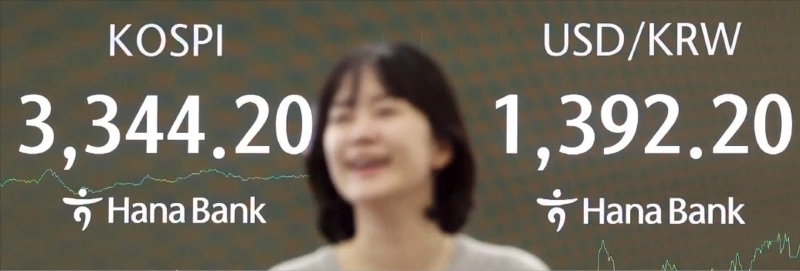
KOSPI 3344…Highest for two consecutive days
The return on equity (ROE) of Korea's representative companies is expected to reach its highest level in 14 years since 2011.
On the 11th, The Korea Economic Daily, commissioned to Daishin Securities, analyzed the financial indicators of the top 30 market-cap companies listed on the KOSPI and found that their average ROE forecast for this year was 12.3%. This far exceeds the peak current account surplus year of 2015 (11.9%).
The ROE of the top 30 market-cap firms struggled during the 2010s. During the 2020 COVID-19 period it hit a low of 3.7% and rarely rose above the 5% level. This was due to pressure from US big tech and Chinese manufacturers and falling behind in artificial intelligence (AI).
The turnaround in leading firms' ROE began last year (9.7%), as semiconductor and shipbuilding industries began to recover. This year, shipbuilding·defense·nuclear companies have entered the upper ranks of market capitalization en masse, leading analysts to say the domestic market has 'leveled up.' They are generating annual operating profits in the trillions of won and driving overall ROE. Companies newly entering the top 10 by market cap such as HD Hyundai Heavy Industries (22.9%), Hanwha Aerospace (19.0%), HD Korea Shipbuilding & Offshore (17.5%) are expected to record ROEs around 20% this year. Improvements in performance are also expected from Hyundai Rotem (28.2%), Meritz Financial Group (21.4%), Korea Electric Power (17.1%), among others.
Securities firms say the 'value for money' of the domestic market has improved. Global investment banks are increasingly naming Korea as the most promising investment destination among major Asian countries. CLSA analyzed that "the Korean market is ready to be revalued through improvements in corporate governance and tax reform" and that "the KOSPI index could rise to the 4500 level." That day the KOSPI index closed at 3344.20, up 0.9%, rewriting the record high set the previous day.
Major reshuffle of market-leading players
Traditional strongholds like steel and petrochemicals are out, and new export growth industries fill the gap
History shows that whenever the Korean market took a step forward, new protagonists appeared. The 'Cha-Hwa-Jeong' (automobiles·chemicals·refining) that led the KOSPI's 2000 breakthrough in 2010 and the 'BBIG' (battery·bio·internet·game) that powered the KOSPI 3000 after COVID-19 in 2020 are representative examples.
Afterward, the domestic market entered a long dark period. Traditional manufacturers such as steel and petrochemicals were chased by China, and the AI field lagged behind US big tech and Chinese startups. As export industries weakened en masse, the KOSPI's rise stalled. While markets in the US, Japan, and Taiwan hit record highs, the KOSPI remained range-bound.
Analysts say the market has only recently seized a genuine rebound opportunity. The main players of this market level-up are the 'super rookies' collectively referred to as 'Jobangwon' (shipbuilding·defense·nuclear power).
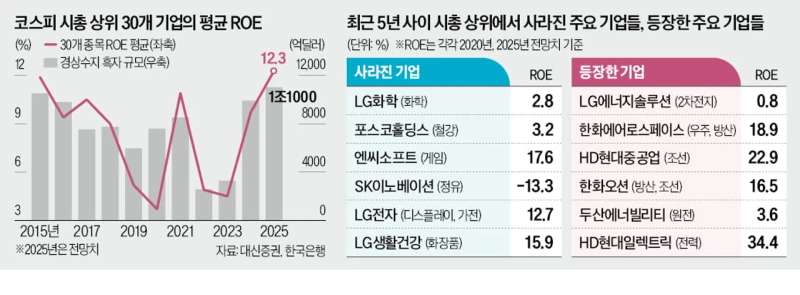
Nine of the top 20 by market cap replaced
The Korea Economic Daily conducted a full survey of KOSPI market-cap leading companies since 2015 and found that over the past decade nine of the top 20 companies have changed hands. Traditional manufacturers such as chemical, steel, and refining firms were pushed out while defense, shipbuilding, and nuclear firms moved in.
In the past five years, companies that fell from the top ranks include LG Chem (chemicals), POSCO Holdings (steel), NCSOFT (games), SK Innovation (refining), LG Electronics (display), and LG Household & Health Care (cosmetics). In particular, the poor performance of refining, chemical, and steel sectors stands out. SK Innovation continues to post deficits due to falling oil prices and fluctuations in feedstock naphtha prices that have reduced refining margins. The profitability of LG Chem and POSCO Holdings also deteriorated sharply. Their ROEs in 2020 were 2.8% and 3.2% respectively, but fell to 1.2% and 1.98% last year.
New entrants to the top market-cap ranks include LG Energy Solution (secondary batteries), Hanwha Aerospace (space·defense), HD Hyundai Heavy Industries (shipbuilding), Hanwha Ocean (defense·shipbuilding), Doosan Enerbility (nuclear), and HD Hyundai Electric (power). Among them, HD Hyundai Electric's ROE this year is expected to reach 34.4%, helped by a surge in power demand amid the AI boom. Jongmin Kim, chief research fellow at Samsung Securities, said, "The upward trend for AI semiconductors and power equipment will not be broken," and added, "Industries that have seen a global paradigm shift can follow growth paths no one predicted."
"K-culture is at the start of a 10-year-sustained industry"
The securities industry diagnoses that the 'K-market' is evolving qualitatively. In the past, the Korean market centered on Samsung Electronics and the 'memory semiconductor market,' but now it has become a gathering place for global strategic industry leaders such as shipbuilding, defense, nuclear power, and batteries.
The investment attractiveness of the Korean market has also increased. One asset management CEO said, "With China being excluded from the value chain, whether big tech invests in AI or the US government increases naval vessels and nuclear plants, they inevitably have to work with Korean companies," and explained, "For global investors, the Korean market has become a luxury department store displaying a variety of premium products."
In addition to Jobangwon, the K-culture industry is expected to strongly support the domestic market. Fueled by the K-culture craze including 'K-pop Demon Hunters,' not only entertainment stocks but also food stocks like Samyang Foods and beauty device stocks like PharmaResearch are showing growth. One fund manager said, "K-culture appears to be at the start of a growth trend that will last more than 10 years," and added, "Industries that reflect Korea's unique characteristics are expected to produce new stories and may emerge as the next leading sectors."
Many point out that for the domestic market to continue a mid- to long-term rally, a full-scale recovery in traditional manufacturers' performance, government policy efforts, and mitigation of global risks such as US tariffs are necessary. Yeon-su Kim, CEO of Kansas Asset Management, said, "The domestic market is at a turning point to shed the burden of 'K-discount' and enjoy a 'K-premium,'" and added, "To accelerate this, the government should take proactive policy steps such as separate taxation on dividend income."
▶ROE
Return On Equity. The value obtained by dividing net income by total equity. It is a representative profitability indicator showing how much profit a company generated using its equity. A higher value indicates superior management efficiency and profit-generating capability.
Reporters Jeon Ye-jin / Park Han-shin / Jo A-ra ace@hankyung.com

Korea Economic Daily
hankyung@bloomingbit.ioThe Korea Economic Daily Global is a digital media where latest news on Korean companies, industries, and financial markets.