

Industry minister returns from U.S. negotiations… silent to reporters' questions
Summary
- The two countries reportedly failed to reach agreement on key issues such as the U.S. investment structure and profit distribution.
- The U.S. is said to be demanding expanded direct investment, leadership in deciding investment targets, and a profit distribution model similar to Japan's.
- Korea is said to be responding cautiously to U.S. demands, arguing for diversifying the burden of direct investment, preserving companies' right to choose, and reasonable profit distribution.
Seem unable to narrow differences on U.S. investment
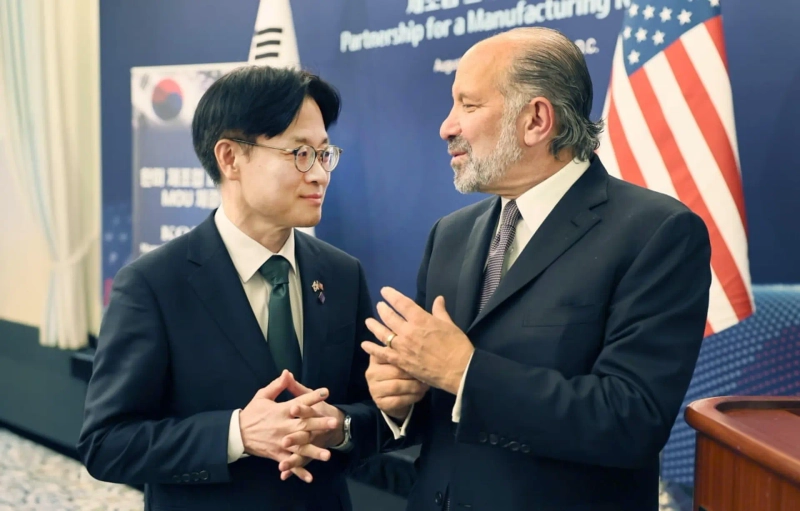
Kim Jeong-gwan, Minister of Trade, Industry and Energy, returned home on the 14th after completing follow-up talks on the Korea-U.S. tariff negotiations. However, he did not disclose achievements during the U.S. visit or the specific details of the negotiations.
On the 12th (local time) in New York, Minister Kim met with Howard Lutnick, U.S. Secretary of Commerce, to discuss Korea's investment structure and methods toward the U.S. and issues of profit distribution. But it is reported that the two sides were unable to reach agreement on key issues. Upon arriving at Incheon International Airport, Minister Kim gave no particular answers to reporters' questions.
Earlier in July, Korea and the U.S. agreed that, in exchange for lowering the U.S. reciprocal tariff rate toward Korea from 25% to 15%, Korea would commit to a total of 350 billion dollars (about 486 trillion won) in investment in the U.S. Although the broad agreement was confirmed at last month's Korea-U.S. summit, the detailed terms remain under negotiation.
Korea wants to reduce the share of direct investment and spread the burden through guarantees, but the U.S. is demanding an expansion of direct investment. Regarding authority to decide investment targets, the U.S. insists on its leadership while Korea is reported to emphasize companies' right to choose based on business viability reviews.
On profit distribution of investments, the U.S. is reportedly pressuring by citing the agreement model concluded with Japan. The case with Japan splits profits half before investment recovery and gives 90% to the U.S. after recovery. Korea rejects this as unreasonable.
The U.S. also demanded removal of non-tariff barriers in agricultural and digital sectors, and Korea responded by proposing industrial cooperation such as in shipbuilding.
Meanwhile, Minister Kim reportedly conveyed to the U.S. the need to improve the visa system and that a stable investment environment for Korean companies must be guaranteed, in relation to the incident in which 330 Korean workers were arrested at the construction site of the Hyundai Motor·LG Energy Solution joint battery plant in Georgia.
Shin Hyun-bo Hankyung.com reporter greaterfool@hankyung.com

Korea Economic Daily
hankyung@bloomingbit.ioThe Korea Economic Daily Global is a digital media where latest news on Korean companies, industries, and financial markets.