

Minister Kim Jeong-gwan returns from New York 'empty-handed'… Seems unable to narrow differences in tariff negotiations
Summary
- Minister Kim Jeong-gwan reportedly returned without narrowing differences regarding the implementation plan for the $350 billion investment to the U.S. in the tariff negotiations.
- The U.S. demanded cash investment and a profit distribution method similar to Japan's, while the government preferred investments in the form of guarantees and loans, leading to large differences in views.
- It warned that until the documentation is completed, Korean cars will be subject to a 25% tariff, which could weaken their price competitiveness in the U.S. market.
Meets with U.S. Secretary of Commerce Lutnick
Confirms differences in views surrounding the investment fund
Concerns over prolonged negotiation deadlock
Foreign Ministry holds vice-ministerial talks with the U.S.
Coordinates on issues including visa matters
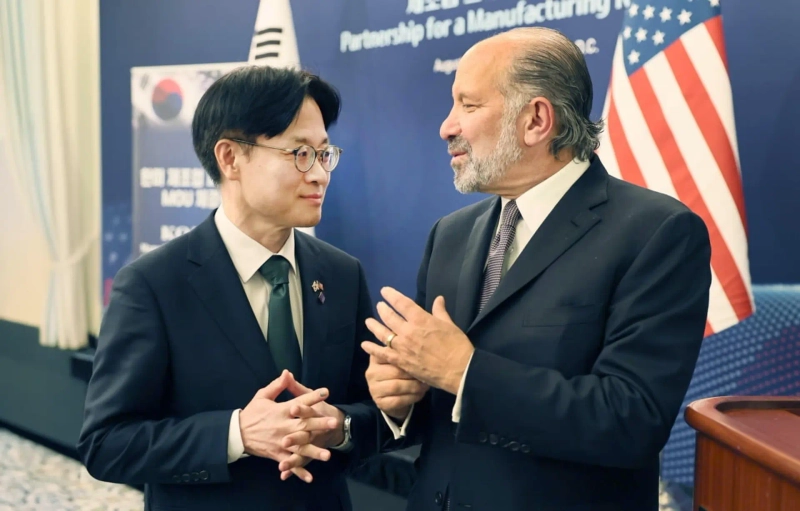
Minister Kim Jeong-gwan of the Ministry of Trade, Industry and Energy, who visited the United States for follow-up consultations on U.S.-Korea tariff negotiations, returned home without narrowing differences with the U.S. regarding the $350 billion investment to the U.S.
According to the ministry on the 14th, Minister Kim, who visited New York, arrived at Incheon Airport early that morning. Minister Kim, who departed for the U.S. on the 10th, met with U.S. Secretary of Commerce Howard Lutnick at a location in New York on the 12th and focused discussions on ways to implement the $350 billion (approximately 486 trillion won) investment to the U.S. that Korea promised as part of the tariff negotiations.
The two countries are conducting working-level talks over the "documentation" of the negotiation terms after reaching a tariff agreement. There are large differences in views regarding the structure of the U.S. investment fund, investment methods, and profit distribution methods. According to trade authorities and political circles, Secretary Lutnick is reportedly demanding a plan to set up a special purpose company (SPC) in the U.S. and put $350 billion in cash into it. The government prefers investments in the form of guarantees and loans, as the European Union agreed with the U.S.
The U.S. is also insisting on a profit distribution method similar to Japan's. Japan, which promised $550 billion in investment, reportedly agreed to split investment returns 50-50 until the principal is recovered, and after recovery ends the U.S. would take 90%. Our government says that, as a non-reserve-currency country, it is difficult to bear such a massive investment amount equal to 20% of gross domestic product (GDP). The "cash $350 billion" that the U.S. wants amounts to 84.1% of Korea's foreign exchange reserves of $416.3 billion as of the end of last year.
There are growing concerns that the negotiation deadlock will be prolonged. President Lee Jae-myung said at a press conference on his 100th day in office on the 11th, "We will never make a decision against national interests," and "We will have to negotiate for a long time to come." Secretary Lutnick appeared on CNBC on the same day (local time) and pressured, "If Korea does not accept the agreement, it can pay the tariff (reciprocal tariff 25%)."
Meanwhile, the tariff rate on Japanese cars exported to the U.S. will be lowered to 15% from the 16th. Korean-made cars will be subject to a 25% tariff until the documentation of the negotiation is completed. There are concerns that the price competitiveness of Korean cars in the U.S. market will significantly decline for the time being.
Meanwhile, Minister Kim expressed concern to Secretary Lutnick about the recent incident at a factory construction site in Georgia where 331 people including Korean workers were arrested and detained by Immigration and Customs Enforcement, and reportedly conveyed that improvements in visa issues between the two countries are needed. At the Government Complex Seoul that day, First Vice Foreign Minister Park Yun-ju and U.S. State Department Deputy Secretary Christopher Landau exchanged views on the launch of a "Visa Working Group."
Kim Dae-hoon/Lee Hyun-il reporters daepun@hankyung.com

Korea Economic Daily
hankyung@bloomingbit.ioThe Korea Economic Daily Global is a digital media where latest news on Korean companies, industries, and financial markets.