

The 'exchange rate rise→export increase' formula doesn't hold…the reason is 'dollar dominance' [Hankyung Foreign Exchange Market Watch]
Summary
- Son Min-gyu of the Bank of Korea said that due to the strengthening of dollar dominance, an exchange rate rise does not immediately lead to increased exports.
- He said that if dollar stablecoins become active, the impact of US dollar value fluctuations on global trade could increase.
- He stated that inclusion of Korean government bonds in the World Government Bond Index (WGBI) could raise the investment attractiveness of domestic government bonds and alleviate the concentration on US Treasuries.
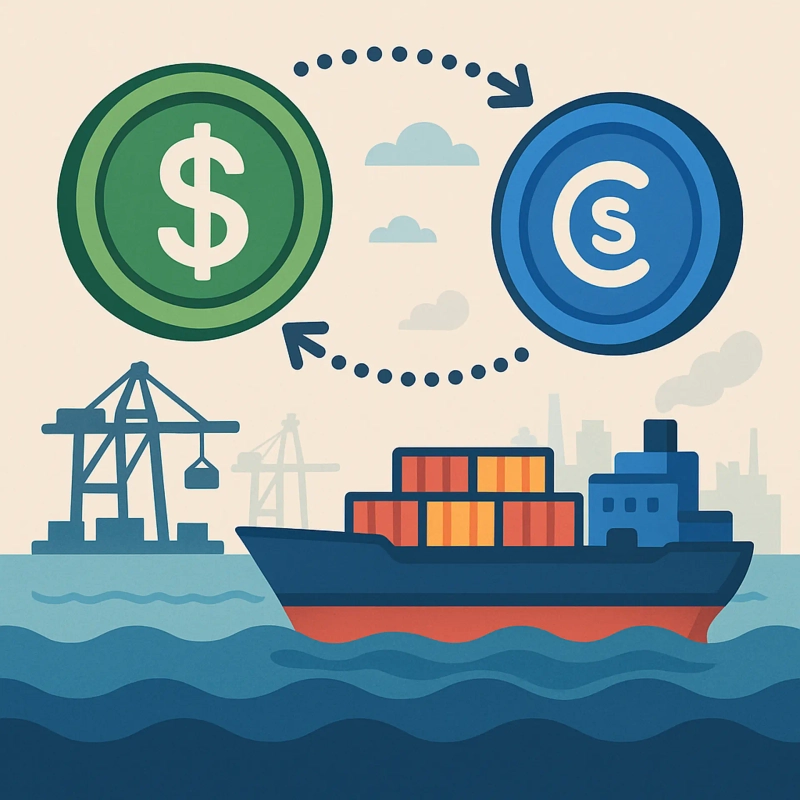
As the hegemony of the US dollar strengthens, the formula that an exchange rate rise leads to increased exports is losing its power. Analysts say it takes too long for the benefits of a high exchange rate to appear because export and import payments are made in dollars. There are concerns that this phenomenon could be further reinforced if dollar stablecoins become widespread.
The Bank of Korea on the 15th introduced these research results through a report by Son Min-gyu, head of the Financial Modeling Team, titled 'Dollar Dominance and International Spillovers of US Financial Shocks.'
Son explained that the US dollar has a large impact on the global economy through functions such as a 'global safe asset', 'working capital for global value chains (GVCs)', and 'settlement currency'. He analyzed that when a US financial risk shock occurs, South Korea's GDP decreases through international financial channels and trade settlement channels.
In the trade settlement channel, the global dollar appreciation resulting from a US financial risk shock leads to higher local prices of products in importing countries, which has a negative effect on our exports. Conventionally, during high exchange rate periods there is room to lower export prices, which improves price competitiveness and helps exports. However, this analysis produced results that contrast with that traditional hypothesis.
Son said, "Because domestic firms settle trade payments in dollars when exporting to countries other than the US," adding, "from the perspective of those importing goods priced in dollars, the effect is that prices rise." He analyzed that this adverse effect worsens for 1 year after the shock and then diminishes. It took about 3 years for the adverse effect to disappear. Son added, "In the medium to long term, domestic firms adjust dollar-denominated prices, which helps the trade balance and aligns with conventional wisdom."
Son said the adverse effects from this trade settlement method could be resolved through the internationalization of the won. If trade payments are settled in won, there would be no room for importing country prices to rise due to an increase in the US dollar's value. Son said, "It is necessary to pursue bilateral currency swaps and the offshore issuance of won-denominated bonds, centered on Asian countries."
He also pointed to the spread of dollar stablecoins as a major variable. If dollar stablecoins are widely used for import and export settlements because of transactional convenience, the impact of dollar value fluctuations on global trade is expected to grow. When asked whether response should be in the form of won stablecoins, Son said, "That is beyond the scope of the research."
In the international financial channel, the adverse effects from the safe asset and GVC working capital roles were pronounced. When a US financial risk shock occurs, global risk aversion strengthens, leading to increased demand for US Treasuries. The dollar strengthens, and Korea's import prices and domestic interest rates rise. As a result, domestic investment and consumption decline.
Also, if US financial conditions deteriorate, borrowing conditions for dollar working capital worsen. This leads to reduced intermediate input and production by domestic firms. Son analyzed that of Korea's GDP decline due to US financial risk, about two-thirds is from production declines via this international financial channel.
To address these aspects, he said inclusion in the World Government Bond Index (WGBI) should proceed smoothly. If the investment attractiveness of Korean government bonds increases, considering safe assets, investors may choose Korean government bonds instead of flocking to US Treasuries.
Reporter Kang Jin-kyu josep@hankyung.com

Korea Economic Daily
hankyung@bloomingbit.ioThe Korea Economic Daily Global is a digital media where latest news on Korean companies, industries, and financial markets.