

China's August production, investment and consumption slow most in a year
Summary
- China's August factory production, investment and consumption indicators showed the slowest growth in a year.
- As a result, the Chinese government is likely to implement stimulus measures such as additional fiscal support to achieve the annual 5% growth target.
- China's central bank is considering benchmark rate cuts and monetary easing, and additional stimulus measures may be implemented in the fourth quarter.
Additional stimulus such as fiscal support expected to achieve annual 5% growth
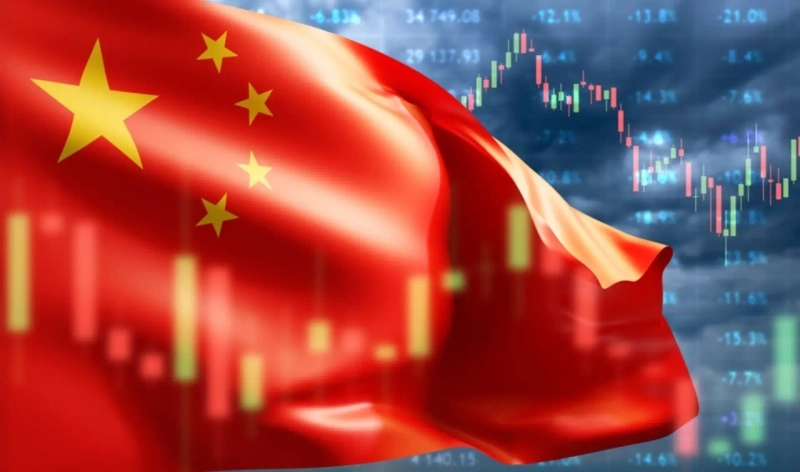
China's August factory production, investment and consumption indicators all showed the slowest growth in a year. As a result, it is widely expected that the Chinese government is likely to introduce additional stimulus measures, such as fiscal support, to achieve annual 5% growth.
On the 15th (local time), Reuters reported that China's National Bureau of Statistics announced industrial production increased 5.2% year-on-year in August. This is the lowest since August 2024 and lower than July's 5.7% increase. It fell short of Reuters' forecast of a 5.7% increase.
Fixed-asset investment also slowed sharply to a 0.5% increase from an average year-on-year increase of 1.6% for January–July, showing the worst investment slump since the pandemic.
This is interpreted as Chinese manufacturers delaying investment until the U.S.'s unpredictable trade policies and clear tariff negotiation outcomes emerge. While Chinese manufacturers maintained export growth by rerouting shipments previously bound for the U.S. to Southeast Asia, Africa and Latin America, weak domestic demand has been constraining investment and production.
Retail sales, a consumption indicator, rose 3.4% in August. This was also the lowest increase since November 2024 and a slowdown from July's 3.7% increase. The expected figure was 3.9%. China began implementing consumer loan subsidies in September, but the impact has not yet appeared.
The slowdown in consumption reflects the property market slump and a weakening labor market.
The unemployment rate rose to 5.3% in August, the highest in six months. This was up from 5.2% in the previous month and 5.0% in June.
According to other data from the National Bureau of Statistics, new home prices fell 0.3% month-on-month last month and 2.5% year-on-year.
China's central bank (the People's Bank of China) is likely to cut the benchmark rate by 50 basis points (1 bp = 0.01%) in the coming weeks, with an additional 10 bp cut also possible.
Zhao Pengxing, ANZ's chief strategist for China, said China's growth is weakening but not yet severe enough to require new stimulus measures.
He said, "In September, consumer support policies and measures are expected to offset the impact on aggregate demand," and added, "Domestic demand looks worse than it actually is because of the Chinese government's crackdown on companies that aggressively cut prices."
Lin Song, ING China's chief economist, said, "Thanks to the strong start at the beginning of the year, this year's growth target is likely achievable, but additional stimulus may be needed."
Xu Tianchen, chief economist at the Economist Intelligence Unit (EIU), said, "Due to base effects, China's economic indicators may worsen further in the fourth quarter." He added that "this makes it likely the Chinese government will implement stimulus measures in the fourth quarter, such as monetary easing, bringing forward bond issuance for this year, and expanding fiscal spending."
China's National Development and Reform Commission said last week, "The government will make full use of fiscal and monetary policies to achieve the annual growth target."
Kim Jeong-a, contributing reporter kja@hankyung.com

Korea Economic Daily
hankyung@bloomingbit.ioThe Korea Economic Daily Global is a digital media where latest news on Korean companies, industries, and financial markets.