

"Rate cuts, not one-off but trend-like"…experts weigh 'additional rally' [Analysis+]
Summary
- The U.S. central bank (Fed) resumed a benchmark rate-cut cycle for the first time in nine months, increasing market attention on the possibility of further cuts.
- This rate cut was driven by a weakening labor market and measures to respond to inflation from tariff policies, and it could act as a supportive factor for assets with downward rigidity such as AI investment.
- Recently, foreign investors have shown strong buying in leading stocks like semiconductors, and an additional rally in domestic asset prices due to the rate cut was mentioned.
U.S. Fed decides to cut benchmark interest rate by 0.25% percentage points
First rate-cut cycle in nine months since last December
"The reasons for the cut are not simply positive news…but AI investment has downward rigidity"
"The 'two semiconductor leaders' with high supply-demand linkage stand out…valuation burden also low"
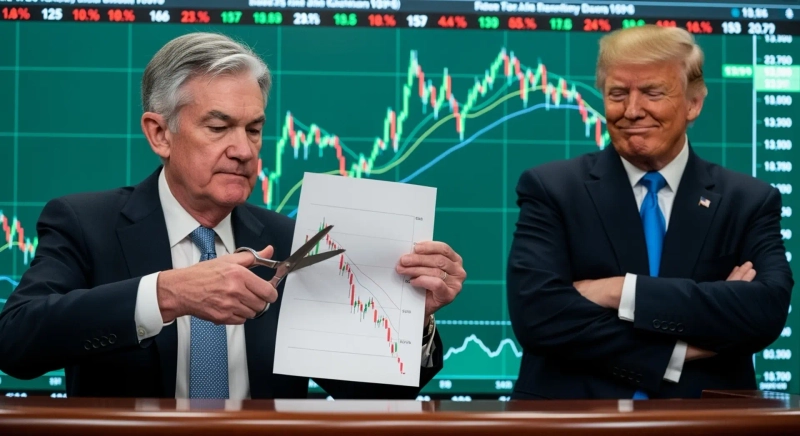
The U.S. central bank (Fed) on the 17th (local time) cut the benchmark interest rate by 0.25% percentage points, resuming a rate-cut cycle for the first time in nine months, drawing attention to how domestic equity investors will respond.
In particular, the background to this cut is deterioration in the labor market, and because it has the character of preparing for inflation increases that could be caused by President Donald Trump's tariff policies, analysts expect the effects to be divided into sectoral positives and negatives.
According to the financial investment industry on the 18th, the U.S. Fed announced through the Federal Open Market Committee (FOMC) meeting in the early hours that it had decided to lower the benchmark interest rate from 4.25∼4.50% to 4.00∼4.25%.
It lowered the rate for the first time in nine months after five consecutive pauses since cutting the benchmark rate by 0.25%p last December, marking the first rate cut under the Trump administration.
Federal Reserve Chair Jerome Powell explained the reason for the cut, saying, "As downside risks to employment have increased, the balance between (inflation risks and employment risks) has shifted," and "therefore we judged it appropriate at this meeting to take another step toward a more neutral policy stance."
Chair Powell described the current labor market situation as "labor supply is decreasing as much as due to changes in immigration" and said, "With almost no increase in labor supply and a sharp drop in labor demand, we are seeing what I previously called a 'curious balance.'" He added, "The focus of today's decision was the risks we are seeing in the labor market."
Powell also diagnosed that the Trump administration's tariff policies are expected to continue accumulating through the remainder of this year and next year, leaving the risk of inflation rising due to tariff effects.
He said, "Rising goods prices explain most of this year's inflation increase," and "at this point this is not a very large effect, but it is expected to accumulate through the remainder of this year and next year."
Typically, a cut in U.S. benchmark interest rates is seen as positive in that it brings liquidity to the stock market, but depending on the background of the cut it can have the opposite effect. In fact, the New York market closed mixed that day as concerns about the background were highlighted despite the rate cut.
Sungwoo Park, a researcher at DB Securities, analyzed, "The background to this cut is an insurance-type reduction to defend against economic risks arising from a worsening labor market," and "a notable feature is that committee members' views on the future direction of the benchmark rate diverged significantly."
He added, "To curb recession risks, there is a higher likelihood of focusing on the early part of the second rate-cut cycle, and an additional roughly 100bp (1bp=0.01% point) of rate cuts could proceed through the first half of next year," and "if so, existing demand for artificial intelligence (AI) investment could be supported on the downside."
With the U.S. Fed lowering the benchmark rate again, attention should be paid to the increased possibility that the Bank of Korea will cut rates next month. The interest rate gap with the U.S. (4.00∼4.25%) narrowed to 1.75%p, somewhat reducing concerns about won-dollar exchange rate rises and outflows of foreign investor funds.
Researcher Park said, "Although inflation uncertainty remains, I see room for further declines in market interest rates," and "also, with the resumption of a rate-cut cycle, limited dollar weakness could continue."
Recently, foreign investors in the domestic market have shown strong buying on expectations of the resumption of the rate-cut cycle, so this cut could once again spur investor sentiment.
Sanghyun Park, a researcher at iM Securities, evaluated, "The rate-cut decision at this meeting confirmed entry into a trend-like rate-cut cycle rather than a one-off, which is the result the financial market wanted," and "there is a greater possibility of an additional rally in asset prices centered on the stock market."
Therefore, there are many forecasts that interest in semiconductors, which have recently re-emerged as leading stocks in a bull market, will be highlighted again, as they have the highest correlation with global market flows. Over the recent ten days, foreign investors have scooped up 5.18 trillion won worth of the two stocks Samsung Electronics and SK Hynix.
Seongsun Park, a researcher at KB Securities, said, "As long as the global AI infrastructure investment cycle continues, the growth story centered on HBM and AI semiconductors remains valid," and "rate declines not only ease funding burdens but are also positive for sector valuation."
Noh Jeong-dong, Hankyung.com reporter dong2@hankyung.com

Korea Economic Daily
hankyung@bloomingbit.ioThe Korea Economic Daily Global is a digital media where latest news on Korean companies, industries, and financial markets.