

Lee "Make 'return to the domestic stock market' be called 'Ji-neung-sun'"
Summary
- President Lee reaffirmed his commitment to revitalize the domestic stock market, saying that amendments to the Commercial Act and a few additional measures would bring an end to structural unfairness improvements.
- A draft amendment to the Commercial Act that includes mandatory cancellation of treasury shares is scheduled to be pursued by the end of the year; he noted there are concerns it could have negative effects on corporate management rights and stock prices.
- The Democratic Party is also discussing amendments to the Capital Markets Act related to protecting minority shareholders, and it is expected that a mandatory tender offer system may be included.
Luncheon with heads of securities firms' research centers
"Amendment to the Commercial Act, if a few measures are added
structural unfairness improvement will be finished"
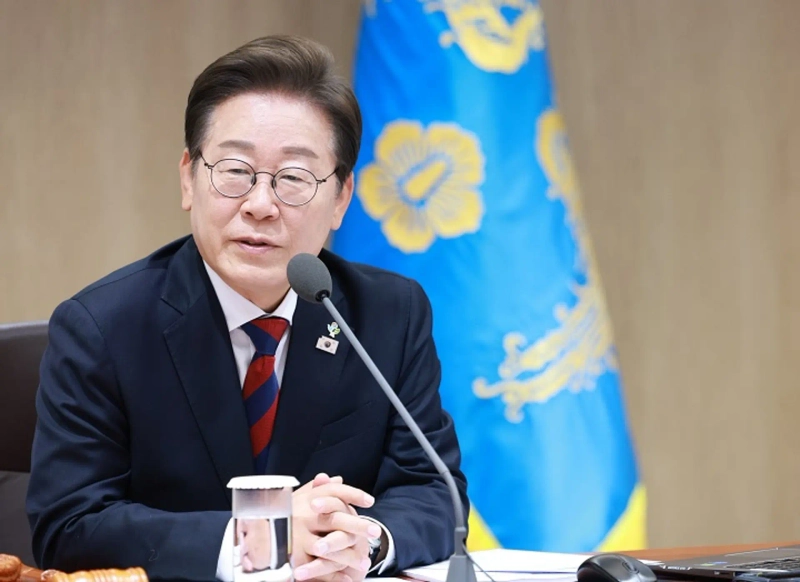
President Lee Jae-myung said on the 18th, "I think it is necessary to revitalize the stock market as an effective investment means for the people," and "Someone said that leaving the guk-jang (domestic stock market) is Ji-neung-sun, but I will make it so that a phrase emerges saying that returning to the guk-jang is Ji-neung-sun." The president had earlier put forward a KOSPI index of 5000 as an election pledge, and on the day again expressed his willingness to stimulate the stock market.
On the day, the president held a luncheon meeting at the Yongsan presidential office with 15 heads of securities firms' research centers and the president of the Korea Analysts Association, saying, "Having taken the baton of state affairs and the economy and actually worked, I increasingly think that normalizing the capital market, including the securities market, is important," and "A few core tasks are still valid."
Specifically, he hinted at the need for additional amendments to the Commercial Act. The president said, "One is a predictable and rational market environment, and there should be no unfair trading or opaque management," and "The other is the rationality of decision-making, and with the amendment to the Commercial Act that will be realized, and if only a few measures are added, I think improving structural unfairness will be all finished."
The Democratic Party's KOSPI5000 Special Committee plans to push a third amendment to the Commercial Act by the end of the year. This bill contains mandatory cancellation of treasury shares, and the business community is concerned that our companies' management rights could be threatened by foreign capital. There is also an argument that introducing mandatory cancellation of treasury shares could reduce companies' incentives to buy back treasury shares and thus negatively affect stock prices.
The president said, "We must eliminate stock price manipulation and unfair disclosure. Progress is considerable," and "I will change finance so it can turn toward the productive sector. Immediate results may not appear, but the direction is clear."
The Democratic Party's KOSPI5000 special committee discussed amendments to the Capital Markets Act being pursued separately from the Commercial Act amendment. The intent is to prepare measures to protect minority shareholders when companies carry out M&A, spinoffs, delisting, issuance of convertible bonds, etc. It is expected that the bill will include a mandatory tender offer system under which, when an acquirer purchases shares from the controlling shareholder, the remaining minority shareholders' shares would also be obligatorily tendered at the same price.
Reporters Kim Hyung-gyu / Choi Hae-ryeon khk@hankyung.com

Korea Economic Daily
hankyung@bloomingbit.ioThe Korea Economic Daily Global is a digital media where latest news on Korean companies, industries, and financial markets.