

"If I had agreed to the U.S. demand of US$350 billion, I would have been impeached"
Summary
- President Lee Jae-myung said he could not agree to the US$350 billion U.S.-bound investment fund because the U.S. demands were excessively strict.
- The United States insists on a structure in which it would take 90% of the profits and South Korea 10% after fund recovery, but the South Korean government has made its opposition clear.
- He reported that subsequent negotiations over the investment fund have not made progress due to differences between the two countries.
President Lee Jae-myung, interview with Time magazine
Repeatedly reiterated a tough stance on tariff negotiations
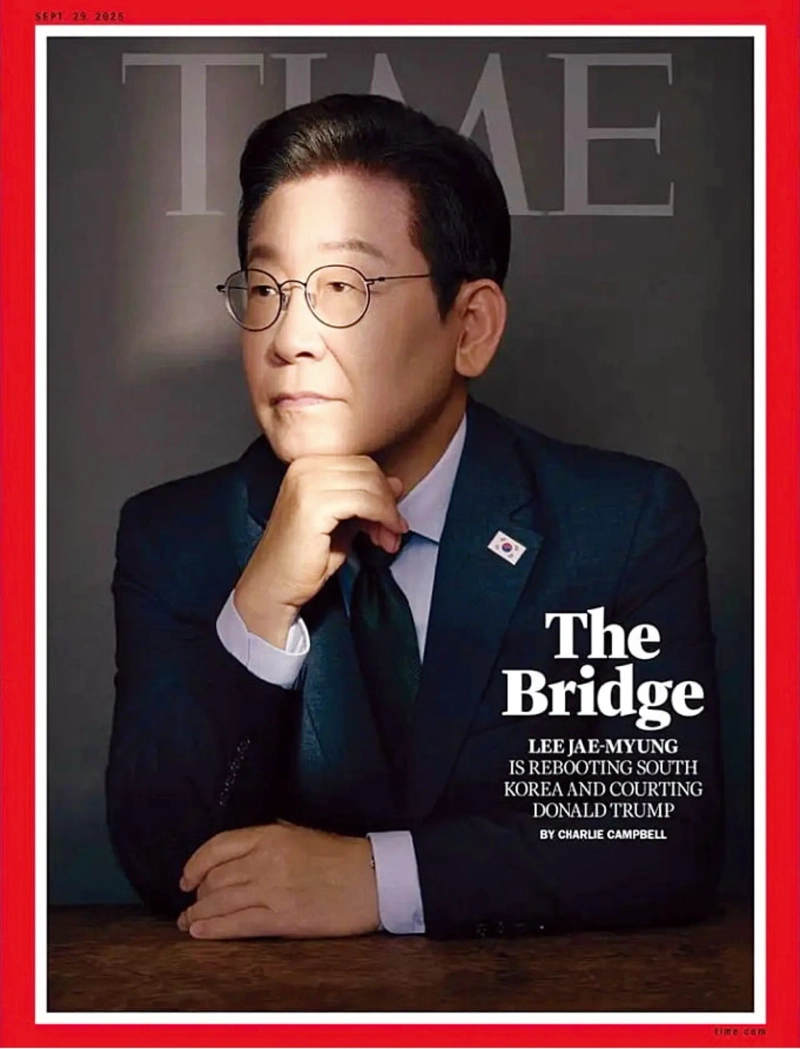
President Lee Jae-myung said of the US$350 billion U.S.-bound investment fund, "The U.S. demands were too strict," and added, "If I had agreed to them, I would have been impeached." As the nation's top official, he once again stated that he could not possibly accept the U.S. demands surrounding the U.S.-bound investment fund.
In an interview with the U.S. current affairs weekly Time released on the 18th, the president said, "I asked the U.S. negotiation team for reasonable alternatives." South Korea and the United States concluded tariff negotiations on July 30, but they have failed to narrow differences in subsequent negotiations over the US$350 billion investment fund. The United States insists on direct local investment, while our government maintains that most of the investment would be in the form of loans and guarantees — a "financial package." The president's interview took place at the Yongsan presidential office on the 3rd.
Regarding relations with the U.S. and China, the president said, "Our values of democracy and market economy are based on the South Korea-U.S. alliance," but added, "However, we cannot completely sever relations with China because we are geographically close and have historical ties, economic linkages, and people-to-people exchanges."
Lee: "We are with the U.S. but need to manage China as well…Western countries should understand"
"Korea risks being on the front line of U.S.-China confrontation"
At a press conference marking 100 days in office on the 11th, President Lee said regarding U.S. demands over the investment fund and related matters, "I will never make decisions that go against national interests." He described the U.S. demands as "rough, radical, excessive, irrational and unreasonable." The U.S. claims not only the lead over managing the US$350 billion investment fund but also a structure in which the United States would take 90% of the profits after fund recovery and South Korea would take the remaining 10%. Kim Yong-beom, the presidential office policy chief, said, "We can never sign such wording."
In the interview published on the 18th, the president emphasized that while the alliance with the U.S. forms a basis, relations with China should be managed smoothly, and said, "I hope the Western world will understand this point."
The president said, "We will be with the U.S. within a new world order and U.S.-centered supply chains, but we need to manage relations with China so as not to antagonize it." He added, "Otherwise, Korea risks being placed on the front line of the confrontation between the two blocs."
He also left open the possibility of negotiations to ease sanctions on North Korea to induce it into a denuclearization process. The president said, "If we continue the current pressure, North Korea will continue to produce more nuclear bombs." He went on, "I believe we can negotiate with North Korea to halt its nuclear and missile programs." His point was that a phased approach of "halt → reduction → denuclearization" is possible, rather than choosing between "tolerating North Korea's nuclear program" and "complete denuclearization."
The president said, "The short-term goal should be to halt North Korea's nuclear and missile programs. We can provide some compensation for North Korea's steps to stop nuclear development, and thereafter pursue disarmament and complete denuclearization."
He also mentioned the 1994 Geneva agreement in which North Korea agreed to freeze its nuclear program in exchange for the international community's provision of a light-water reactor and heavy fuel oil. The president said that negotiations to ease or lift sanctions could be possible on the premise of a phased denuclearization process, and added, "Donald Trump, the U.S. president, would probably hold a similar view." The Geneva agreement was nullified in 2003, shortly after the 2002 "second North Korean nuclear crisis."
Reporter Jaeyoung Han jyhan@hankyung.com

Korea Economic Daily
hankyung@bloomingbit.ioThe Korea Economic Daily Global is a digital media where latest news on Korean companies, industries, and financial markets.