

U.S.-China leaders' call leaves subtle awkwardness... Will it be resolved at the APEC meeting? [Lee Sang-eun's Washington Now]
Summary
- The U.S. and Chinese leaders agreed to meet at the APEC summit, and their call reportedly discussed major issues including trade, the TikTok deal, and semiconductor export controls.
- The U.S. acquisition of TikTok raised issues over algorithm management and intellectual property, and the deal was reported as not yet fully finalized.
- There was no clear agreement reached on key technology areas such as semiconductor export controls, and experts assessed that major issues are unlikely to be resolved in the near term.
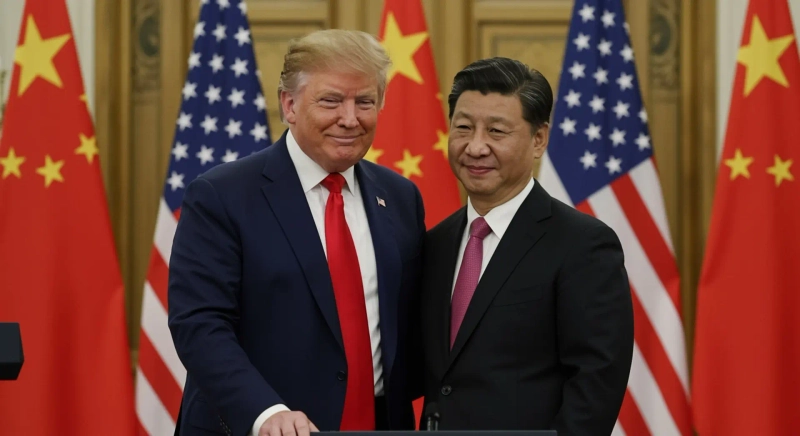
U.S. President Donald Trump said he and Chinese President Xi Jinping have agreed to meet at the Asia-Pacific Economic Cooperation (APEC) summit, which will be held in Gyeongju at the end of next month.
President Trump wrote on Truth Social after speaking with President Xi at 8 a.m. on the 19th (U.S. Eastern Time) that "I just had a very productive call with President Xi Jinping," and that "we made progress on several important issues including trade, fentanyl, the need to end the Russia-Ukraine war, and approval of the TikTok deal."
President Trump also said "we agreed to meet at the APEC summit in South Korea," adding "I said I would go to China early next year, and President Xi said he would visit the United States at an appropriate time." He continued, "the call was very good and we will speak again," adding "I appreciate the approval of the TikTok (U.S. acquisition) and look forward to meeting at APEC." If the two meet at APEC, it would be a reunion after six years since the G20 meeting in Osaka, Japan in June 2019.
Although President Trump described the leaders' call very positively, the lack of detailed disclosure about the call's content raises the possibility that there may have been differences between the U.S. and China. The Chinese Foreign Ministry, commenting on the call, said President Xi told President Trump that "he proposes providing Chinese companies with a fair business environment." It emphasized avoiding trade control measures (such as semiconductor export restrictions) and not reversing progress made in previous trade-related meetings between the two countries.
Scott Kennedy, head of the China Business and Economics Program at the Center for Strategic and International Studies (CSIS), told Reuters in this regard that "China seems to be aware of the possibility of new export controls or other types of measures," and evaluated that "what they are saying is that if the U.S. imposes such measures, everything negotiated so far could disappear, and President Xi drew a clear line."
◆Possible 'different expectations' over the TikTok deal
The tone was particularly different regarding the TikTok deal. The Chinese Foreign Ministry did not use the word 'approved' for the U.S. acquisition of TikTok, and said President Xi told President Trump that "we respect the wishes of TikTok-related companies and hope those companies will find solutions to the issues." This suggests that, contrary to President Trump's implication, the deal is not yet fully confirmed.
Earlier, foreign outlets such as Bloomberg and the Financial Times (FT) reported that investors including Oracle, Andreessen Horowitz (venture capital), and Silver Lake Management (private equity) would invest in a fund to acquire TikTok in the U.S., which is operated by China's ByteDance. ByteDance's future stake is expected to fall below 20%. Existing ByteDance investors Susquehanna International Group (SIG) and General Atlantic are also expected to participate in this fund. Oracle is currently the company that stores TikTok's U.S. user data and plans to maintain a cloud partnership after ownership changes.
The contentious parts are national security and the algorithm. Earlier, the FT reported that the Chinese side described the deal as "exporting China's intellectual property (IP)," and that the Chinese government portrays the deal as one concerning "algorithm licensing." ByteDance said it developed separate algorithms and systems for U.S. users. In this regard, President Trump said "it will be entirely owned by American investors" and that "companies that love the United States" will buy it. However, he did not properly answer questions about the app's algorithm.
TikTok became the focal point of U.S.-China tensions because, unlike ordinary apps, there are suspicions that it contains elements that threaten national security. The U.S. Congress passed a bill last year saying there are national security concerns arising from TikTok's platform algorithm and intended to restrict its use. This law, enacted in bipartisan agreement in April last year, required TikTok's parent company ByteDance to sell its stake in TikTok by January, otherwise it would be expelled from the U.S. In January, the law took effect and there was a momentary suspension of TikTok use. However, President Trump repeatedly signed executive orders extending the deadline so that the app "beloved by young people" could remain, allowing the app to continue to be used without significant regulation. It is a case of the president effectively neutralizing a law passed by Congress.
◆NVIDIA chips still a hot potato
One of the core axes of the U.S.-China trade conflict is semiconductor export controls. Regarding NVIDIA's access to the Chinese market, President Trump showed a conciliatory stance while also indicating he would take a portion of sales as a toll (15%), showing a complex posture. China has continuously voiced complaints about U.S. semiconductor export controls. On this matter, the two countries did not mention any particular progress that day. This shows that the issue remains a hot potato and cannot be resolved by a single phone call.
William Yang, senior Northeast Asia analyst at the International Crisis Group (ICG), told Reuters that "Xi's remarks suggest that China wants the U.S. to further ease existing export controls before agreeing on more specific implementation measures that could lead to a final trade agreement," and explained that "in particular, China hopes controls on advanced semiconductor chips will be relaxed."
When the two leaders meet at the APEC summit in Gyeongju, scheduled from late October to early November, various issues including TikTok are expected to be raised. However, experts predict that it is unlikely that the main causes of tension between the two countries will be resolved all at once at that meeting.
Neo Wang, chief China macroeconomist at Evercore ISI in New York, told Bloomberg that "it seems difficult to produce a large-scale agreement in the near term." He added, however, that "focused discussions on the TikTok issue could signal the possibility of resolving other differences in future negotiations."
Kennedy of CSIS said, "Neither side's statements mentioned elements that had reached agreement in negotiations," adding "it could be that final corporate approvals are still needed for the agreed content, that parts of the negotiation are incomplete, or that they intend to withhold announcements until there is more progress across all areas."
Bonnie Glaser, head of the Indo-Pacific Program at the German Marshall Fund, told Reuters that "it's interesting that President Xi did not mention Taiwan," and diagnosed that "China's concerns about U.S. Taiwan policy may have lessened due to the Trump administration's actions such as delaying approval of an arms package to Taiwan, denying President Lai Ching-te's transit through New York, and downgrading the U.S.-Taiwan defense policy talks."
Washington = correspondent Lee Sang-eun selee@hankyung.com

Korea Economic Daily
hankyung@bloomingbit.ioThe Korea Economic Daily Global is a digital media where latest news on Korean companies, industries, and financial markets.