

PiCK
Kim Seo-joon "K-Digital Citizenship Will Connect Korea and the World" [Eastpoint: Seoul 2025]
Summary
- Kim Seo-joon, CEO of Hashed, emphasized implementing a new digital citizenship experience by combining infrastructure such as digital IDs and wallets with privacy-guaranteeing technologies.
- He said it could become a national strategy to spread a digital citizenship model worldwide based on Korea's unique cultural assets such as K-pop fandom.
- He stated that by combining assets and privacy technologies such as stablecoins and zero-knowledge proofs (ZKP) on top of a digital ID foundation, it would provide an experience for both foreigners and citizens to access the digital nation.
"Korea stands at a golden time to spread a digital citizenship model to the world, based on unique cultural assets like K-pop fandom. By combining privacy-guaranteeing technologies with an infrastructure centered on digital IDs and wallets, we must implement a new digital national experience that both citizens and foreigners can access."
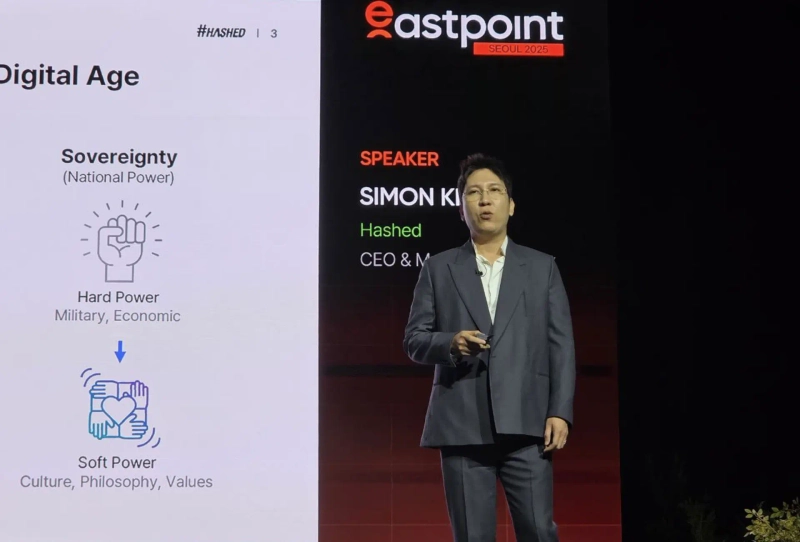
On the 22nd, Kim Seo-joon, CEO of Hashed, emphasized this at the global Web3 private conference 'Eastpoint: Seoul 2025' held at the Grand Hyatt Seoul in Yongsan-gu, Seoul. The event was co-hosted by global blockchain venture capital firm Hashed, blockchain media BloomingBit under the Hankyung Media Group, the Korea Economic Daily, and World Liberty Financial (WLFI), a virtual asset investment firm founded by the family of President Trump. The event brought together key figures in blockchain, finance, and policy to discuss the direction of the global digital asset industry.
Kim stressed that the concept of the nation is fundamentally changing. He said, "The nation as we have known it was defined around territory and blood ties, but it is now expanding into a new community that shares networks and values," adding, "Physical territory is extending into digital space, and the concept of citizenry is evolving from a single identity to multiple digital identities. Nationality is in the process of shifting from ownership to a protocol basis, and digital citizenship will evolve based on contribution rather than coercion."
He continued, "The 'network state' presented by Balaji Srinivasan refers to a process in which communities that share value and mission online secure economic autonomy and social contracts and ultimately gain diplomatic recognition," noting, "In practice, future city projects that combine virtual assets (cryptocurrency) and longevity industries are being pursued in places like Montenegro, Croatia, and Siberia, and experiments in crypto-friendly cities or the 'Liberland' case, which secured 70,000 online citizens, are representative."
Kim emphasized that Korea has a unique foundation to experiment with digital citizenship. He said, "K-pop fandom has already formed a massive network community that shares values, connecting hundreds of millions to digital communities," adding, "Their annual consumption reaches trillions of won. This is a powerful cultural asset that can realize a digital citizenship model in Korea and expand it globally."
He also mentioned the need to remove barriers for foreigners alongside overseas examples. In fact, Estonia has seen over 100,000 participants obtain e-residency and establish more than 20,000 companies, Abu Dhabi built a foreigner-friendly environment with a platform integrating administration, civil affairs, and corporate services, and Singapore's 'SingPass' has also taken root as a digital citizen platform. Kim said, "Korea is a digital powerhouse, but there are still high barriers for foreigners. Payment inconveniences, language issues at public institutions, and loneliness and social disconnection among foreign residents are typical examples," adding, "A platform is needed to solve these problems and realize the values of openness, innovation, and connection."
He presented a concrete vision for K-Digital Citizenship. Kim said, "K-Digital Citizenship should be designed around four pillars: △digital IDs and wallets △smart mobility and tourism support △digitalization of real estate contracts △culture and wellness-linked services." He added, "Pilot programs can start centered on K-pop culture fandom. If expanded to the entire population including nationals and developed into a digital transformation governance platform, K-Digital Citizenship could become a national strategy that can be exported globally." He emphasized, "Ultimately, digital citizenship is not just a form of citizenship but a technology project and a new social contract, and if Korea leads it, it can create a fateful opportunity to connect with the world for the next 100 years."
Alongside this, he offered a technical blueprint. Kim said, "On the basis of digital IDs, an asset layer such as stablecoins will be overlaid, and privacy-guaranteeing AI agents and third-party programs utilizing zero-knowledge proofs (ZKP) will be built on top," explaining, "Through this, citizens, tourists, and foreign residents will all gain the experience of accessing a digital nation." He added, "The philosophy blockchain must uphold is privacy and a seamless experience," noting, "Sensitive data should be securely protected while usability should be simplified to Web2 levels."

Minseung Kang
minriver@bloomingbit.ioBlockchain journalist | Writer of Trade Now & Altcoin Now, must-read content for investors.