

Korean-won stablecoin: Issuing entity and institutional challenges?…"Demand can expand through policy and K-culture" [Eastpoint Seoul 2025]
Summary
- Panelists said it is not desirable to limit issuers of Korean-won stablecoins to banks only.
- They stated that excessive regulation and the seigniorage controversy over stablecoins need reconsideration, and that seigniorage under private operation is limited.
- Panelists projected that demand for Korean-won stablecoins could expand based on K-culture and policy will.
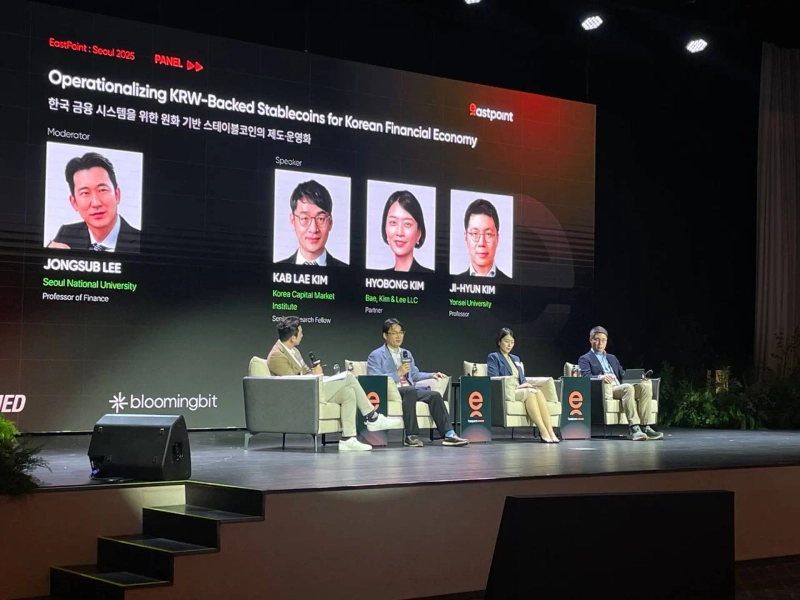
On the 22nd at the Grand Hyatt Seoul in Yongsan-gu, Seoul, the global Web3 private conference 'Eastpoint 2025' held a panel discussion on "Institutionalization and operation of Korean-won-based stablecoins for the Korean financial system." The panel discussion was moderated by Professor Lee Jong-seop of Seoul National University Business School, and included Senior Research Fellow Kim Gap-rae of the Korea Capital Market Institute, Attorney Kim Hyo-bong of Taepyeongyang Law Firm, and Professor Kim Ji-hyun of Yonsei University Business School.
"Korean-won stablecoin issuers: banks alone have limits"
Panelists agreed that limiting stablecoin issuers to banks alone is not desirable.
Professor Kim Ji-hyun said, "If the banking sector has exclusive issuance opportunities, a winner-takes-all phenomenon could occur based on the platform economy's network effects and existing payment systems," and added, "It is necessary to ensure issuance opportunities fairly from a regulatory perspective."
Attorney Kim Hyo-bong also said, "Banks have strengths in anti-money laundering (AML) in traditional finance, but on blockchains there are unique risks such as transactions between personal wallets and secondary circulation," and questioned, "Whether banks have sufficient blockchain-based AML experience is still unclear."
"Stablecoins: excessive regulation and seigniorage concerns need reconsideration"
The panel also argued that the seigniorage controversy raised when issuing stablecoins is weakly grounded. Research Fellow Kim Gap-rae explained, "Issuing stablecoins does not produce seigniorage like a central bank does," adding, "With a 1:1 reserve asset condition there is no minting profit for private issuers." He added, "Private-operation seigniorage is only at the level of prepaid electronic payment operators or voucher issuers, and exaggerating this is wrong." Seigniorage refers to the profit arising from the difference between a currency's face value and its issuance cost.
He also said, "Stablecoin bank-run risk is different from that of banks," and "Even if large-scale withdrawals occur, because reserve assets are secured it would only result in short-term discounts (according to market principles) rather than systemic crises like banks." Kim emphasized, "The Bank of Korea must present specific risk paths and prepare countermeasures," and added, "Repeating only abstract concerns is a problem."
Attorney Kim Hyo-bong stressed, "The digital asset market is not closed," and warned, "Unconditional regulation could rather cause loss of business opportunities." He added, "If only domestic issuers are regulated, overseas issuers could bypass Korean regulation," and suggested, "A method that opens doors to high-credit overseas institutions, like in Singapore, is needed."
"Korean-won stablecoin demand can be created by K-culture and policy will"
There was also a view that demand for Korean-won stablecoins could expand based on policy will and the K-culture industry.
Attorney Kim Hyo-bong said, "Demand for Korean-won stablecoins could increase depending on the will of policy authorities," and added, "Demand can also be formed based on manufacturing and K-culture." He emphasized, "In an era when AI agents perform payments, a system where the won can be expressed as code must be established."
Professor Kim Ji-hyun cited the example of foreign students paying tuition, saying, "In over 20,000 overseas remittances annually, inefficiencies from exchange rate fluctuations and delays are significant," and added, "If Korean-won stablecoins are incorporated into the regulatory framework, such problems can be solved and new business opportunities can be created."

Minseung Kang
minriver@bloomingbit.ioBlockchain journalist | Writer of Trade Now & Altcoin Now, must-read content for investors.