

Kim Jong Un "Good memories with Trump"…Will the 'surprise Panmunjom meeting' be reenacted?
Summary
- Kim Jong Un signaled the possibility of negotiations with former U.S. President Trump, raising the prospect that a U.S.-North Korea summit could be realized.
- Kim Jong Un set the abolition of denuclearization demands as a condition for dialogue, so the actual realization of U.S.-North Korea talks remains uncertain.
- Experts assessed that Kim Jong Un's stance could place a political burden on the U.S. while affecting international tensions and the investment environment.
Mention of U.S.-North Korea talks at the Supreme People's Assembly
"If they give up demands for denuclearization, there's no reason we can't meet"
Possible meeting linked to Trump's visit to Korea
To South Korea: "We won't engage…why unify?"
Presidential Office: "Resolve hostility with a long-term perspective"
Kim Jong Un, chairman of North Korea's State Affairs Commission, signaled a forward-leaning stance toward negotiations with the United States on the 22nd, saying he "has good memories with U.S. President Donald Trump." Since President Trump is scheduled to visit Korea around next month’s Asia-Pacific Economic Cooperation (APEC) summit in Gyeongju, Gyeongsangbuk-do, the possibility of a 'surprise U.S.-North Korea summit' has been raised. However, Kim Jong Un set the abolition of demands for denuclearization as a condition for dialogue, so analysts say resuming U.S.-North Korea talks may not be as easy as expected.
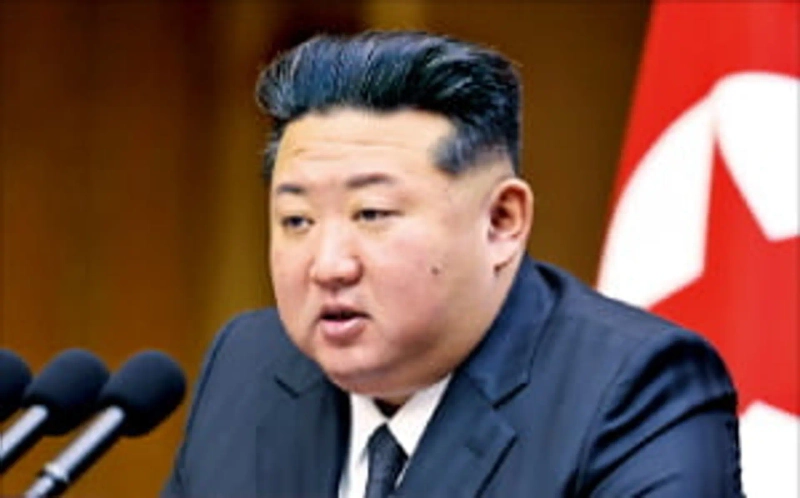
According to the Korean Central News Agency (KCNA) that day, Kim Jong Un said in a speech at the 13th session of the 14th Supreme People's Assembly held at the Mansudae Assembly Hall in Pyongyang the previous day that "if the U.S. sheds its unrealistic obsession with denuclearization and, based on accepting reality, genuinely desires peace and coexistence with us (North Korea), there is no reason we cannot stand face to face with the United States." The Supreme People's Assembly is an institution similar in role to South Korea's regular National Assembly.
This is the first time Kim Jong Un has expressed a positive stance on holding a summit with a U.S. president since the start of Trump's second-term administration. President Trump has continued to hope for meetings with Kim Jong Un, framing it as a justification to establish a permanent peace regime on the Korean Peninsula, which remains under an armistice, while at the same time designating North Korea as a 'nuclear power (nuclear power).' At the Korea-U.S. summit held in Washington, D.C. on the 25th of last month, he said, "I want to meet Kim Jong Un this year."
Kim Jong Un reiterated the legitimacy of possessing nuclear weapons and set the end of demands for denuclearization as a condition for U.S.-North Korea dialogue. He said, "There can absolutely be no denuclearization for us," and "possessing nuclear weapons is a matter of national law, and there is a legal duty to defend that." Experts evaluated that Kim Jong Un, having recently solidified a 'tripartite solidarity' with China and Russia, clearly declared a diplomatic line of nuclear possession to the international community. Chinese President Xi Jinping is also expected to visit North Korea for the 80th anniversary of the founding of the Workers' Party of Korea to be held next month. Kim Jong Un is expected to assert the legitimacy of North Korea's nuclear possession at that event as well.
By emphasizing the legitimacy of possessing nuclear weapons, Kim Jong Un inevitably complicates the U.S. position. While President Trump and Peter Hegseth, U.S. officials, have characterized North Korea as a nuclear power, some U.S. officials such as Elbridge Colby, deputy assistant secretary of defense for policy, judge North Korean denuclearization to be unrealistic.
Jeong Seong-jang, deputy director of the Sejong Institute, said, "Kim Jong Un strongly signaled that he would meet President Trump if Trump proposed meeting in Korea on the occasion of the APEC summit," but added, "Because opinions within the U.S. are divided over North Korean denuclearization, he has simultaneously shifted a political burden onto President Trump."
Kim Jong Un also emphasized the legitimacy of the 'two antagonistic states' theory by saying to South Korea, "We absolutely do not need unification." He said, "We will not sit face to face with South Korea and will share nothing with them." However, an official from the Ministry of Unification said, "North Korea has not itself confirmed that it has finalized the two-state theory through constitutional amendment," and "the mood from this speech was that nothing has been decided." The Presidential Office said, "The government will, with a long-term perspective, pursue easing tensions and restoring trust to resolve hostility between the South and the North and promote development into peaceful relations."
Bae Seong-su/Lee Hyun-il reporters baebae@hankyung.com

Korea Economic Daily
hankyung@bloomingbit.ioThe Korea Economic Daily Global is a digital media where latest news on Korean companies, industries, and financial markets.