

"There is a possibility of one rate cut this year"…Monetary Policy Board forecasts 'major decision' [Kang Jin-kyu's BOK Watch]
Summary
- Monetary Policy Board member Hwang Geon-il agreed on the possibility of a rate cut this year, but said he is cautious about the timing decision.
- He suggested that a rate hold is more appropriate to ease financial instability and said the increase in household debt needs ongoing management.
- He expressed a cautious stance on the introduction of won stablecoins, emphasizing concerns about foreign currency outflows and shocks to financial stability.
Hwang Geon-il, Monetary Policy Board member
"One rate cut this year…whether it will be October is uncertain"
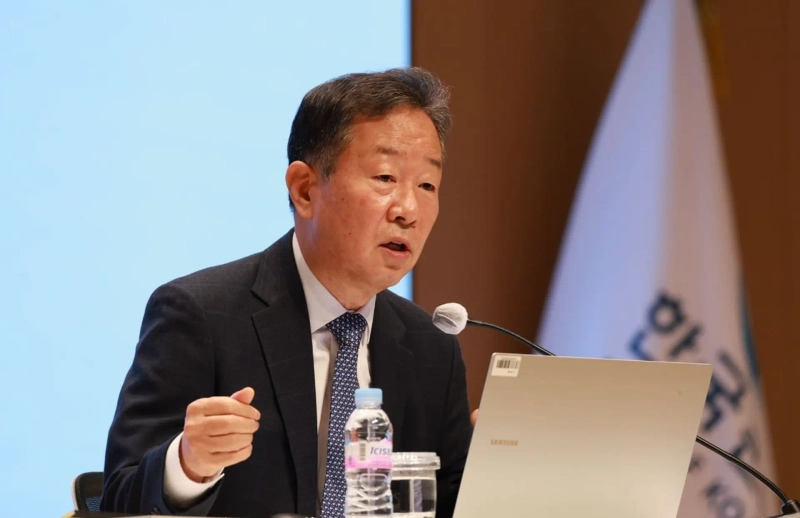
Hwang Geon-il, a Monetary Policy Board member who participates in decisions on the base interest rate, said at a rate decision that "he is focusing on financial stability." He indicated that a rate hold to calm financial instability is more necessary than a rate cut to prevent an economic slowdown. He agreed on the possibility of one rate cut this year but said, "Whether it will be October is something to consider."
"If deciding the rate now, focus on 'financial stability'"
On the morning of the 23rd, Hwang held a press briefing at the Bank of Korea annex auditorium on Namdaemun-ro in Seoul and stated this. Regarding the recent economic situation surrounding monetary policy, Hwang said, "The economy and financial stability are in conflict," and added, "If I had to decide now, personally I would like to put a little more focus on financial stability."
Hwang described the economic situation as "consumption and exports are less bad than expected." The problem is the construction sector. Hwang said, "The construction downturn is more severe than expected," and noted, "We need to confirm whether it has worsened further."
On financial stability, he said, "Household loans are increasing somewhat in September as well," adding, "Since household loans have exceeded the level where an asset effect appears, it is necessary to reduce household debt." Hwang said, "It may be possible to manage the household debt growth rate within the potential growth rate," while noting, "The June 27 measures and the September 7 measures are producing meaningful effects, but we need to watch the trends more to see whether housing price expectations in some regions spread to other regions."
Hwang predicted that next month's Monetary Policy Board meeting would be one of the most difficult. He said, "I think we should cut rates at least once this year as the market expects, but it is a situation where I am wondering whether it will be next month or November."
"Won stablecoins make foreign currency outflows easier"
There were many questions at the briefing about the foreign exchange market and exchange rates, related to international finance. This is because Hwang is an international finance expert who served as International Economic Management Officer (vice minister-level) at the Ministry of Economy and Finance.
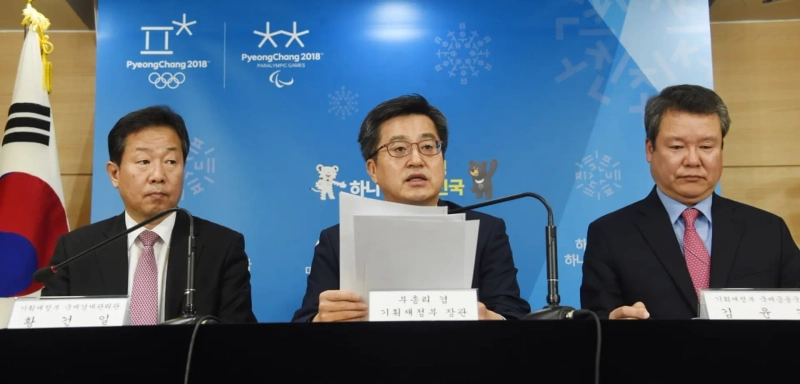
Regarding negotiations on a currency swap with the United States, Hwang was reserved, saying it is "more in the realm of politics than economics." However, he said, "It is true that concluding a currency swap is good for psychological stability," and added, "I cannot say how negotiation strategies will be handled, but the more currency swaps are concluded, the better." On foreign exchange reserves, he explained, "The more, the more it acts as a safety net," while noting, "In the process of expanding them, the exchange rate may rise, so various factors must be considered."
On the won-dollar exchange rate that has surpassed 1,400 won, he pointed to supply and demand factors. He explained, "Although many foreigners have entered due to the stock market rising, residents' overseas securities investment far exceeds that." However, he added, "Volatility is more important than the exchange rate level," and said, "Volatility has decreased compared to April–May."
On the debate over introducing won stablecoins, Hwang said it is "an issue to consider from the perspective of foreign exchange regulation." He said, "Korea has a regulatory framework for foreign exchange management that is stricter than other countries," and expressed concern that "if won stablecoins are allowed, foreign currency could be easily sent overseas, and it would become difficult to identify the scale and counterparties of outflows." However, he added, "He is not fundamentally opposed to the issuance of won stablecoins," and said, "They should be pursued step by step in a way that does not cause shocks to financial stability."
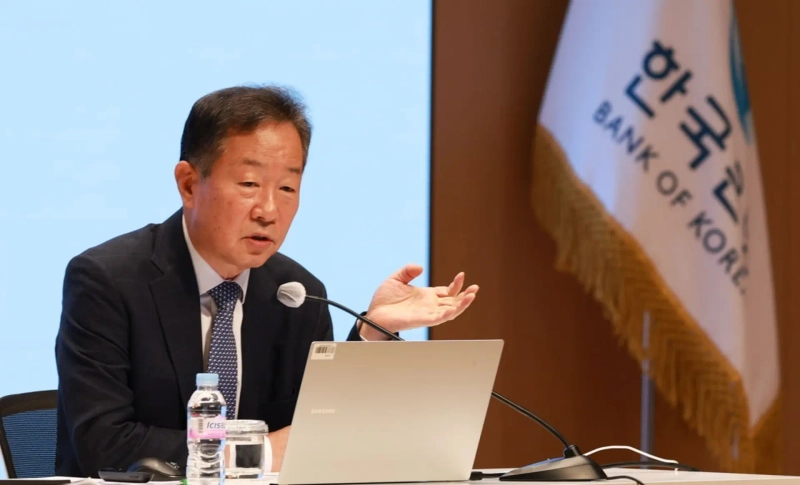
Hwang emphasized that the Bank of Korea should voice more on structural reforms. He said, "There are areas that are difficult for the government to address, such as care services or agricultural imports," and added, "There is no other place to propose policies besides the Bank of Korea." Among structural reform items, he emphasized the need for "fiscal reform." Hwang said, "Among mandatory expenditures such as public pensions, the local allocation tax, and local education grants, there are many cases where reform is needed to fit the changed times."
Kang Jin-kyu, reporter josep@hankyung.com

Korea Economic Daily
hankyung@bloomingbit.ioThe Korea Economic Daily Global is a digital media where latest news on Korean companies, industries, and financial markets.