

Director Maggie Kang "You have to gain the support of core audiences to be loved by everyone"
Summary
- Director Maggie Kang said securing the support of the core audience is an important strategy for overall box-office success.
- K-pop Demon Hunters achieved success, recording record view counts in the OTT industry.
- Kang emphasized the value of storytelling and the importance of audience-expansion strategies through SNS.
Zoom In - Maggie Kang, director of 'Kedehun', attending Origin Summit 2025
Discussion on intellectual property in the AI era
"The core of entertainment companies is storytelling
Without a plot, flashy decoration is meaningless"
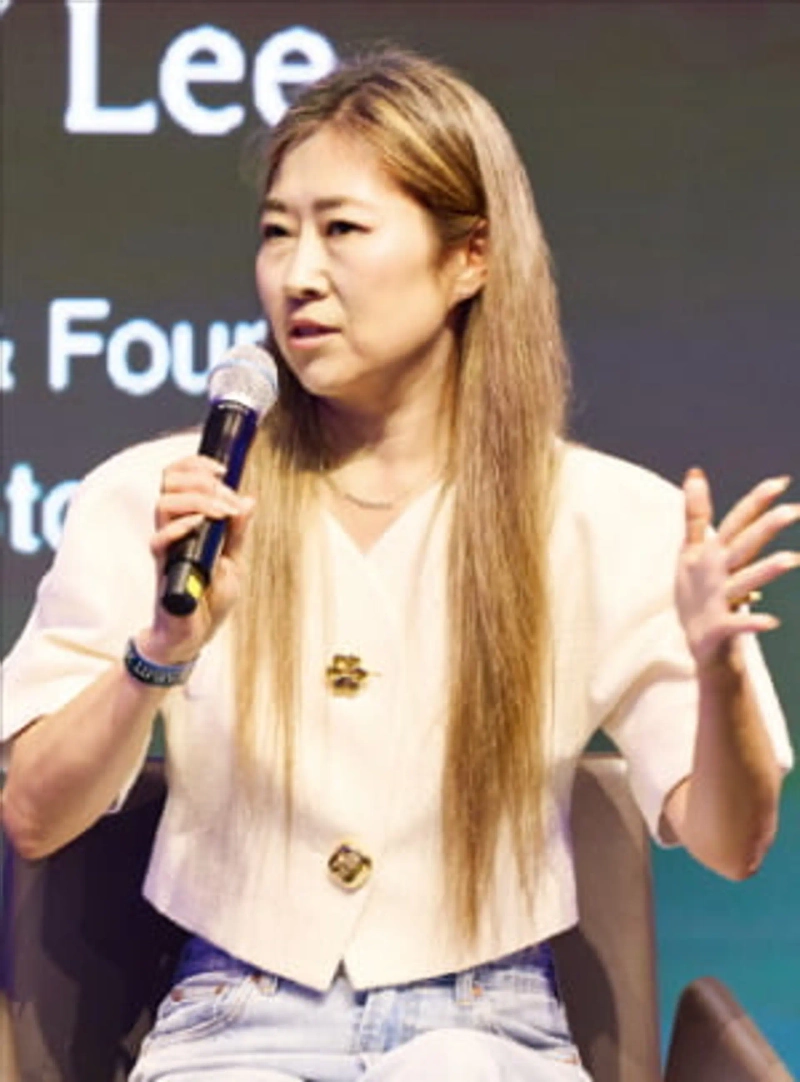
"If you try to appeal to everyone you may end up losing everyone. I chose to target a small audience, gain recognition, and then rely on word of mouth."
Maggie Kang, director of the animation "K-pop Demon Hunters" (Kedehun), said this at the 'Origin Summit 2025' event held on the 22nd in Seongdong District, Seoul. The Origin Summit was an event hosted by Story and Blockworks, information technology (IT) companies seeking to build blockchain infrastructure that can be used for intellectual property (IP). In a discussion with Lee Seung-yoon, CEO of Story, on the global spread of IP, Kang revealed Kedehun's success strategy and the secrets behind its success.
Kedehun is the most successful content in the history of the over-the-top (OTT) industry. The animation ranked first worldwide by view count on Netflix's weekly movie chart for the period of the 8th to the 14th. Despite being released on June 20 this year, it remains popular nearly three months later. Cumulative view count was 314.2 million as of the 14th, surpassing the previous record held by "Squid Game" Season 1 (265.2 million). This was an outcome Kang could not have imagined when she began planning Kedehun in 2018.
When Kedehun was revealed, the title combining K-pop and demon hunters initially presented a barrier to audiences. Kang said, "I agonized over it, but I used this name from the planning stage." She explained, "For people unfamiliar with K-pop, it could provoke an extreme reaction or be ignored," but added, "I believed that if any concept failed to win the love and support of its core audience, it would ultimately lose all audiences." She said she was confident that "K-pop fans would be able to accept this film."
Behind the strategy of securing K-pop fans lay Kang's experience with fans. "I once attended a BTS concert in Los Angeles. The arena held about 50,000 people, but Asians seemed to make up only around 10%. Everyone in the audience knew the lyrics and sang along. Seeing that energy, I thought the trend of K-pop would continue to rise. I was convinced that this film could capture K-pop fans. Even if the audience didn't broaden beyond that, I felt it would still be meaningful." Kang herself was a fan of first-generation K-pop artists such as H.O.T. and Seo Taiji and Boys when she was young.
She did not simply rely on K-pop fans' interest. "After developing the idea for about six years, it was hard to predict whether the concept would still be valid when it was finally released," she said. Kang focused on SNS as a channel for success, similar to how BTS gained popularity by communicating with fans on social media. She said, "It was important to target the age group most active on SNS, ages 12 to 25," and explained, "The posts they uploaded helped the film create a large ripple effect."
Inserting shamanistic elements such as dokkaebi and shamans into the animation was not intended from the start. These elements were naturally introduced in the process of unfolding the K-pop concept. Kang said, "(The elements attached to K-pop) naturally felt like they should be based on shamanism," and explained, "Shamanism exists in most cultures, so it was something everyone could understand." She said her father, who was deeply into movies, had a great influence on her becoming an animation director. Watching films at age 12 developed her ability to view the world through characters.
Kang closed the discussion by emphasizing the importance of storytelling. "The most important thing for entertainment companies is story. People want to empathize with something and feel a sense of continuity. Those are the things a story can do. Without a plot, no matter how artistic or flashy the decoration is, it is useless."
Reporter Lee Joo-hyun deep@hankyung.com

Son Min
sonmin@bloomingbit.ioHello I’m Son Min, a journalist at BloomingBit