

"K-pop fandom directly creating content… Korea to leap forward as a global IP hub"
Summary
- Experts said IP tokenization and blockchain technology could solve structural problems in the content industry, such as protecting creators' rights and fair revenue distribution.
- Korea is evaluated as an IP-, AI-, and crypto-native country, and they noted that K-content's high scalability and tech-friendliness give it an advantage in seizing the global IP ecosystem.
- Content IP is expected to be a core pillar for activating won-denominated stablecoins, and the legal status and use cases of stablecoins were actively discussed.
Global IP·Blockchain Conference
Star-level figures from 20 countries
"Korea's IP needs new production and distribution rules"
K-pop and other content have large scalability
But distribution depends on global platforms
Creators' rights are not being properly protected
"If creators are supported by tokenizing IP,
rights protection and fair revenue distribution are possible
Blockchain is a technology that can solve IP monopolies"
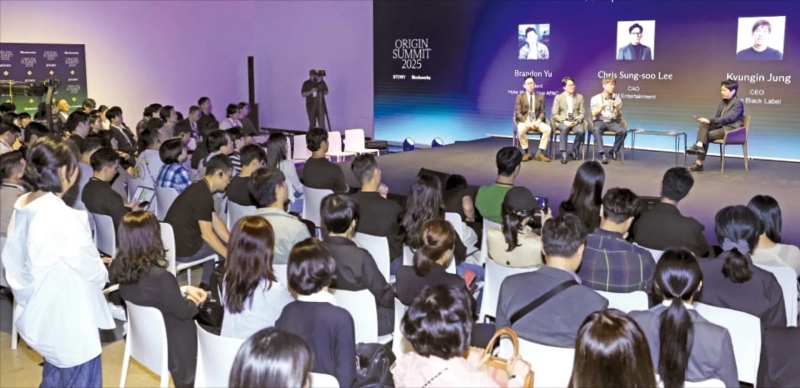
"It's a shame to confine K-pop to just the music business. It's important to expand into larger businesses like film, performances, and branding. We're applying various technologies to do that." (Yoo Dong-ju, Head of APAC at HYBE Music Group)
"With the development of artificial intelligence (AI), works like Studio Ghibli animations and 'Squid Game' can be produced in just a few months. We need new rules for discovering and utilizing intellectual property (IP)." (Lee Seung-yoon, CEO of Story)
◇"Korea is IP-crypto native"
On the 23rd at Anderson C in Seongsu-dong, Seoul, the global IP conference 'Origin Summit 2025' brought together star figures from the content, blockchain, and AI industries from 20 countries. Participants included Lee Seung-gyu, co-founder of The Pinkfong Company and creator of 'Baby Shark', Justin Sun, founder of TRON, Arthur Hayes, co-founder of BitMEX, and Luca Netz, founder of Fuzzy Penguin. Experts at the event agreed that, having proven the global competitiveness of Korean IP through the success of Netflix's animation 'K-pop Demon Hunters' (Kedeheon), a new production and distribution ecosystem is needed.
Jung Kyung-in, CEO of The Black Label, which handled most of the music for K-pop Demon Hunters, predicted, "In a few years, Korea will become a global content hub." He said, "K-pop fandoms are digital natives and, beyond being prosumers, actively participate in content creation." Lee Sung-soo, Chief A&R Officer (CAO) of SM Entertainment, said, "SM Entertainment advanced its content with technological development, introducing a paid fan club system and building a communication platform with fans," and added, "Recently, we are paying attention to AI and web3 developments and preparing ways to apply them." Yoo Dong-ju said, "We are combining a multi-label system, fandom platforms, and advanced technologies to try various approaches."
However, some raised concerns that relying on distribution through global platforms like Netflix prevents IP creators from properly protecting their rights. They pointed out that due to the illiquid nature of IP assets, monopolistic investments from giant platforms like Netflix are inevitable. Lee Seung-yoon said, "If an ecosystem can be built to support creators by tokenizing IP, creators' rights can be protected while fair revenue distribution becomes possible," adding, "Blockchain technology can solve the issue of IP monopolies that favor large platforms."
Lee analyzed that Korea is optimally positioned to build a new content IP ecosystem using blockchain. He cited Korea as an "IP, AI, crypto-native country." Kim Seojun, CEO of Hashed, said, "As can be seen in fandom platforms, K-content is very tech-friendly," adding, "It will integrate well with blockchain."
◇A new IP ecosystem suited to AI is coming
According to Story, the global content IP asset size across art, brands, science, and other areas totals $80 trillion.
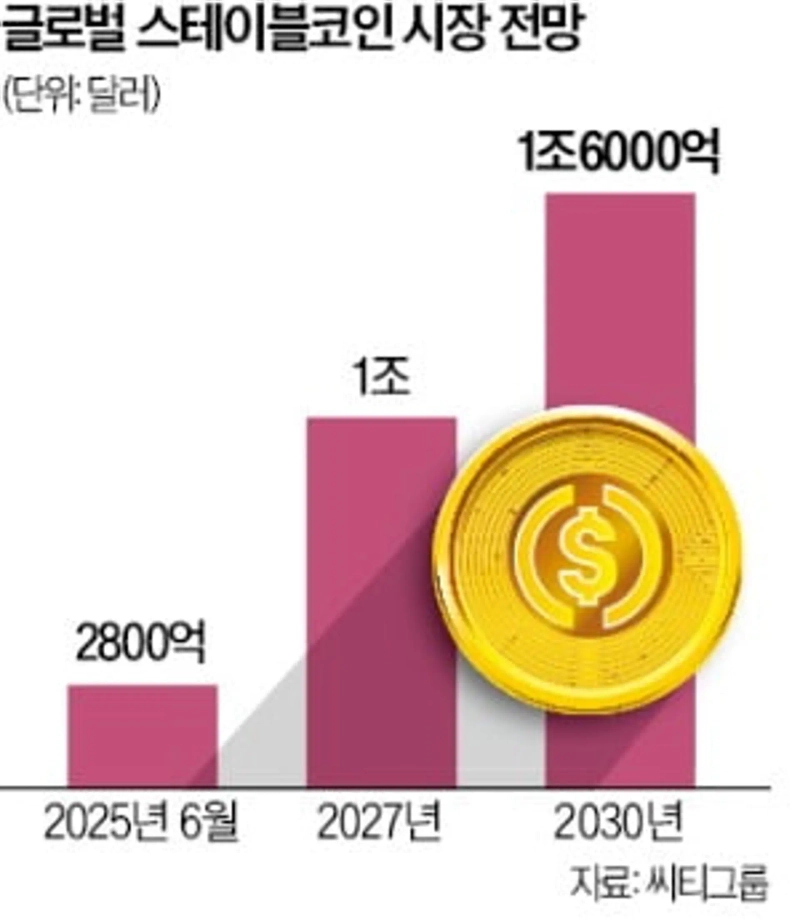
Content IP is expected to be a core pillar for activating won-denominated stablecoins. In this context, Min Byung-duk, a lawmaker of the Democratic Party, attended as a speaker in the 'Korean Digital Dollar Construction Strategy' session and said, "We should think about ways to create use cases for stablecoins domestically," suggesting that stablecoins could be used for overseas remittances by foreign workers. He also proposed, "Many local governments operate 'local currency' projects; we could consider converting these into stablecoins."
Lee Jun-seok, a lawmaker of the Reform New Party, emphasized the importance of establishing the legal status of stablecoins. He explained, "The key is whether (stablecoins) will gain legal tender status," adding, "If the legal status is clear, banks can also accept stablecoins." However, he said that the standards for stablecoin 'collateral' need to be clarified at the legislative stage.
Reporter Ko Eun-yi koko@hankyung.com

Korea Economic Daily
hankyung@bloomingbit.ioThe Korea Economic Daily Global is a digital media where latest news on Korean companies, industries, and financial markets.