

Retail investors were excited in the bull market…stock market 'stirred' as bad news struck
Summary
- It reported that recently the won–dollar exchange rate broke into the 1400 won range for the first time in 4 months, reducing the investment appeal of domestic stock markets such as the KOSPI.
- It stated that despite the U.S. central bank's rate cut, continued hawkish signals have kept the dollar strong, and uncertainty over Korea–U.S. tariff negotiations is also acting as downward pressure on the won.
- Markets say a short-term switch to a decline is unlikely, and there are projections that a gradual decline by year-end is highly likely.
KOSPI slightly lower for the second day…risk-asset avoidance sentiment activated
Won–dollar exchange rate breaks 1410 won in night trading for the first time in 4 months
"U.S. price stability delayed, expectations for monetary easing also weakened"
"Short-term switch to decline unlikely…gradual decline expected by year-end"
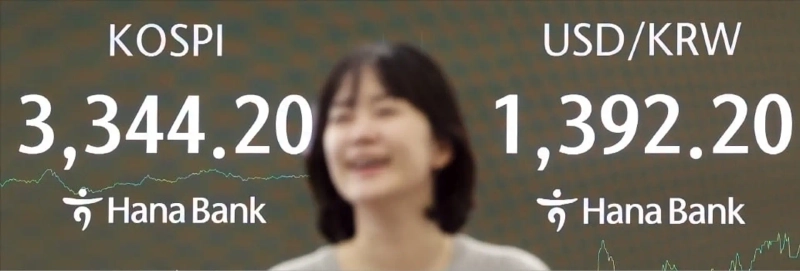
The won–dollar exchange rate climbing into the 1400 won range for the first time in 4 months is pouring cold water on the stock market. This is due to the emergence of 'hawkish (preference for monetary tightening)' signals that have encouraged dollar strength even though the U.S. central bank (Fed) resumed a rate-cutting cycle after 9 months. In addition, follow-up Korea–U.S. tariff negotiations are being seen by the market as a potential trigger.
In night trading on the 26th (closes at 2 a.m.), the won–dollar exchange rate closed at 1409.3 won, up 11.8 won from the previous session. On a night-trading basis, it was the highest level in about four months since May 13 (1416.30 won).
The U.S. dollar's value has come under upward pressure despite the U.S. Fed cutting the policy rate by 0.25% points on the 17th. The dollar index, which shows the dollar's value against six major currencies, rose from 96 at the time of the rate cut on the 17th to the high 97s, nearly up 2% recently. Early that morning it briefly jumped to around 98, continuing its upward trajectory.
Despite the Fed's rate cut, hawkish signals have emerged in various places, dampening market expectations. Jerome Powell, Chair of the U.S. Fed, on the 23rd expressed concern that tariffs under the Trump administration could raise prices and said that rates might need to be raised to achieve the 2% inflation target.
As a result, the initial expectation of two additional rate cuts within the year retreated from 81.5% on the 17th to 74.4% recently.
Uncertainty over Korea–U.S. tariff negotiations is also putting downward pressure on the won. President Trump is demanding an investment of 350 billion dollars in full cash as a condition of the negotiations.
President Trump, after signing an executive order at the White House related to a deal on Chinese video platform TikTok, said, "Thanks to tariff and trade agreements, in one case (the European Union) we secured 950 billion dollars, an amount that was not paid at all before," and added, "As you know, we get 550 billion dollars from Japan and 350 billion dollars from Korea. This is up front (up front)."
Earlier, in the Korea–U.S. trade deal concluded on July 30, the U.S. agreed to lower reciprocal tariffs and auto tariffs imposed on Korea from 25% to 15% in exchange for Korea implementing about 350 billion dollars in investments in the U.S. However, the two sides have been unable to narrow differences over how to structure and implement the U.S. investment package.
The U.S. argues it will receive dollar cash from Korea through equity investments, while Korea's position is to minimize equity investments and mostly use guarantees. President Lee Jae-myung, in an interview published by Reuters on the 22nd, said that Korea and Japan's situations are completely different and expressed concern that "if Korea invests the entire 350 billion dollars in cash to the U.S. in the manner the U.S. demands without a Korea–U.S. currency swap, the Korean economy could face a serious crisis similar to the 1997 foreign exchange crisis."
The KOSPI index closed slightly lower for the second day due to the burden of the won–dollar exchange rate. As the dollar's value rises, the attractiveness of the KOSPI market denominated in won relatively falls.
Moon Da-woon, a researcher at Korea Investment & Securities, said, "Domestically, anxiety surrounding the U.S. investment negotiations has acted as downward pressure on the won," adding, "The president mentioned that if the negotiation proceeded as the U.S. demands, it could face a situation like a foreign exchange crisis, which has heightened market anxiety."
"Now that the psychologically significant 1400 won level has been breached, the next meaningful upper level is expected to be 1420 won," he said, adding, "Due to vigilance about intervention by foreign exchange authorities and level-related burdens, the pace of further rises will be limited."
Choi Kyu-ho, a researcher at Hanwha Investment & Securities, judged, "With U.S. price stability delayed and expectations for monetary easing weakened, a short-term switch to decline is difficult," and "it could return to a gradual downtrend around year-end."
No Jeong-dong Hankyung.com reporter dong2@hankyung.com

Korea Economic Daily
hankyung@bloomingbit.ioThe Korea Economic Daily Global is a digital media where latest news on Korean companies, industries, and financial markets.