

'Should I sell even now?'…Retail investors trembling ahead of Chuseok
Summary
- Ahead of the Chuseok holiday, it said that external uncertainties such as a rising exchange rate and tariff negotiations could increase risk-avoidance and profit-taking selling by domestic stock market investors.
- It reported that the won·dollar exchange rate recently exceeded 1,400 won, increasing sensitivity to global variables along with foreign investors' shift to net selling.
- It said that the domestic market's weak trend during the holiday period could be a bargain-buying opportunity, and that a post-holiday easing of external uncertainty and a buy strategy focused on structurally benefiting sectors would be effective.
Historic-length long holiday amid uncertainty
Exchange rate rising and tariff negotiation risks too
'You never know what might happen…avoid risks'
vs 'Now is a bargain-buying opportunity'
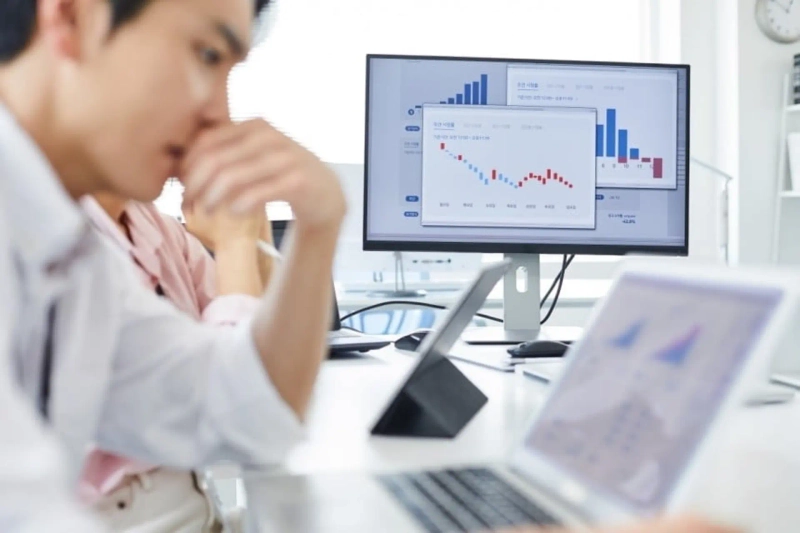
With the long Chuseok holiday one week away, domestic stock market investors' calculations are getting complicated. With large external uncertainties such as the exchange rate and vehicle tariff negotiations, the domestic market will be closed for an 'unusually' long holiday period. The domestic market will be closed from the 3rd through the 9th.
'Avoid uncertainty' — markets typically 'decline' just before Chuseok
According to the financial investment industry on the 28th, the domestic stock market has typically shown a downward trend before and after the Chuseok holiday. Many investors sensitive to uncertainty sort their portfolios to avoid risk. When the market is closed, there is no way to respond if major markets like the U.S. plunge or exchange rate variables emerge.
This phenomenon is said to be more pronounced around Chuseok than around the Seollal holiday, according to the securities industry. An official at an asset management company said, "The Chuseok holiday often coincides with the start of the U.S. federal government's fiscal year," and "each year concerns about a possible U.S. government shutdown, potential won·dollar exchange rate fluctuations, and domestic political uncertainty arise, so more people tend to liquidate holdings before Chuseok to reduce risk exposure compared to Seollal."
Last year, the KOSPI index, which was in the high 2,600s through the end of August, slid to the mid-2,500s in the week before Chuseok (Sept. 9–13, 2024), and then rebounded after the holiday to recover to the 2,600s.
Securities firms expect a similar phenomenon could occur ahead of this year's Chuseok holiday. The KOSPI has repeatedly hit record highs in September, increasing price burden, and the holiday period is also long.
Kang Jin-hyuk, a researcher at Shinhan Investment, said, "Ahead of an unusually long Chuseok holiday, profit-taking selling may emerge as part of portfolio adjustments to avoid uncertainty exposure," and added, "Rather than a clear direction, a wait-and-see sentiment is likely to appear."
Exchange rate at 1,409 won…foreigners also 'selling'
The exchange rate has recently surged. At 2 a.m. on the 27th, the won·dollar exchange rate closed at 1,409 won 70 jeon, up 9 won 10 jeon. The U.S. Department of Commerce's finalized figure for U.S. Q2 GDP, announced on the 25th, was 3.8%—well above the market expectation of 3.3%—which raised concerns that the Fed's rate-cutting cycle would slow, triggering a stronger dollar. In addition, South Korea was hit further when U.S. President Donald Trump made remarks about "up front" payments, saying that U.S.-bound investment resulting from the Korea-U.S. trade deal should be cash rather than loans or guarantees.
The fact that foreign investors, who had been net buyers in the domestic market, have turned to net sellers is seen by securities firms as largely influenced by this. Seo Sang-young, a researcher at Mirae Asset Securities, said, "Historically, the won·dollar exchange rate exceeding 1,400 won occurred during the IMF era, the 2008 financial crisis, the 2022 period of aggressive Fed rate hikes, and times with high uncertainty such as in 2024 due to martial law," and added, "Many evaluate that Trump's excessive demands on Korea have increased uncertainty in the foreign exchange market."
The government plans to announce the contents of 'exchange rate negotiations' with the United States. On the previous day, Deputy Prime Minister and Minister of Economy and Finance Koo Yun-chul said on the 27th, "Consultations with the U.S. on exchange rate negotiations have been completed this time and will be announced soon." He also said, regarding a Korea-U.S. unlimited currency swap, "We have fully explained to the U.S. side and are currently waiting for a response."
U.S. employment data adds uncertainty…'stock picking approach'
On the 1st of next month, one of the U.S. employment indicators, the ADP private employment report, will be released. If it underperforms expectations, hopes for a Fed rate cut could revive and markets might breathe a sigh of relief; but if it is stronger than expected, dollar strength could persist and accelerate foreign capital outflows from Asian markets including Korea, according to securities firms.
Lee Kyung-min, a researcher at Daishin Securities, said, "Due to the Chuseok holiday, domestic investors will find it difficult to respond to the U.S. Labor Department's official employment figures, so they may use the ADP private employment report as a proactive reference." He added, "Global markets are currently highly sensitive to bad news," and "depending on the U.S. employment data released on the first day of the holiday, risk-aversion and caution could increase."
If one expects a general upward trend in the domestic market, the weakening trend leading up to Chuseok could be used as a bargain-buying opportunity, analysts advised. Na Jeong-hwan, a researcher at NH Investment & Securities, said, "The current correction is a result of preemptive concerns that tariff negotiations may face difficulties," and evaluated, "Considering the APEC meeting in October and expanded Korean corporate investment in the U.S., the likelihood of an extreme scenario is small."
He added, "After the Chuseok holiday, progress in negotiations is expected to ease external uncertainties," and advised that treating the price correction as a buying opportunity focused on structurally benefiting sectors such as artificial intelligence (AI) software, robots, and semiconductors is a valid strategy.
Reporter Seon Han-gyeol always@hankyung.com

Korea Economic Daily
hankyung@bloomingbit.ioThe Korea Economic Daily Global is a digital media where latest news on Korean companies, industries, and financial markets.