

Summary
- It reported that the three major indices opened lower amid concerns about a U.S. government shutdown.
- It said that a weakening labor market and delays in economic data releases could amplify investor uncertainty.
- Some AI-related stocks such as NVIDIA and Meta showed strength, but overall market volatility increased.
Three major indexes down, gold's rally halts
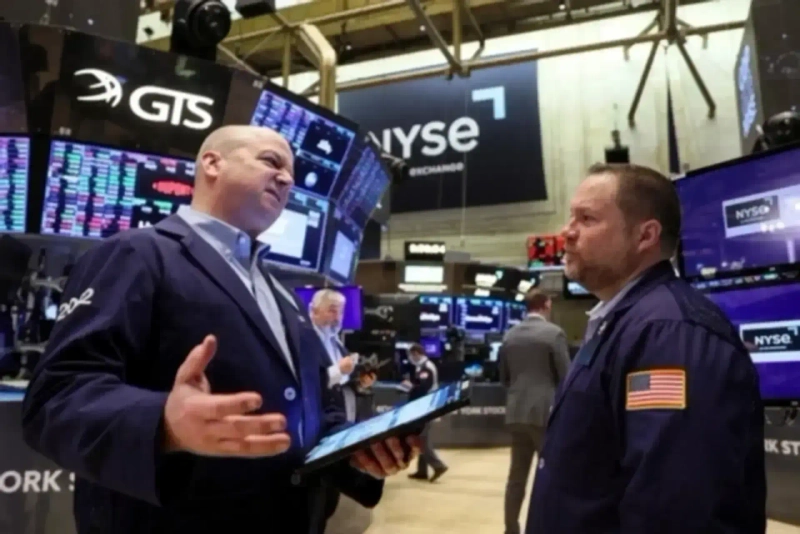
With the likelihood of a U.S. government shutdown rising, New York markets opened slightly lower on the 30th (local time).
Gold's record rally halted and the dollar's value swung.
At 10 a.m. Eastern Standard Time, the S&P 500 was down 0.18% and the Nasdaq was down 0.26%. The Dow Jones Industrial Average was trading with a decline of less than 0.1%.
Spot gold, which had been rising for days amid concerns over a federal government shutdown, fell 0.4% that day to $3,818 an ounce. The Bloomberg Dollar Spot Index, which fluctuated earlier in the morning, was at a level similar to the previous day.
The 10-year Treasury yield fell 2 basis points (1bp=0.01%) to 4.119%, and the 2-year Treasury yield dropped 3bp to 3.602%.
Typically a U.S. federal government shutdown does not have a major impact on markets. However, this time it could be different as stagflation risks loom amid a cooling labor market. In addition, President Trump’s threats to fire thousands of federal workers in the event of a shutdown could amplify the economic fallout.
A government closure could also prompt credit rating agencies to reassess the U.S. credit rating, as Moody’s downgraded U.S. credit in May.
The Labor Department also said that if a shutdown occurs, the September nonfarm payrolls report, which was scheduled to be released on Friday, would not be published. That report is a crucial economic indicator the Federal Reserve (the Fed) needs to justify further rate cuts.
David Saif, Nomura’s chief economist for advanced markets, told Bloomberg TV, “Still, the less data there is, the less reason the Fed has to deviate from the dot plot.” The dot plot signaled a 25bp cut in October.
Jack Zanasievitz, chief portfolio strategist at Natixis Investment, said, “If investors are aware of a weakening labor market and there is also the inflation risk from tariffs, postponing economic data releases will amplify uncertainty. When uncertainty rises, financial market volatility often increases.”
Despite this, as September ends the major U.S. indexes remain near record highs. Over the past five years, U.S. stocks have fallen an average of 4.2% in September, but so far this month the S&P 500 has risen 3%. The Dow is up 1.7% and the Nasdaq is up 4.9%.
That day CoreWeave (CRWV) announced a $14.2 billion contract related to building AI infrastructure for Meta (META). It was trading at $140, up more than 14% in early trading.
NVIDIA rose 1% for the day following yesterday's gains, while Intel fell 2.6%. Electronic Arts, which surged the previous day, reversed to a decline. Canaccord raised Tesla's price target on expectations that deliveries increased this quarter, but the stock fell 1%.
Contributing reporter Jeong-a Kim kja@hankyung.com

Korea Economic Daily
hankyung@bloomingbit.ioThe Korea Economic Daily Global is a digital media where latest news on Korean companies, industries, and financial markets.