

'Will even the 'Samsung Electronics rescue team' leave?'…Foreigners who sold 15 trillion won in government bonds [Kim Ik-hwan's Ministry Hands Up]
Summary
- Foreign investors net-sold more than 14 trillion won in government bond futures over the past two weeks, while net-buying about 4 trillion won in domestic stocks.
- Large-scale government bond selling pushed the exchange rate up to near 1,410 won, which could act as a risk factor for domestic stocks such as Samsung Electronics.
- Experts say expectations of a policy rate cut and a likely stabilization of the won–dollar exchange rate prevail, but concerns over exchange rate volatility remain due to factors such as negotiations over a US-focused investment fund.
Foreigners net-sold 1.4 trillion won in government bond futures
Impact of selling proceeds converted to foreign currency…exchange rate near 1,410 won
Foreigners net-bought over 4 trillion won in Samsung Electronics
Exchange rate and interest rate trends…a variable for Samsung Electronics' share price
"The 9th-floor rescue team is here. What should we do?"
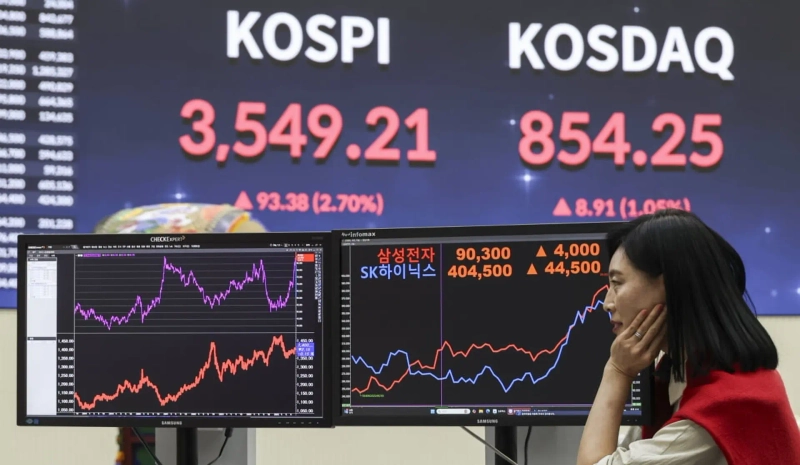
As Samsung Electronics' share price soared, stock communities also went wild. When Samsung Electronics' intraday price surpassed 90,000 won on the 2nd, investors agonized over 'profit-taking (selling to realize gains)' and 'holding (holding)'.
A storm of purchases by foreign investors was a major driver lifting the share price. However, the rising won–dollar exchange rate was identified as a risk factor for Samsung Electronics' stock. There is a possibility that foreigners may withdraw from the domestic market due to concerns about foreign exchange losses. Unlike in the stock market, foreigners net-sold nearly 15 trillion won in the bond market. As a result, the exchange rate recently surged to near 1,410 won.
According to the Ministry of Economy and Finance and the Korea Exchange, foreigners net-sold 144,690 contracts of government bond futures (face value of 14.469 trillion won) over the past two weeks (September 22–October 2). This contrasts with net buying of 63,794 contracts in August.
The foreign sell-off in government bonds is interpreted as stemming from growing expectations that the Bank of Korea will keep the policy rate unchanged this month. Earlier, the bond market had widely expected the Bank of Korea to cut the policy rate by 0.25 percentage points from 2.5% to 2.25%. If the policy rate is lowered, government bond yields fall (bond prices rise). Foreigners had expected bond prices to rise and bought large amounts of government bonds from early September.
However, as Seoul apartment prices continued to surge, expectations that the Bank of Korea would keep the policy rate unchanged spread from late last month. The remark by Monetary Policy Committee member Hwang Geon-il on the 23rd of last month—"I will focus more on financial stability (such as housing prices) when deciding the policy rate"—also had an effect. In light of this shift, foreigners are analyzed to have sold large holdings.
As government bond selling continued, the won–dollar exchange rate also jumped. Analysts say the exchange rate rose as foreigners converted proceeds from bond sales into dollars. In night trading on the 2nd, the exchange rate closed at 1,407 won, 4 won higher than the previous day. That is a rise of 15.5 won from September 22 (1,391.50 won).
Some of the funds from foreigners' government bond sales were redirected into the domestic stock market. Over the past two weeks, foreigners net-bought 4.2989 trillion won in domestic stocks. Of that, net buying in Samsung Electronics (including preferred shares) amounted to 4.0221 trillion won. Buying was concentrated after news that Samsung Electronics would supply high-bandwidth memory (HBM) to OpenAI's KRW 700 trillion 'Stargate Project'.
Over the past two weeks, foreigners net-sold more than 14 trillion won in government bond futures and net-bought about 4 trillion won in stocks. It is estimated that the government bond selling, which overwhelms stock purchases, pushed the exchange rate up to the 1,400-won level. Many expect that if foreigners' selling of government bond futures continues after Chuseok, the upward trend in the exchange rate will persist. That could act as a factor to restrain the rise in Samsung Electronics' stock price.
However, many experts expect the won–dollar exchange rate to stabilize soon. Moonjong Heo, head of the Woori Financial Management Research Institute, said, "With expectations of US Federal Reserve rate cuts and a possible US federal government shutdown, the dollar will weaken," and forecasted, "The average exchange rate in October will fall to around 1,390 won, lower than now."
The flow of government bond futures selling is also expected to calm. Many expect the Bank of Korea to lower next year's policy rate to around 2.0%. However, there are variables that could push up the exchange rate and prompt net selling of Korean government bonds and stocks by foreigners. The stalled negotiations to form a US-focused investment fund worth US$350 billion are a representative example. Analysts say Korea's exchange rate and interest rates could swing depending on the negotiation results.
Andongcheol Ahn, a professor in the Department of Economics at Seoul National University, said, "Our government will somehow show goodwill toward the US$350 billion US investment fund," adding, "Since funds raised by the Export-Import Bank and the Korea Development Bank are likely to be injected into the fund, there is concern it could increase exchange rate volatility."
Reporter Kim Ik-hwan lovepen@hankyung.com

Korea Economic Daily
hankyung@bloomingbit.ioThe Korea Economic Daily Global is a digital media where latest news on Korean companies, industries, and financial markets.