

"U.S. S&P Set to Make New History Passing 7000"
Summary
- Wall Street said the S&P 500 index is expected to surpass 7,000 within the year thanks to expanded AI investment and expectations of Fed interest-rate cuts.
- It was assessed that solid corporate earnings, tax cuts, and consecutive rate cuts strengthen the market's fundamentals.
- Some warned that AI overinvestment, slower-than-expected pace of rate cuts, and black-swan risks could lead to short-term corrections.
Despite overheating concerns…Wall Street: "It will keep climbing"
AI investment expansion and rising expectations of rate cuts
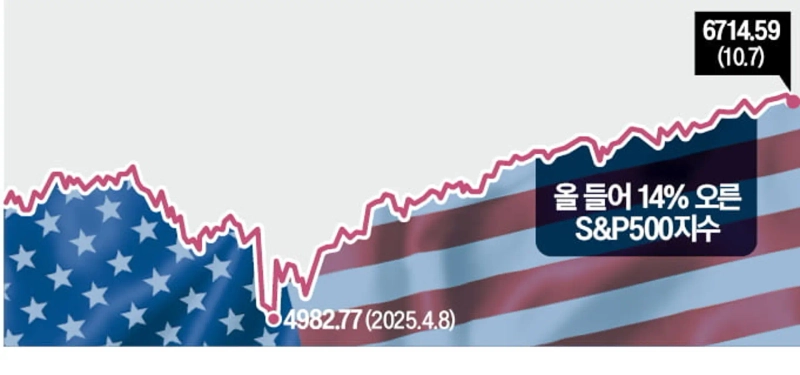
U.S. stock markets have been posting record highs day after day. Alongside the ongoing boom in artificial intelligence (AI) investment, hopes that the U.S. central bank (the Fed) will resume cutting rates and thereby help the economy recover have joined the momentum. Wall Street expects the S&P 500 index to exceed 7,000 within the year. Some voices warn of a tech bubble similar to 1999.
On the 7th (local time), according to Wall Street, Deutsche Bank, BMO Capital Markets, Yardeni Research, Fundstrat and others set year-end targets for the S&P 500 index at 7,000. The S&P 500, which closed at 6,714.59 that day, has already risen more than 14% this year, but is expected to climb more than an additional 4% by year-end. Oppenheimer forecasted 7,100, and Goldman Sachs projected 6,800.
This is due to continued AI investment spending, solid corporate earnings growth, and expectations of Fed rate cuts. OpenAI recently signed AI computing supply contracts worth $100 billion and $60 billion with Nvidia and AMD respectively, and Oracle disclosed contract backlogs totaling $455 billion. The U.S.-China summit to be held in Korea later this month is also expected to ease trade-war tensions.
The Fed's rate cuts, resumed last month, have also raised expectations for a further bullish market. Goldman Sachs expects two more cuts this year and four by next year, analyzing that "while corporate stock levels are at historic highs, given the macroeconomic backdrop and corporate fundamentals, valuations are close to fair value."
On Wall Street, potential rally impediments include worries about AI overinvestment, the possibility that the U.S. Supreme Court could rule tariffs under the International Emergency Economic Powers Act (IEEPA) illegal, and a hawkish shift by the Fed if economic growth and inflation rebound.
Some point out that with the market hitting new highs daily, Fed rate cuts could inflate a bubble similar to 1999. Prominent Wall Street investor Paul Tudor Jones recently said, "It seems all the elements for a blow-off are in place," adding, "It feels like 1999 now."
"If rate cuts come amid the AI rally, a Goldilocks scenario could emerge"…Q3 earnings are the test
"S&P 500 will hit 7,000 within the year" Wall Street confident
"Investors are facing a once-in-a-lifetime technological revolution opportunity that comes around maybe twice in a life."
Despite tariff uncertainty, a U.S. federal government shutdown replayed after seven years, and ongoing debates over a tech-stock bubble, Wall Street investment banks are issuing bullish outlooks largely based on optimism that AI will drive a boom. Julian Emanuel, Evercore ISI's chief equity and quant strategist — who drew attention by forecasting the S&P 500 could climb to 9,000 by next year — said, "This is another AI revolution rally, like the internet revolution 30 years ago," and added, "The tech revolution is lifting stock prices and overall societal growth rates to record levels."
◇Rate cuts to drive the market
Fueled by AI optimism, the U.S. stock market has risen 31% in just five months since the April low. Except for short-lived rebounds during recessions, this is the best performance in about 20 years. The key force to push the already rallying U.S. market to even higher highs is the Fed's rate cuts.
The Fed, which resumed cutting rates last month after an eight-month pause, is expected to cut rates again this month and in December. The U.S. economy avoided recession risk for now by growing 3.8% in Q2 despite a slowing labor market. Competitive increases in AI infrastructure investment acted as a growth driver. If consecutive Fed rate cuts join this, a risk-friendly "Goldilocks" scenario could unfold. Chris Muller-Glissmann, head of asset allocation strategy at Goldman Sachs, who recently upgraded near-term three-month views on global equities from "neutral" to "overweight," said, "Solid corporate profit growth, Fed rate cuts, and global fiscal expansion will provide sustained upward momentum for equities."
◇Corporate earnings also support the rise
The tax cut law enacted in July by U.S. President Donald Trump is another factor boosting expectations for economic improvement and stock gains. The law included provisions increasing deduction limits and allowing immediate expensing for corporate equipment, machinery, and research & development (R&D) expenditures. Dubravko Lakos-Buj, JPMorgan's global market strategist, said, "It will help unblock corporate investment and partially offset the headwinds to growth from tariffs and immigration policies."
Rate cuts and tax cuts positively affect corporate earnings, which are directly tied to market fundamentals. Wall Street views the Q3 corporate earnings season, starting with major banks on the 14th, as an important test to gauge whether the year-end rally will continue. Yardeni Research, which recently raised its S&P 500 year-end target to 7,000, expects "better-than-expected corporate earnings in Q3 to underpin the market's record rise." Wall Street currently estimates Q3 S&P 500 company earnings per share (EPS) growth at 6% year-on-year. Yardeni Research projects 10.7%.
From the second half of October through year-end has historically been the best period for U.S. stock market performance. Since 1950, the S&P 500 has recorded a median 4.9% gain in the fourth quarter, with an 81% probability of a positive return. In years when the Fed cut rates starting in September, such as 1998 and 2024, the fourth-quarter average gain reached 13.8%.
◇Black swans for the U.S. market
Some voices mention the possibility of a short-term correction. Barclays warned that the AI infrastructure investment — the core engine of the U.S. market — could become the biggest 'black swan' risk. It analyzed that if AI model efficiency improves, or if power shortages or financing pressures cause data-center capital expenditures to be 20% lower than currently projected over the next two years, S&P 500 company EPS could decline by 3–4%.
Wall Street also warns against scenarios in which the U.S. economy is stronger than expected or inflation accelerates again, preventing the Fed from cutting rates as much as the market expects. Excessive optimism already priced into the market could be unwound, producing a temporary shock.
New York=Kim Hyun-seok/Bin Nansae correspondents realist@hankyung.com

Korea Economic Daily
hankyung@bloomingbit.ioThe Korea Economic Daily Global is a digital media where latest news on Korean companies, industries, and financial markets.