

Takaichi previews Abenomics Season 2…yen tops 152 per dollar for first time in 8 months
Summary
- It reported that following Takaichi's announcement of fiscal expansion and monetary easing policies, Japan's stock market has surged and the yen is weak.
- It stated that since Takaichi's inauguration, the Nikkei has risen led by defense stocks, and there are projections that it may break the 50,000 level within the year.
- It reported that concerns over rising prices and deteriorating public finances driven by the push for Abenomics Season 2 have pushed government bond yields to their highest level in 17 years.
Japan's 'Takaichi effect'…stock market surge, sharp yen decline
First female prime minister to take office in mid-month
Fiscal expansion and monetary easing announced
Offshore won-dollar jumps 24 won
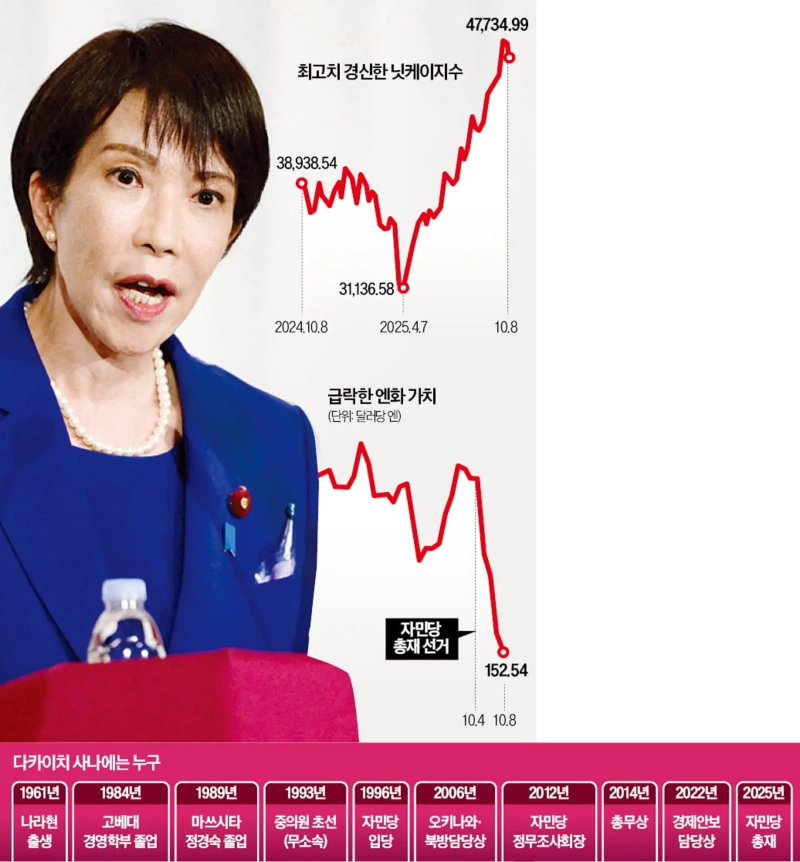
The ruling Liberal Democratic Party, reduced to a 'small ruling party' after successive election defeats, chose the hardline conservative female politician Sanae Takaichi (64, photo). Takaichi, who won the leadership election on the 4th, is expected to take office as Japan's first female prime minister following the parliamentary prime ministerial election in mid-month. With the appearance of Takaichi, who has signaled fiscal expansion and monetary easing and thus previewed 'Abenomics Season 2', Japan's stock market surged and the yen plunged.
Since Takaichi was elected LDP leader, Japan's stock market has been on a bull run day after day. On the first trading day after the election, the Nikkei rose 4.75% from the previous close to break 47,000 for the first time ever, and on the 7th it closed at 47,950, up 0.01%, setting a new record high. On the 8th it fell 0.45% to take a breather, but the securities industry expects the Nikkei to reach 50,000 within the year.
The yen-dollar exchange rate surged (yen value plunged). On the 6th it exceeded 150 yen per dollar for the first time in about two months, and on that day it even surpassed 152 yen per dollar for the first time in about eight months. As speculation grew that the Bank of Japan would find it difficult to raise its policy rate further this month, yen selling spread.
According to Bloomberg, on the 8th in the New York non-deliverable forward (NDF) market, the one-month won-dollar contract once rose to 1,422 won 37 jeon. Considering the recent one-month swap points (-2 won 5 jeon), this is more than 24 won higher than last weekend's Seoul FX market weekly trading closing price (1,400 won).
With Takaichi, known as a 'hawk' on diplomatic and security policy, set to become Japan's prime minister in mid-month, concerns have arisen that uncertainty in Korea-Japan relations has increased. Junya Nishino, professor of political science at Keio University, said, "It is crucial to build a relationship of trust with President Lee Jae-myung at the Korea-Japan summit at the end of this month."
"Emphasis on 'responsible proactive fiscal policy'…prioritizing public investment to strengthen defense"
Mitsubishi Heavy Industries, IHI and other defense stocks surge…Nikkei may break 50,000 within the year
"The Takaichi trade is back."
This is an assessment of the movements in Japan's stock and foreign exchange markets since Sanae Takaichi became LDP leader. With Takaichi, who inherits Abenomics policies such as fiscal expansion and monetary easing, expected to become prime minister in mid-month, stock prices surged and the yen plunged. However, there are criticisms that 'Abenomics Season 2' could backfire in an inflationary regime. It risks stoking price increases and heightening concerns about deteriorating public finances, which is driving up government bond yields.
◇ 'Buy stocks, sell yen' wave
Ahead of last September's LDP leadership election, the Nikkei rose and the yen fell. At that time, market expectations spread that the candidate Takaichi, who campaigned on inheriting Abenomics, would beat candidate Shigeru Ishiba (the current prime minister). This was the so-called 'Takaichi trade.' But when Ishiba won, stock prices fell and the yen rose. Ahead of this leadership election, markets that expected Shinjiro Koizumi, who emphasized fiscal consolidation and monetary normalization, to prevail did not expect a return of the Takaichi trade.
Market observers say that after Takaichi's victory on the 4th, the 'buy stocks, sell yen' wave began. In her campaign pledges she advocated a 'responsible proactive fiscal policy' and promised bold public investment. With expectations that Takaichi will focus on strengthening defense capabilities, defense industry stocks have driven the Nikkei's rise. Mitsubishi Heavy Industries and IHI are representative examples. Masatoshi Kiguchi, chief equity strategist at Mizuho Securities, forecast that the Nikkei, currently in the 47,000s, could reach 50,000 within the year.
Takaichi is regarded as a dovish figure on monetary policy who favors monetary easing. In last year's leadership election she strongly criticized the Bank of Japan's moves toward raising the policy rate and even mentioned the dismissal of the BOJ governor. Accordingly, there is growing speculation that the Bank of Japan will find it difficult to raise its policy rate further this month. The yen-dollar rate exceeded 152 yen per dollar for the first time in about eight months, marking a return to yen weakness.
However, Abenomics, which was implemented to overcome deflation, is criticized as being ill-suited to an inflationary era. There is a significant risk that it will only fuel price rises. Takaichi has indicated she would tolerate issuing deficit-covering government bonds, and bond yields have been volatile. The recent 10-year government bond yield recorded 1.695%, soaring to its highest level in 17 years. Concerns about worsening public finances have spread.
That day in the offshore non-deliverable forward (NDF) market, the won-dollar rate surged into the 1,420 won range. Compared with the spot closing price traded in the Seoul FX market last weekend (1,400 won), it rose by more than 20 won. In global markets the won was regarded as a 'proxy' currency for the yen and followed the yen's weakness.
◇ 'Aso's caution, Trump dissatisfaction' variables
Markets are paying attention to the actions of former prime minister Taro Aso, who is expected to exert influence in the Takaichi era. Having served as finance minister for a long time, Aso is seen as a proponent of fiscal discipline. As a decisive contributor to Takaichi's election and emerging as a 'kingmaker', there is speculation that former prime minister Aso could rein in fiscal expansion. The decline in the yen's value could also rile U.S. President Donald Trump. The Nihon Keizai Shimbun pointed out, "President Trump might judge that Takaichi is inducing a weak yen to expand Japan's exports."
Attention is also focused on Takaichi's actions on diplomacy and security policy. After her election she said at a press conference, "First, it is important to reaffirm the Japan-U.S. alliance," and added, "There are times when Japan, the U.S. and South Korea must cooperate." Before the election, at a debate she said, "Japan and South Korea have active cultural exchanges and economic competition in areas such as shipbuilding, but they cooperate," and "In a crisis where China, Russia and North Korea are aligning closely, I think it is very important to cooperate with (South Korea) and respond."
A variable is a visit to the Yasukuni Shrine. She regularly visited the Yasukuni Shrine, where Class A war criminals from World War II are enshrined. According to the Yomiuri Shimbun, Takaichi is discussing refraining from visiting the Yasukuni Shrine during the Autumn Festival on the 17th–19th, judging that it would be necessary to avoid turning it into a diplomatic issue with Korea and China.
Tokyo = Correspondent Kim Il-gyu / Reporter Lee Kwang-sik black0419@hankyung.com

Korea Economic Daily
hankyung@bloomingbit.ioThe Korea Economic Daily Global is a digital media where latest news on Korean companies, industries, and financial markets.