

PiCK
Public services based on blockchain open up…Government pushes 'Blockchain Framework Act'
Summary
- The government is pushing for the enactment of the Blockchain Framework Act and said it plans to apply blockchain technology to various public services such as local currencies and public vouchers.
- The draft law includes grounds for operating public blockchain infrastructure and financial support for blockchain operators, and it said it will grant legal effect to smart contracts.
- The Ministry of Science and ICT is pushing major blockchain projects such as a KRW stablecoin platform, and said it is considering corporate global competitiveness and export potential based on this.
Local currencies and public vouchers also managed by 'blockchain'
Government to pursue enactment of Blockchain Framework Act
Build national platform to apply the technology
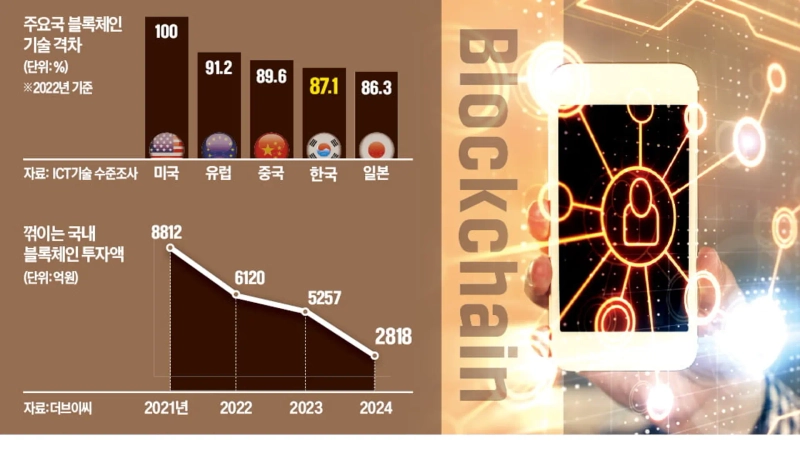
The Ministry of Science and ICT is seeking to enact a Framework Act to foster the blockchain industry, the underlying technology for stablecoins, etc. It includes measures to prepare a public blockchain platform at the national level so that blockchain technology can be easily applied to various government public services such as local currencies and public vouchers.
On the 10th, The Korea Economic Daily obtained from Lee Ju-hee, a member of the Democratic Party of Korea, a research report (working title 'Blockchain Framework Act') whose core is the establishment of a 'national blockchain infrastructure.' The Korea Internet & Security Agency (KISA), at the request of the Ministry of Science and ICT, prepared a draft together with law firm Bae, Kim & Lee. They are currently refining the wording of the provisions and plan to submit it to the 22nd National Assembly.
A Ministry of Science and ICT official explained, "You can see it as a model law to enable active use of blockchain across various fields." Blockchain is a technology designed to maintain trust and security without a central administrator, based on mathematical verification and consensus of a continuously connected network (blocks). It is especially used as the underlying technology for decentralized fund transactions such as cryptocurrencies.
The industry has argued that a Framework Act on blockchain technology is needed even for the issuance and circulation of KRW stablecoins. The draft Framework Act specifies, in addition to measures for operating public blockchain infrastructure, grounds for financial support to blockchain operators. Kim Jong-hyeop, CEO of Parameta, said, "If a legal basis is established, new innovation opportunities will open in areas other than digital assets."
KRW stablecoin platform could be applied to tokenized securities
Grant legal effect to smart contracts…designate a dedicated agency to ensure safety
The Ministry of Science and ICT is pursuing the Framework Act because it judged that the Digital Asset Framework Act, which falls under the Financial Services Commission, alone is insufficient to foster the overall blockchain industry apart from crypto assets. The industry has voiced that when trying to apply blockchain to major IT systems, there are practical limits due to insufficient legal grounds or various regulations. If legal grounds for blockchain technology are established, it is expected that blockchain technology can be applied to various public service fields such as mobile IDs, online voting, local currencies, and public voucher management.
◇"Exports possible through system construction"
According to Lee Ju-hee of the Democratic Party of Korea on the 10th, the draft Framework Act being pursued by the Ministry of Science and ICT recognizes the legal effect of documents and platforms using blockchain technology and includes content encouraging the government and local governments to actively develop services that apply blockchain.
A Ministry of Science and ICT official said, "New services based on blockchain technology, from tokenized securities (STO) to stablecoins, continue to emerge, but there is no basic law on blockchain," adding, "The intent is to create a basis for supporting blockchain services and industries." The plan is to grant legal effect to smart contracts and designate a dedicated agency to secure transaction trust and safety.
Despite being an advanced technology, blockchain has often not been applied to major infrastructure and platforms due to lack of legal grounds. Kim Jong-hyeop, CEO of blockchain firm Parameta, said, "Even for local currency settlement systems, a settlement operator had to exist and be responsible through a centralized system, so it was difficult to apply blockchain under the old standards," adding, "STO tasks could only use blockchain to record stored data, so there were major limitations."
According to the draft Blockchain Act, the government may also designate regional blockchain industry support centers. This would allow each institution to use a shared blockchain platform instead of building and operating separate blockchains, raising necessary elements such as network, authentication, smart contracts, and security. The plan also includes forming a Blockchain Business Review Committee and granting the committee the authority to announce temporary standards required for each business.
Separately from legislation, the Ministry of Science and ICT plans to promote a large-scale blockchain project next year. It is reported to be reviewing pilot projects such as building a KRW stablecoin platform and an integrated platform for local currencies and vouchers. A Ministry of Science and ICT official said, "If good cases come out through pilot projects, this system could be exported."
◇'Blockchain as a Service' spreading in the U.S. and elsewhere
Domestically, blockchain's institutionalization has lagged due to a negative image tied to 'junk coins.' The domestic blockchain industry rapidly grew from 208.5 billion won in 2019 to 402.6 billion won in 2022, but growth slowed to 405.3 billion won in 2023 and 471.3 billion won in 2024. An industry official pointed out, "Even overseas, there is not always a basic law on blockchain technology, but policies focus on promotion rather than regulation."
With the AI era making data acquisition important, analysis suggests blockchain technology advancement has become essential. The European Union (EU) has introduced blockchain into the data infrastructure Gaia-X.
Korea is still using blockchain mainly for tamper prevention, so some argue a different approach is needed. Overseas, the Blockchain-as-a-Service (eBaaS) model is rapidly spreading. It is similar to borrowing cloud systems from large providers like Amazon Web Services (AWS) instead of each institution or company building their own. Lawmaker Lee said, "Starting with the enactment of the Blockchain Framework Act, support through technology standardization and R&D investment is needed so our companies can secure competitiveness in the new global order."
Reporter Ko Eun-yi koko@hankyung.com

Korea Economic Daily
hankyung@bloomingbit.ioThe Korea Economic Daily Global is a digital media where latest news on Korean companies, industries, and financial markets.