

Gold's New Phase "Will Go Further After Adjustment" VS "Central Bank Demand Ending"
Summary
- This year gold has risen sharply thanks to political tensions, uncertainty over US tariffs, and the FOMO phenomenon.
- Some experts said the rally could ease due to stalling demand from central banks and emerging markets, while others maintained the possibility of further increases in gold prices through 2026.
- Market experts said that increased gold price volatility and a slowdown in investment momentum could, if jewelry demand falls, become factors that weigh on prices.
"Central banks and buyers such as China that drove demand over the past two years have stalled in purchases"
"FOMO among Western retail investors will continue"
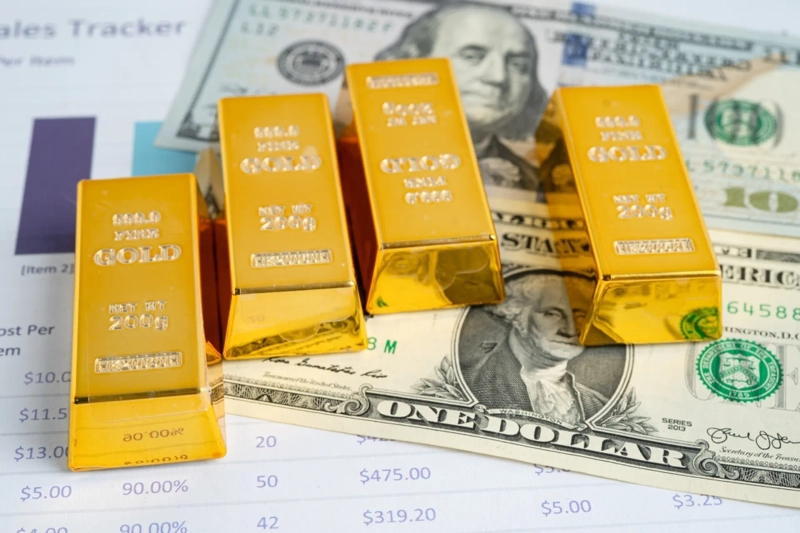
Gold, which has shown a remarkable rise this year, has entered a new phase. With speculative forces entering, influence and volatility have increased. Some experts expect the rally to ease now due to a relaxation in central bank demand and a stall in demand growth in China and India, while other experts have stuck to predictions that prices will rise in 2026.
On the 22nd (local time) in the US market, December-delivery gold traded at $4,048 per ounce, down 1.68% from the previous day. Earlier, in the London market, spot gold traded below $4,100 and continued two consecutive days of declines.
The previous day, spot gold plunged almost 6% intraday in the London and US markets, marking the worst decline in 12 years.
Despite the plunge, gold is still up more than 50% year-to-date. In March it broke the key psychological resistance level of $3,000 per troy ounce, and in October $4,000. This marks the largest annual gain since 1979.
Reuters cited political tensions, uncertainty over US tariffs, and, recently, a buying frenzy driven by FOMO (fear of missing out) as factors behind this year's rise in gold.
John Reade, the World Gold Council's chief market strategist, said, "The nature of the rally has changed this year." Over the past two years, purchases were mainly by emerging markets such as China and India, but now Western investors are leading gold buying.
He added, "Even if the factors moving gold prices are expected to persist, that means greater uncertainty and volatility."
On the 20th, gold hit an all-time high of $4,381 per ounce. A year ago, few people expected this, and few expected to see such prices in their lifetimes. A year ago, a delegation from the gold industry that attended a meeting of the London Bullion Market Association predicted that gold would be $2,941 a year later.
After seeing its largest sell-off in five years, in the 5% range, gold bullion's relative strength index fell for the first time in seven weeks from "overbought" into the "normal" range.
Carsten Menke, an analyst at Julius Baer, said, "After such a sharp rise, price corrections are not uncommon and should be considered healthy." He added, "The fundamentals for gold remain positive."
Gold has risen 20% since the US Federal Reserve cut interest rates in September.
Analysts at Oxford Economics said that compared with typical gold rises in recent Fed easing cycles, this year's increase has been much faster.
Nicky Shiels, head of metals strategy at MKS PAMP, said, "In previous rate-cut cycles the US stock market was not at record highs," pointing out that there are bubble concerns in the market now and inflation still well exceeds targets.
He predicted, "There seems to be room for the bubble in all of this to continue growing, and if gold prices exceed $4,500, only retail investors' FOMO sentiment will persist."
Gold prices have doubled over the past two years. They have also well surpassed the inflation-adjusted value of the previous peak in 1980 — a nominal $850, which adjusts to $3,590 per ounce, according to MKS PAMP.
Market experts are also closely watching the S&P 500's gains. Some gold buying was as a hedge against stock market declines, but historically when equity markets plunge sharply, safe assets including gold also tend to be sold.
James Steel, an analyst at HSBC, noted, "As in the past, if the stock market falls, investors may be forced to liquidate gold holdings to raise cash or meet margin calls."
Central banks in emerging economies have been increasing the share of gold in their foreign exchange reserves since late 2022. Price increases have already automatically pushed up the value share of central bank holdings.
MKS's Shiels said, "Central banks will likely have already reached portfolio limits, and long-term institutional investors will be similar."
Analysts warned that if investment momentum slows in 2026, demand from the jewelry sector in China and India could fall, potentially leading to a physical supply glut and weighing on prices.
Trade data cited by Reuters show that China's gold imports fell 26% by tonnage from January to September this year. India's gold imports fell 25% from January to July.
Guest reporter Jeong-A Kim kja@hankyung.com

Korea Economic Daily
hankyung@bloomingbit.ioThe Korea Economic Daily Global is a digital media where latest news on Korean companies, industries, and financial markets.