

Summary
- The won–dollar exchange rate surpassed 1440 won intraday, recording its highest level in about six months.
- Uncertainty over Korea-U.S. trade talks and foreign investors' net selling were cited as the main causes of the won's weakness.
- Lee Chang-yong, governor of the Bank of Korea, said that if tariff negotiations proceed positively, the exchange rate could fall.
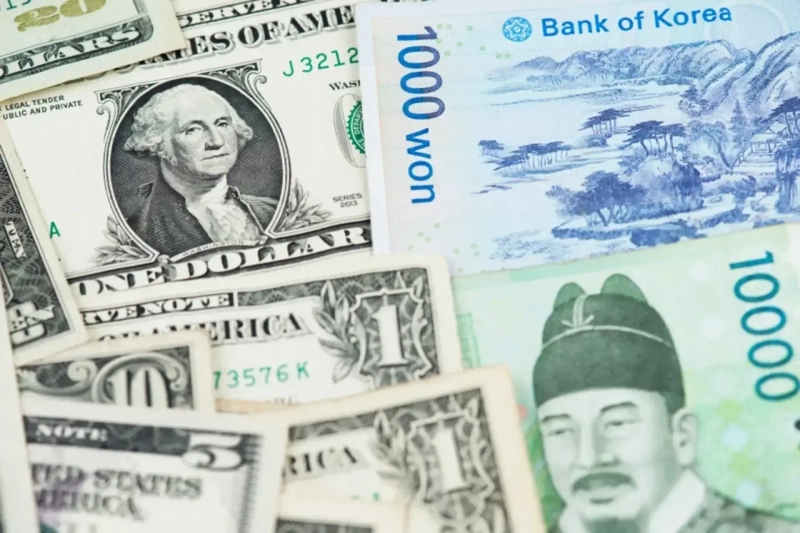
The won–dollar exchange rate surpassed 1440 won intraday, reaching its highest level in half a year. Uncertainty over Korea-U.S. trade talks and net selling by foreign investors appear to be contributing factors to the won's weakness.
According to the Seoul foreign exchange market on the 23rd, as of 2:47 p.m. the won–dollar exchange rate was trading at 1439.8 won, up 0.49% from the previous session. It briefly jumped to 1441.5 won intraday. This is the highest intraday level since April 29 (1441.5 won), about six months ago.
News that a plan is being discussed between the two countries for South Korea to invest 25 billion dollars annually for eight years, totaling 200 billion dollars (about 286 trillion won), as part of settling Korea-U.S. tariff negotiations appears to have led to the won's weakness.
There is also an assessment that the recent rise in the won–dollar exchange rate stems from structural factors. Lee Chang-yong, governor of the Bank of Korea, said at a press briefing held after the Monetary Policy Committee meeting, "The impact of dollar strength on the recent rise in the won–dollar exchange rate is one-quarter, and the remainder is due to yuan fluctuations from U.S.-China tensions, concerns about expansionary fiscal policy by Japan's new prime minister, tariff negotiations and issues such as securing 350 billion dollars." He added, "If tariff negotiations proceed in a positive direction, the won–dollar exchange rate will fall."
Ko Jeong-sam, Hankyung.com reporter jsk@hankyung.com

Son Min
sonmin@bloomingbit.ioHello I’m Son Min, a journalist at BloomingBit