

Korean stock market ignited by AI…"KOSPI could reach 4400"
Summary
- The KOSPI has been hitting record highs day after day due to AI market growth and fears of currency depreciation.
- Global investment banks and experts forecast that a rally led by semiconductors and other AI-related stocks will continue through the first half of next year and could push the KOSPI to the 4200~4400 level.
- Korea's stock market PER (price-to-earnings ratio) remains lower than that of the US and China, making it an attractive investment.
Rally driven by AI and fear of currency depreciation
Morgan Stanley also raises semiconductor price targets↑
Korea's PER lower than US·China 'attractive'
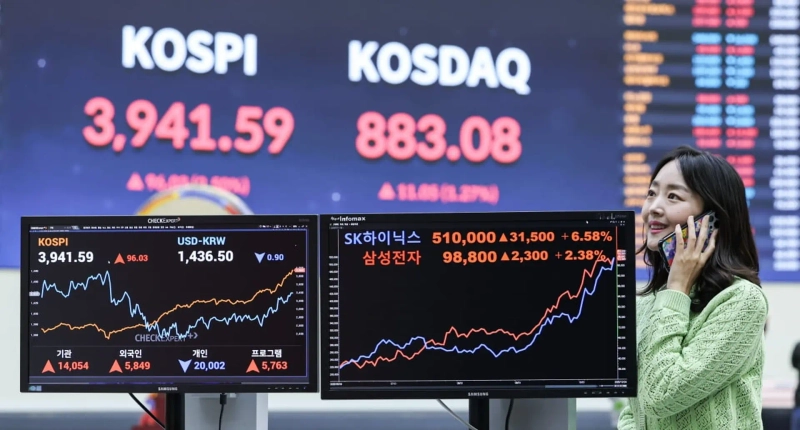
The KOSPI has been hitting record highs day after day at a terrifying pace. Fear of currency depreciation and confidence in the growth of the artificial intelligence (AI) market have combined, funneling investment money sharply into the stock market, particularly into the 'top two' semiconductor companies. Experts are predicting that this trend is likely to continue at least until the first half of next year, painting rosy forecasts that there is enough room to climb to the 4200~4400 level.
○ Rally led by 'AI believers'
According to the Korea Exchange on the 24th, since September the stock prices of Samsung Electronics and SK Hynix have risen by 41.85% and 89.59%, respectively. The sharp rise in these two companies' stock prices quickly pulled the KOSPI from the 3500 level to the 3900 level. That day, the combined market capitalization of Samsung Electronics and SK Hynix exceeded 1000 trillion won for the first time in history. It nearly doubled in one year.
This is because OpenAI has successively signed mega chip purchase contracts with NVIDIA (10 gigawatts), AMD (6 gigawatts), and Broadcom (10 gigawatts), strengthening the view that the AI-related market will explode in growth. Kim Tae-hong, CEO of Growth Hill Asset Management, said, "As NVIDIA invested massive funds in OpenAI and at the same time OpenAI started purchasing semiconductors, an 'AI-driven credit expansion' has begun," adding, "The volume of semiconductor chips OpenAI contracted for is about 10 times the current producible amount, so semiconductor demand will grow exponentially."
Global investment bank Morgan Stanley, once dubbed a 'semiconductor grim reaper,' sharply raised its price targets that day: Samsung Electronics from 111,000 won to 120,000 won, and SK Hynix from 480,000 won to 570,000 won. This came just two weeks after raising Samsung Electronics' target price by 14% on the 10th.
AI-related stocks also led the domestic market that day. As demand for energy storage systems (ESS) surged to build AI data centers, secondary battery sectors such as LG Energy Solution (9.94%) jumped sharply. Companies expected to benefit from power infrastructure investment for data center expansion, such as Iljin Electric (15.03%) and Hyosung Heavy Industries (2.81%), also rose significantly. Kang Dae-kwon, CEO of Life Asset Management, diagnosed, "Strong expectations that the AI market boom will continue and fear of currency depreciation are interacting to strongly drive the stock market."
○ "There is still room to go"
Experts believe the KOSPI rally led by AI-related stocks will likely continue through the first half of next year. While a technical correction is likely after the sharp rise, they expect the market to recover and continue upward. Securities firms forecast a high likelihood that the KOSPI could reach the 4200~4400 level by the first half of next year. Kim Ji-young, head of the research center at Kyobo Securities, said, "Semiconductor corporate earnings are positive through the second quarter of next year, and with expectations that the government will introduce additional market-stimulating measures, the KOSPI could rise to the 4150~4200 level by the first half of next year."
Although it rose rapidly, the Korean market is still cheap. The KOSPI's forward price-to-earnings ratio (PER) is 11.8 times. As of last week, Taiwan's Taiex and China's Shanghai Composite were 17.7 times and 13.8 times, respectively. Kim Tae-hong said, "If the KOSPI's forward PER rises to 13 times like during COVID-19, it could go to 4400."
There are even cautious views that 5000 is not impossible. The prevailing expectation is that the ongoing rally will be led by existing leading AI-related stocks and sectors related to the advancement of capital markets such as holdings and finance. Cho Soo-hong, head of NH Investment & Securities Research Center, said, "As semiconductor earnings estimates continue to be revised upward, reaching the 5000 level by around the first half of next year is also possible."
However, some pessimists argue that the 4000 level may be the peak. Lee Jin-woo, head of Meritz Securities Research Center, said, "The figure 'KOSPI 4000' already reflects the expected net profit of listed companies on the Korea Exchange rising to 240~250 trillion won next year," adding, "For the index to reach 5000, net profit would have to rise to at least the 300 trillion won level, and if that doesn't happen, the market could stall."
Reporters Shim Seong-mi / Ryu Eun-hyeok / Seon Han-gyeol smshim@hankyung.com

Son Min
sonmin@bloomingbit.ioHello I’m Son Min, a journalist at BloomingBit