

Trump and Xi Jinping, talks for the first time in 6 years… 'Small deal' likely
Summary
- It reported that President Trump and President Xi Jinping will meet at the Gyeongju APEC summit for the first time in six years.
- The U.S. and China said that, on major issues such as tariffs, rare earths, and agricultural products, a 'small deal' rather than a 'big deal' is more likely.
- It said that both countries' extremely high tariffs and controls on rare-earth exports place a burden on both economies, focusing investors' attention on agreements to ease conflicts.
Summit meeting at the APEC in Gyeongju
Key issues: tariffs, rare earths, agricultural products
A 'big deal'-level agreement seems unlikely
U.S. President Donald Trump and Chinese President Xi Jinping will meet on the 30th during the Asia-Pacific Economic Cooperation (APEC) leaders' meeting in Gyeongju. Their meeting will be the first in 6 years and 4 months since the G20 summit held in Osaka, Japan, in June 2019.
The White House announced on the 23rd (local time) that President Trump is scheduled to hold a summit with President Xi on the 30th. The meeting venue was not announced in detail, but Gyeongju is reported to be a likely location.
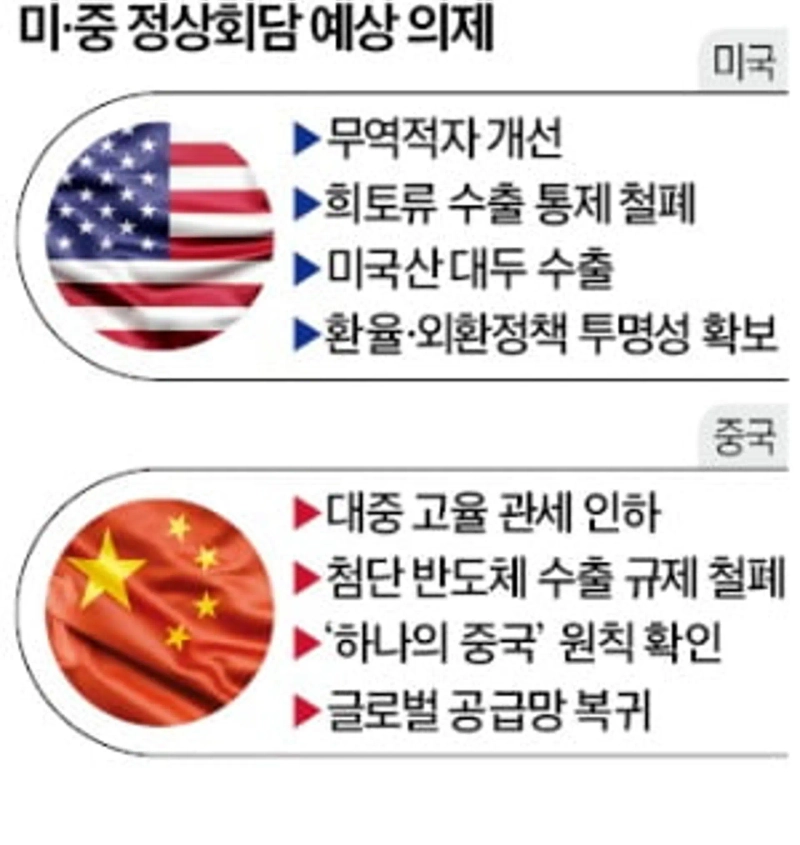
Since January, after the start of Trump's second administration, the U.S. and China have been engaged in sharp conflicts over tariffs, rare earths, semiconductor technology, agricultural purchases, and fentanyl (synthetic drug). This has focused attention on how much the two sides can ease their conflicts at this meeting.
For now, the prevailing view in Washington is that the likelihood of a 'big deal' that could resolve the conflicts all at once is not high. Given that the two countries are effectively competing for hegemony, it is difficult to bridge differences in a single meeting.
However, many expect that a 'small deal' producing agreement at a certain level is possible. Neither the U.S. nor China wants the conflict to become extreme or prolonged. In any case, it is difficult to sustain an ultra-high tariff policy for long. Even President Trump himself has said that the 100% additional tariffs he said he would impose on China are "not sustainable." If import prices rise and demand falls, causing economic slowdown, domestic backlash in the U.S. could grow. For the U.S., it is best to get what it wants from China as quickly as possible. China cannot be ignored either, given its cards such as halting soybean imports to hurt Midwestern U.S. farms and strengthening controls on rare-earth exports that could damage the U.S. defense industry.
China is also by no means in a comfortable internal situation. Based on experience dealing with Trump's first administration, it has used measures such as rare-earth export controls and halting U.S. soybean imports, but if high tariffs persist and the U.S. continues various export controls, the Chinese economy will inevitably be hit.
China's economy grew by 4.8% year on year in the third quarter. It fell below 5% for the first time this year. The escalation of U.S.-China tensions and worsening economic conditions are certainly unwelcome for President Xi, who seeks a fourth term.
The two sides continued their pre-summit posturing. The U.S. Trade Representative (USTR) is preparing a new investigation to evaluate whether China has complied with the commitments in the Phase One U.S.-China trade deal signed in 2020, the Wall Street Journal (WSJ) and the New York Times (NYT) reported that day. China Rare Earth Group, a Chinese state-owned rare-earth company, said it would strictly implement rare-earth export control policies in the fourth quarter of this year.
Washington=Lee Sang-eun/Beijing=Kim Eun-jung correspondents selee@hankyung.com

Korea Economic Daily
hankyung@bloomingbit.ioThe Korea Economic Daily Global is a digital media where latest news on Korean companies, industries, and financial markets.