

Yuan gaining strength… China, with BRICS at the forefront, accelerates de-dollarization alliance
Summary
- Reported that China is accelerating yuan internationalization and the expansion of the payment ecosystem.
- Said that yuan assets, lending, and payment usage are increasing centered on BRICS and developing countries.
- Reported that the US-China digital currency competition is intensifying, and China is strengthening policies such as e-CNY to bolster financial sovereignty.
Global Focus
US·China, after tariffs comes 'currency war'
Building a payment ecosystem to counter dollar dominance
Yuan assets doubled over 10 years
Loan volumes to developing countries have increased
30% of China's total trade settled in yuan
'BRICS block' plays a key role in payments
Digital currency competition with the US intensifies
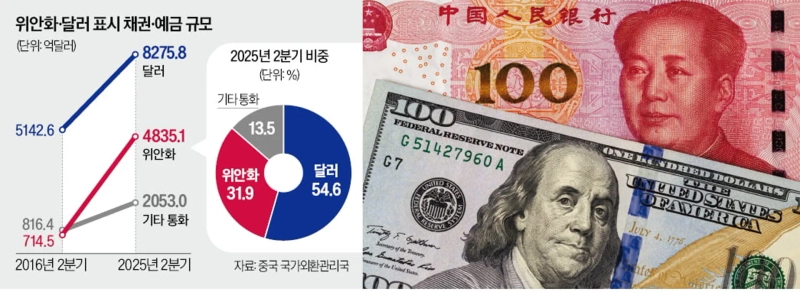
China is strengthening the 'power of the yuan' against dollar dominance. It is building a yuan-centered payment ecosystem while encouraging developing countries to convert dollar debt into yuan with low interest rates to form a 'yuan block.' The competition over monetary sovereignty between the US and China is also heating up in the digital currency arena.
◇ China "Pushing the internationalization of the yuan"
On the 26th (local time), Bloomberg reported that the People's Bank of China said at a meeting chaired by Pan Gongsheng, governor of the People's Bank of China, on the 24th that "it will actively promote the internationalization of the yuan and expand the use of the yuan in trade." Foreign media noted that when the central bank has mentioned yuan internationalization policies in recent years it had always added the qualifiers 'prudent and steady,' but this time those qualifiers were removed, interpreting this as confidence that the yuan's role in the global currency system is growing.
Yuan assets are exploding in overseas markets. According to China's State Administration of Foreign Exchange (SAFE), Chinese banks' external claims and deposits have more than doubled over the past 10 years, exceeding 1.5 trillion dollars. Yuan-denominated assets reached a record 483.8 billion dollars in the first quarter of this year.
In particular, yuan lending to developing countries has grown. The Bank for International Settlements (BIS) reports that yuan lending to developing countries increased by 373 billion dollars over the past four years. Relatively low Chinese interest rates have driven this demand. This year Kenya, Angola, and Ethiopia, among others, converted existing dollar debt into yuan debt, and Indonesia and Slovenia are also pursuing yuan bond issuance. Last month, the Development Bank of Kazakhstan issued offshore bonds totaling 2 billion yuan at an annual 3.3% interest rate.
◇ 'Yuan block' becomes a reality
The presence of the yuan in trade finance is also rapidly increasing. According to SWIFT, the yuan's share of global trade finance quadrupled over the past three years, reaching 7.6% as of September. The yuan is the second most used settlement currency after the dollar. In actual trade settlement stages, yuan usage is active.
According to Chinese Customs data, monthly yuan trade settlements exceed 1 trillion yuan. About 30% of China's total trade and more than half of cross-border transactions are settled in yuan. Accordingly, China's payment network 'China International Payment System (CIPS)' is also growing rapidly. CIPS's quarterly transaction volume now exceeds 40 trillion yuan.
BRICS countries in particular are becoming a central pillar of the yuan block. Within BRICS, settlements using multiple currencies beyond the dollar are spreading. Among these, the yuan is used for roughly half of intra-block trade. China is expanding yuan-based currency swap agreements with various countries to broaden the yuan's foundation.
However, capital controls remain the biggest obstacle to yuan internationalization. According to the International Monetary Fund (IMF), as of early this year the yuan accounted for only 2.1% of global foreign exchange reserves. This is because investable yuan assets are limited. To improve this, China is nurturing Hong Kong as a 'yuan hub.' Hong Kong authorities have released a roadmap to activate the market for yuan bond issuance and liquidity expansion.
◇ Digital currency war also intensifies
The US-China competition over monetary sovereignty has shifted to the digital currency realm. The US is strengthening the dollar's position in the global payment order by fostering dollar-pegged stablecoins led by the private sector. The 'Genius Act' passed by Congress last July specified the legal status and collateral requirements for stablecoins. However, the US central bank (Fed) is criticized for being slower in central bank digital currency (CBDC) research compared with major countries.
In response, China is accelerating market development by using the digital yuan (e-CNY) as a core tool of financial sovereignty. China is challenging the dollar-centric market order by lowering dependence on SWIFT through its own payment system capable of processing transactions per second. Chinese authorities halted big-tech stablecoin projects that Alibaba and JD.com planned to issue in Hong Kong and emphasized the principle that "the authority to issue currency lies with the central [authority]."
Reporter Lee Hye-in hey@hankyung.com

Korea Economic Daily
hankyung@bloomingbit.ioThe Korea Economic Daily Global is a digital media where latest news on Korean companies, industries, and financial markets.